Meaning at a glance
The Helm of Awe combines an older literary name with later Icelandic magical-stave imagery; the familiar radial design is not securely documented as Viking Age jewelry, while modern wearers may use it for courage, resolve, or protection as personal interpretations.
Historical evidence and cultural context
Two strands of evidence explain how the Helm of Awe entered our modern imagination. First, the name Aegishjalmur (often rendered Aegishjalmr or Ægishjálmur in Old Norse orthography) appears in literary and magical contexts in Icelandic sources. Academic study of these sources shows that the name itself has a textual history distinct from the graphic pattern many people associate with it (De Gruyter).
Second, the specific radial, spoked or arm-like design commonly called the Helm of Awe is attested in later Icelandic manuscripts of magical staves, not in securely dated Viking Age metalwork or jewelry. Manuscript collections such as the Galdraskræða preserve many galdramyndir — magical figures and staves — that were recorded in the early modern period in Iceland. Reference materials on the Galdraskræða collection identify the radial stave as part of this later tradition rather than a documented feature of Viking Age personal ornaments (Gelmir; De Gruyter).
Because the name and the graphic tradition come from overlapping but distinct sources, historians and scholars caution against assuming the modern radial motif is an ancient amulet form worn in the Viking Age. That distinction is important when speaking about cultural provenance: the literary and magical traditions of Iceland evolved over centuries and were recorded in manuscript cultures that postdate the era commonly described as the Viking Age (De Gruyter).
Documented meanings versus modern personal interpretations
Documented historical meanings for Aegishjalmur come from textual and manuscript contexts rather than from archaeological evidence of widespread amulet use with that precise image. Manuscript sources transmit instructions and attributions for magical staves, and in those contexts the names and uses are part of a broader early modern Icelandic magical repertoire (De Gruyter). Those texts do not, however, provide a unified or universally applied symbolic meaning identical to how contemporary consumers might describe the symbol.
Contemporary meanings are largely personal, creative, or revivalist. Modern people who wear Helm of Awe jewelry commonly attribute to it ideas such as protection, courage in battle or challenge, inner resolve, or a ward against misfortune. These are valid contemporary uses as personal or cultural symbols, but they should be framed as modern interpretations, not as direct continuations of a single, documented Viking Age belief system. Scholarly sources emphasize this difference and recommend careful labeling: present the historical facts and make clear where modern symbolism begins (De Gruyter).
How the motif appears in jewelry today
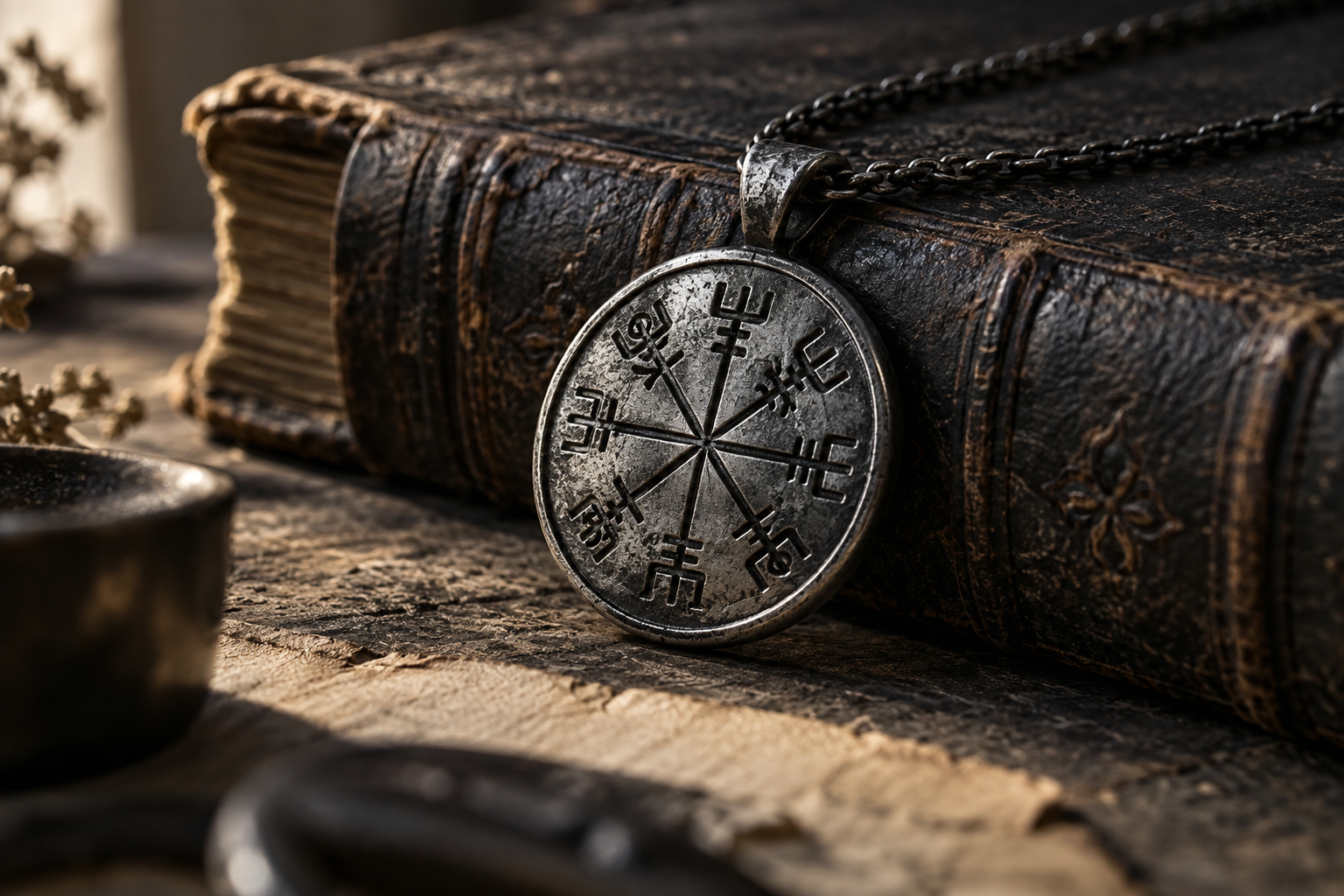
The radial stave of the Helm of Awe appears in many contemporary jewelry forms. Designers create small engraved or cast pendants, signet-style rings, charms, cufflinks, and stamped or etched bracelets that reproduce the familiar multirayed pattern. Production techniques range from hand-engraving and lost-wax casting in silver and bronze to laser engraving on steel and anodized aluminum for lower-cost pieces.
Jewelry makers also combine the motif with other motifs or materials. The radial figure may appear surrounded by runic scripts, set into a bezel with a colored enamel background, or paired with a cabochon stone such as labradorite, onyx, or garnet to enhance a chosen aesthetic. More artisanal pieces favor hammered or patinated finishes to evoke a historically inspired appearance, while minimalist makers render the stave as a clean geometric pendant for daily wear.
Because the Helm of Awe is used as a symbol rather than as a religious relic, makers offer it across styles: historically inspired replicas, contemporary geometric pendants, and pieces tailored to New Age or neo-pagan markets. Regardless of style, modern jewelry generally treats the design as emblematic rather than archaeological: it is a motif rooted in Icelandic manuscript tradition that has been adapted into wearable forms for present-day meanings (De Gruyter; Gelmir).
Practical and respectful selection or gifting guidance
If you are selecting a Helm of Awe piece for yourself or as a gift, begin by deciding what the symbol will mean in your context. Are you selecting it primarily for aesthetic reasons, as a nod to Norse-inspired design, or as a personal talisman for courage or protection? Being clear about your intent will guide choices about style, metal, and presentation.
Respect the symbol’s provenance by acknowledging that the radial design most people call the Helm of Awe comes from later Icelandic manuscript traditions rather than direct Viking Age burial or hoard finds. If the recipient values historical accuracy, choose pieces that describe the symbol honestly and provide brief context. If the recipient prefers a spiritual or personal meaning, make that explicit in a note or inscription so the piece is understood as a contemporary expression.
Material and craftsmanship matter. For daily wear, choose solid sterling silver, gold-fill, or stainless steel for durability and skin safety. For heirloom pieces, consider solid gold or high-karat silver and a secure setting for any stones. If you are engraving a personal message, consider a discreet inside-band inscription on rings or a small plate on a box for pendants rather than altering the motif itself.
When gifting across cultures or to someone from Icelandic or Norse heritage, be attentive and ask if they would appreciate or be comfortable with a symbol tied to those traditions. Avoid assuming that a symbol is a neutral decoration; some people may prefer contemporary designs that do not claim ancient authenticity. Finally, avoid marketing or claiming guaranteed magical effects; present the piece as meaningful personal jewelry and let the recipient decide what it represents to them.
A short note on ethical reproduction and labeling
Jewelry sellers and makers should label Helm of Awe pieces accurately. If a design is reproduced from a specific Icelandic manuscript or a modern artist’s rendering, credit that source. If a piece is inspired by manuscript staves but not a faithful reproduction, describe it as inspired by or adapted from Icelandic galdramyndir. Accurate labeling respects both consumers and the cultural-historical record and aligns with scholarly cautions about claiming Viking Age authenticity where the evidence does not support it (De Gruyter).
Concluding perspective
The Helm of Awe meaning is therefore twofold in practice: a documented literary and magical-stave tradition from Icelandic manuscripts and a modern set of personal and cultural interpretations adopted by jewelers and wearers. Scholarly work indicates that the radial image people commonly associate with the name belongs in the later Icelandic magical-stave tradition and is not securely attested as Viking Age jewelry (De Gruyter; Gelmir). That history need not reduce the symbol’s contemporary resonance; it simply invites honesty about provenance and respect for the symbol’s cultural context.
Frequently asked questions
Is the Helm of Awe an authentic Viking symbol?
No single radial design commonly sold today is securely documented as Viking Age jewelry. Scholarly work indicates the name Aegishjalmur has literary roots and the familiar radial motif appears in later Icelandic magical-stave manuscripts rather than being archaeologically attested as a Viking-era amulet (De Gruyter; Gelmir).
What did the Helm of Awe mean historically?
Historical meanings derive from Icelandic textual and manuscript traditions where names and staves appear in magical contexts. Those sources do not provide a single, universal meaning equivalent to modern claims; scholars advise distinguishing the manuscript traditions from contemporary symbolic uses (De Gruyter).
Can wearing Helm of Awe jewelry offer protection?
Protection is a common modern interpretation and personal use, but it is a contemporary symbolic meaning rather than a historically proven effect. Present such pieces as meaningful jewelry or personal talismans rather than as guarantees of supernatural protection.
How should I choose a Helm of Awe piece as a gift?
Decide whether the gift is aesthetic, historically minded, or a personal talisman. Choose durable materials for daily wear, label the piece honestly about its manuscript-based provenance if historical accuracy matters, and be sensitive to the recipient’s cultural background and beliefs.
Where does the common Helm of Awe image come from?
The common image is part of the Icelandic galdramyndir or magical-stave tradition recorded in manuscripts such as those in the Galdraskræða collection and discussed in academic studies; it is therefore best described as an early modern Icelandic manuscript motif rather than a documented Viking-age jewelry type (Gelmir; De Gruyter).