Meaning at a glance
Documented museum and consumer-guidance sources show that the unicorn motif has appeared in medieval, Renaissance, Victorian, and modern decorative arts with changing associations; separate historic allegory from contemporary personal meanings, know typical materials and gemstone choices, and follow practical buying and gifting steps including asking about treatments and disclosure.
Quick answer
Historically documented evidence shows the unicorn motif appears in European medieval and Renaissance decorative arts and in later revival jewellery styles; those historical uses often carried allegorical or heraldic meanings recorded in museum collections, while modern wearers also assign personal, fantasy, or fashion meanings. Choose unicorn jewellery by considering the documented material quality, maker, and disclosure of stone treatments, and select a design that respects the recipient’s tastes and cultural context.
What the historical evidence actually shows
Museum catalogues and exhibitions document the unicorn as a recurring decorative motif rather than a single, fixed symbol. The Victoria and Albert Museum’s treatment of jewellery history describes how motifs migrate across forms and periods and how meanings change with context; evidence for unicorns in dress and decorative arts is best read as part of those broader shifts rather than as an invariant emblem.
In medieval Europe the unicorn repeatedly appears in devotional and courtly images and in heraldry and tapestries; those appearances are preserved in collections and studies of medieval art and decorative objects. The V&A’s work on jewellery history places such motifs within a social and visual history of ornament, showing that a motif’s presence in an object is evidence of cultural interest but not of a single, universal meaning.
During the Renaissance and in later early modern decorative arts, the unicorn appears in books, silverwork, and personal ornament where it is integrated with established allegories, heraldic language, and fashions. Museum records trace these uses as examples of how legendary creatures were adapted to new media and new patronage.
The Victorian period and subsequent revivals reused medieval and Renaissance imagery, including unicorns, within sentimental and moralizing jewellery fashions. The V&A’s overview of jewellery history documents this pattern of revival and reworking of earlier motifs into 19th- and 20th-century forms.
Separating documented historical meanings from modern personal interpretations
Documented historical meanings are the interpretations recorded at the time an object was made, or those reliably inferred by historians from context and contemporary texts. For example, museums interpret many medieval unicorn images within Christian allegory or heraldry because those were common symbolic languages of the period; the V&A situates such motifs within those documentary contexts.
Modern personal interpretations—such as using a unicorn as a statement of individualism, a badge of fandom for fantasy genres, or as a playful fashion motif—are valid contemporary uses but are not the same as the historical meanings preserved in museum records. These modern readings are shaped by popular culture, media, and personal associations rather than by the documentary evidence that informs museum catalogues.
How the unicorn motif appears in jewellery (forms and techniques)
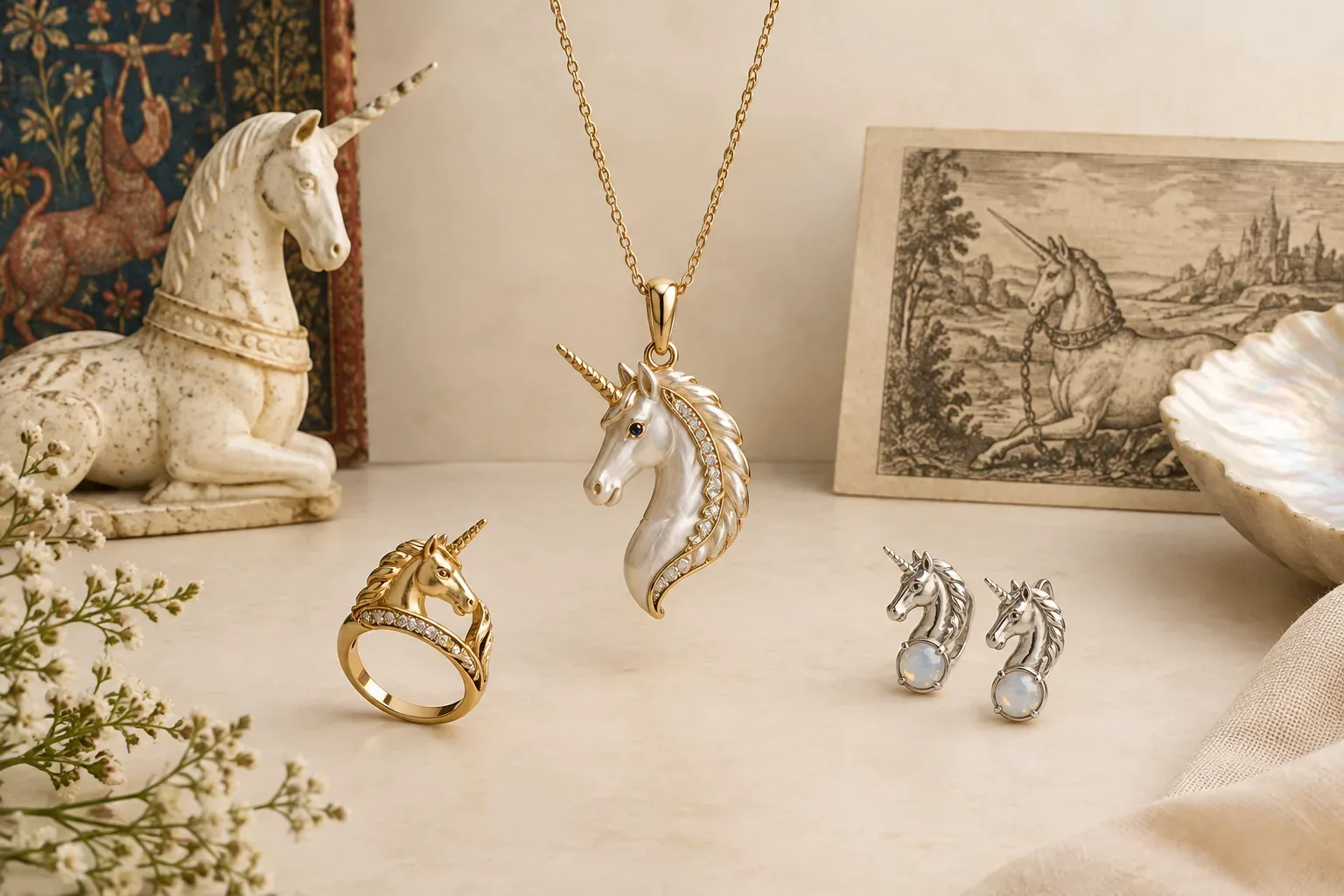
The unicorn has been realized in jewellery in many ways: as small engraved or cast figurative elements on rings, brooches, and pendants; as heraldic devices on signet rings and lockets; and as decorative motifs in enamel, metalwork, and stone carving. The V&A’s exhibition materials and collections discuss how motifs such as mythical animals are incorporated into diverse jewellery types across time.
Techniques for rendering the motif range from lost-wax casting for three-dimensional pieces to engraving and niello for flat metal decoration, and to enamel painting for coloured detail. In later and contemporary pieces the unicorn is also translated into stylized silhouettes, laser-cut metal, and mixed-material charms suitable for mass-market and artisanal jewellery alike.
Gemstones, materials, and what to expect
Unicorn-themed jewellery uses the same range of metals and stones that feature across other motif-led jewellery. Historically and today, makers choose metals (gold, silver, gilt metals), gem accents, and enamels to suit the design. Museum resources on gemstones, such as the V&A’s A–Z of Gemstones, provide helpful context on how different stones were valued and used in jewellery.
If a piece advertises particular gemstones, follow consumer guidance about disclosure: the Federal Trade Commission advises buyers that treatments, enhancements, and imitations should be openly disclosed, and that written information or certificates are appropriate for significant purchases. For costume or novelty pieces the materials may be plated metals and glass or synthetic stones; for fine jewellery you should expect hallmarking, maker information, and transparency about any treatments.
Practical guidance for choosing and gifting unicorn jewellery
Start by deciding whether the piece is intended as a fashion item, a sentimental keepsake, or an heirloom-quality gift. For fashion and novelty pieces choose materials that match the recipient’s lifestyle and skin sensitivities; sterling silver and gold vermeil are good mid-range choices, while plated base metals may wear sooner.
For higher-value pieces check for hallmarks, maker marks, and any gemstone certification. Ask the seller about gem treatments, authenticity, and return policies, following the Federal Trade Commission’s advice to request clear disclosure about treatments and imitations. If you are buying vintage or antique unicorn jewellery, provenance and condition reports from reputable dealers or museum records add useful context.
Be mindful of cultural or religious sensitivities: while many people wear mythical motifs with purely aesthetic or personal meanings, others may associate specific animals or symbols with particular beliefs. Choose designs and occasions that respect the recipient’s background, and when in doubt have a discreet conversation or select a subtler motif such as a small pendant or a stylized silhouette.
For a gift intended to endure, consider classic settings and high-quality materials that are easy to repair, and accompany the piece with care instructions. If the gift has sentimental intent—marking a milestone, memory, or relationship—pairing the jewellery with a short personal note that explains your thought can make the symbolism explicit and respectful.
Buying, care, and verification
When purchasing unicorn jewellery, especially pieces with gemstones, request clear information about materials and any treatments. The FTC’s consumer guidance emphasises that dealers should disclose enhancements, synthetic origins, or imitation materials; obtain written confirmation when buying valuable stones.
For care, treat unicorn pieces like comparable jewellery: clean according to the metal and stone type, avoid harsh chemicals that can damage enamels or pearls, and store pieces to minimise abrasion. If a piece is described as antique or vintage, ask the seller about prior repairs and consider a professional appraisal before insuring the item.
Final note: meaning is layered and personal
Museum documentation helps us trace how the unicorn motif has been used and understood in different periods, but it does not prescribe a single meaning for every wearer. The documented record—summarised in museum catalogues and exhibitions like those of the Victoria and Albert Museum—gives important historical context, while contemporary wearers may attach private or fashionable meanings that reflect their lives today.
If you want a piece that connects to a documented history, look for provenance, maker information, and material quality. If your priority is personal symbolism, choose a design that communicates the sentiment you intend and accompany it with clear communication when gifting.
Frequently asked questions
Is the unicorn motif historically a symbol of purity or something else?
Museum scholarship records that in many medieval European contexts the unicorn was used allegorically within Christian imagery and courtly symbolism, where associations such as purity were one of several meanings; consult museum catalogues, such as the Victoria and Albert Museum’s resources, for the context behind specific objects.
How can I tell whether a unicorn necklace is fine jewellery or costume jewellery?
Check for hallmarks and maker’s marks, ask for material and gemstone disclosures, and request written confirmation of any gemstone treatments; the Federal Trade Commission advises buyers to seek clear disclosure and documentation for valuable stones and metals.
What gemstones pair well with a unicorn motif?
There is no single rule—designers choose stones for color, contrast, and symbolism. Museums’ gemstone guides, such as the V&A’s A–Z of Gemstones, are useful for understanding historical preferences and the properties of specific stones when selecting a colour palette.
Should I be concerned about cultural sensitivity when giving unicorn jewellery?
Consider the recipient’s cultural and religious background; while many wearers treat mythical motifs as personal or aesthetic symbols, being respectful about how a motif may be read in certain contexts is good practice, and a subtler or more stylized design can be a considerate choice.
How should I care for a unicorn pendant with enamel or pearls?
Avoid harsh chemicals and ultrasonic cleaners for enamel and pearls, store pieces to prevent abrasion, clean gently according to the material, and follow any care guidance provided by the seller or maker.
Sources and further reading
- Bedazzled: A History of Jewellery — Victoria and Albert Museum
- An A-Z of Gemstones — Victoria and Albert Museum
- Buying Gemstones, Diamonds, and Pearls — Federal Trade Commission