Meaning at a glance
Dragon jewelry meaning is historically layered and culture-specific: museums document the motif across periods and places, while modern wearers add personal or pop-cultural meanings; choose and gift with attention to provenance, materials, and cultural context.
Quick answer
Dragon jewelry meaning is not a single fixed idea but a record of changing uses and interpretations: museum collections and exhibitions show the dragon motif in jewelry across different periods and cultures, and contemporary wearers layer personal or popular meanings on top of that history. This article explains the documented historical record, distinguishes it from modern personal interpretation, describes how dragons appear in jewelry and gemstones, and offers practical, culturally respectful guidance for selection and gifting.
What the historical record shows
Public museum research and exhibitions make it clear that the dragon motif has been used repeatedly in jewelry and decorative objects in many places and eras rather than belonging to a single tradition. The Victoria and Albert Museum documents dragon motifs within its broader coverage of jewelry history and changing social contexts, noting examples from medieval and later European jewelry as well as decorative arts and objects from East Asia that entered museum collections and exhibitions.
Those museum records show two reliable facts: first, the motif recurs in multiple regions; second, its social meaning and use change with time and context. In different historical settings dragon imagery could be decorative, heraldic, apotropaic (intended to ward off harm), or part of costume and status display. The V&A frames these shifts as part of the broader history of jewelry’s changing social functions rather than as a single symbolic message applicable to all periods or cultures.
Separating documented meanings from modern interpretations
When we look at historical objects, museums like the Victoria and Albert Museum describe how pieces were used, who owned them, and how designs circulated, but they do not collapse those findings into a single universal meaning. A museum’s catalog entry or exhibition text will note provenance, materials, and context rather than claim a single spiritual or emotional message for every wearer across time.
Modern interpretations—personal, spiritual, or pop-cultural—are a different layer. Contemporary wearers may choose dragon jewelry to symbolize strength, protection, transformation, rebellion, or fandom. Those are valid personal meanings, but they should be distinguished from the historically documented uses shown in museum records. To avoid overstating a symbolic claim, treat historical evidence and modern personal meaning as complementary: museums document use and context; modern wearers supply individual significance.
How the dragon motif and gemstones appear in jewelry
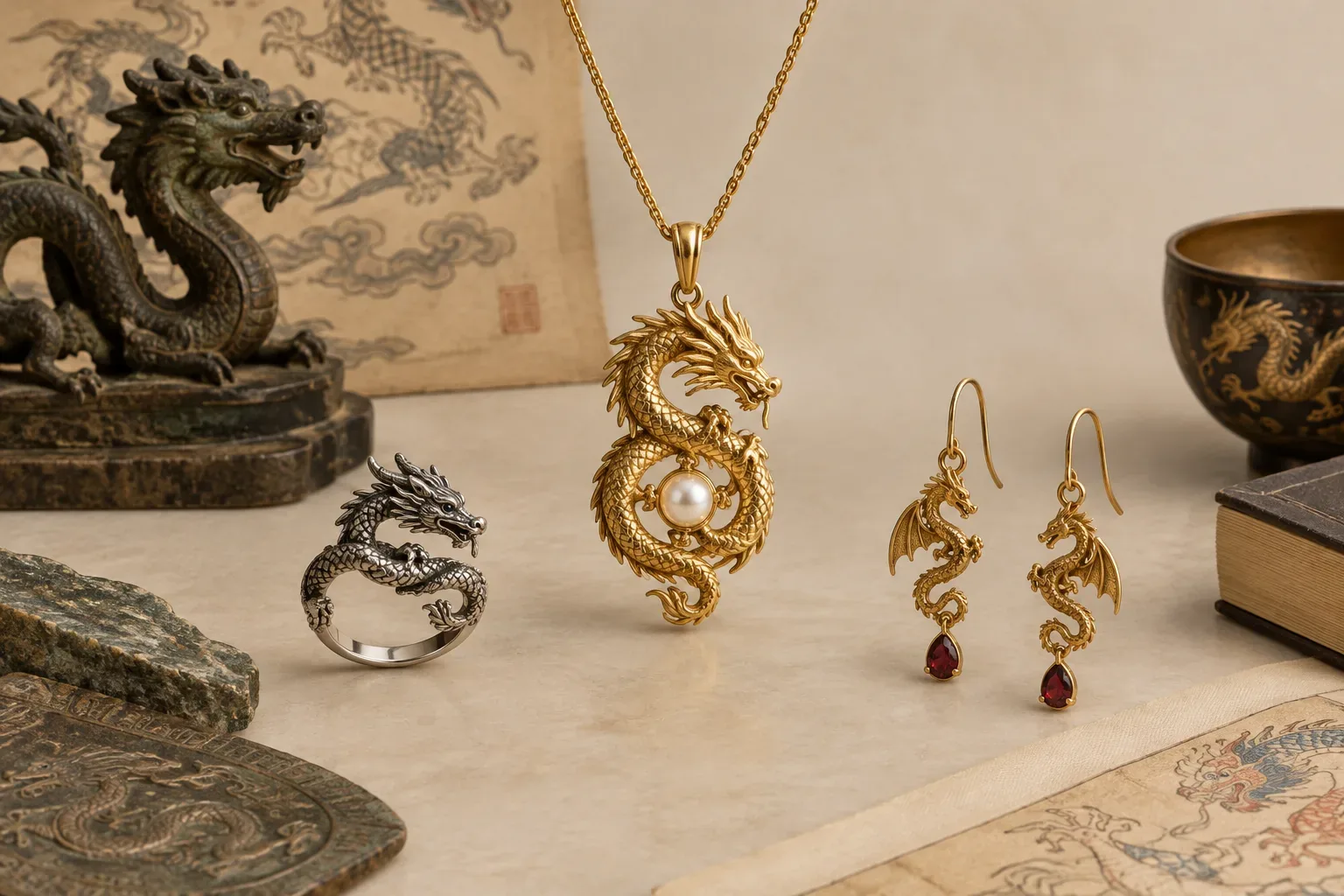
Dragon motifs appear in many forms: pendants and lockets with a dragon silhouette, intricately carved or engraved brooches, rings with a coiling creature around the band, and clasp or charm motifs on bracelets. Museum collections and survey exhibitions documented by the Victoria and Albert Museum illustrate a range of scales from small gem-set eyes to full-bodied figurative mounts, showing how artisans adapted the motif to the technical possibilities and fashions of their time.
Gemstones often play a role in dragon jewelry as accents rather than as fixed symbolic elements. Historically, jewelers set small stones for a dragon’s eyes, used cabochons or beads as scale-like ornament, or combined metalwork with inlay to create texture. The Victoria and Albert Museum’s resources on gemstones explain how particular gems and cutting styles were available to makers at different times, which influenced how motifs were executed. For modern buyers, that means gemstones in dragon pieces may be decorative, period-appropriate, or chosen for modern color or belief associations rather than historically mandated symbolism.
Material and authenticity considerations
When assessing dragon jewelry, the material record matters. The Victoria and Albert Museum’s treatment of jewelry history underscores that designs vary with available techniques, from cold‑worked silver to complex gem settings. For buyers, the Federal Trade Commission’s guidance on buying gemstones, diamonds, and pearls is especially relevant: the FTC explains the importance of disclosure for treatments, enhancements, and imitations, so always ask sellers whether a gemstone has been treated, dyed, or synthesized.
Ask for clear descriptions of metals, hallmarks, and gemstone reports if weighty value is involved. For historically styled or antique dragon pieces, provenance and conservation records can explain past repairs or restorations. For contemporary pieces, look for maker marks and clear material statements to avoid confusion about plating versus solid metal or natural versus simulated gemstones.
Choosing and gifting dragon jewelry: practical and respectful guidance
First, consider cultural context and the recipient’s background. Because the dragon motif appears in multiple traditions, it can carry distinct cultural resonances for different people. If you are gifting to someone from a culture where the dragon has specific traditional meanings, ask discreetly or choose a design and explanation that show awareness and respect rather than appropriation. Matching the style—minimalist silhouette versus an object grounded in a particular cultural style—helps communicate intent.
Second, match the object to the occasion and the wearer’s style. A small pendant with a subtle dragon silhouette suits everyday wear and can be a discreet token. A bold, gem‑set brooch or ring makes a statement and suits ceremonial or fashion-focused contexts. If you want the piece to function as a talisman, discuss that intention with the recipient rather than assuming shared beliefs.
Third, check materials and disclosures. Use the FTC’s guidance as a baseline: request written confirmation of metal purity, gemstone treatments, and return policies. For antique pieces, ask about conservation and any replacements. For modern pieces, prefer retailers who clearly describe plating versus solid alloys and who will provide an appraisal or gemstone report for expensive items.
Finally, consider personalization and presentation. A short note explaining why you chose the motif—for example, admiration for the recipient’s resilience, a shared interest in mythology, or a nod to a specific cultural form—helps the piece land as intended. If the design is inspired by a particular culture, a brief, respectful note about that inspiration signals awareness and care.
Care and display
Care depends on materials. Fine metals and gemstones require different routines than costume pieces. Museums such as the Victoria and Albert Museum explain how historical jewelers combined materials and how those materials respond to wear and conservation. In practice, avoid prolonged exposure to water or chemicals, store pieces separately to protect delicate enamel or stones, and use a soft cloth for cleaning. For high‑value stones or antique pieces, seek professional conservation or a qualified jeweler for any repair.
Modern meanings and personal interpretation
Today, dragon jewelry meaning is often personal. People choose dragon motifs to evoke courage, independence, transformation, or connection to fantasy and storytelling. Pop culture, fiction, and fashion play a large role in these contemporary associations. These modern meanings are legitimate but distinct from the historical record: where museum documentation explains provenance and technique, modern wearers supply individual narratives and sometimes reinvent symbols for new contexts.
Frequently asked questions
What does dragon jewelry mean?
Dragon jewelry meaning varies by culture and by wearer. Museum records show the motif recurs in different regions and periods but do not assign a single universal meaning. Today, people often choose dragon designs for personal reasons such as protection, strength, transformation, or aesthetic preference.
Is it appropriate to give dragon jewelry across cultures?
Gifting dragon jewelry is often appropriate, but be mindful of the recipient’s background and the design’s cultural references. If a piece borrows a specific cultural style, pair it with a respectful note or choose a more neutral design to avoid accidental appropriation.
How can I verify a gemstone in a dragon piece?
Ask the seller for written disclosure of any treatments and, for high‑value stones, an independent report. The Federal Trade Commission recommends clear statements about treatments, enhancements, and imitations; reputable sellers should provide this information.
Do dragon motifs indicate a piece is antique or high value?
Not necessarily. Dragon motifs have been used historically and in contemporary production. Value depends on materials, maker, provenance, and condition rather than motif alone. Museum studies show motif use across socioeconomic ranges and periods.
How should I care for dragon jewelry?
Care depends on materials: avoid chemicals and prolonged moisture, store pieces separately, and use a soft cloth for cleaning. For antique or high‑value pieces, consult a professional conservator or qualified jeweler before attempting repairs.
Sources and further reading
- Bedazzled: A History of Jewellery — Victoria and Albert Museum
- An A-Z of Gemstones — Victoria and Albert Museum
- Buying Gemstones, Diamonds, and Pearls — Federal Trade Commission