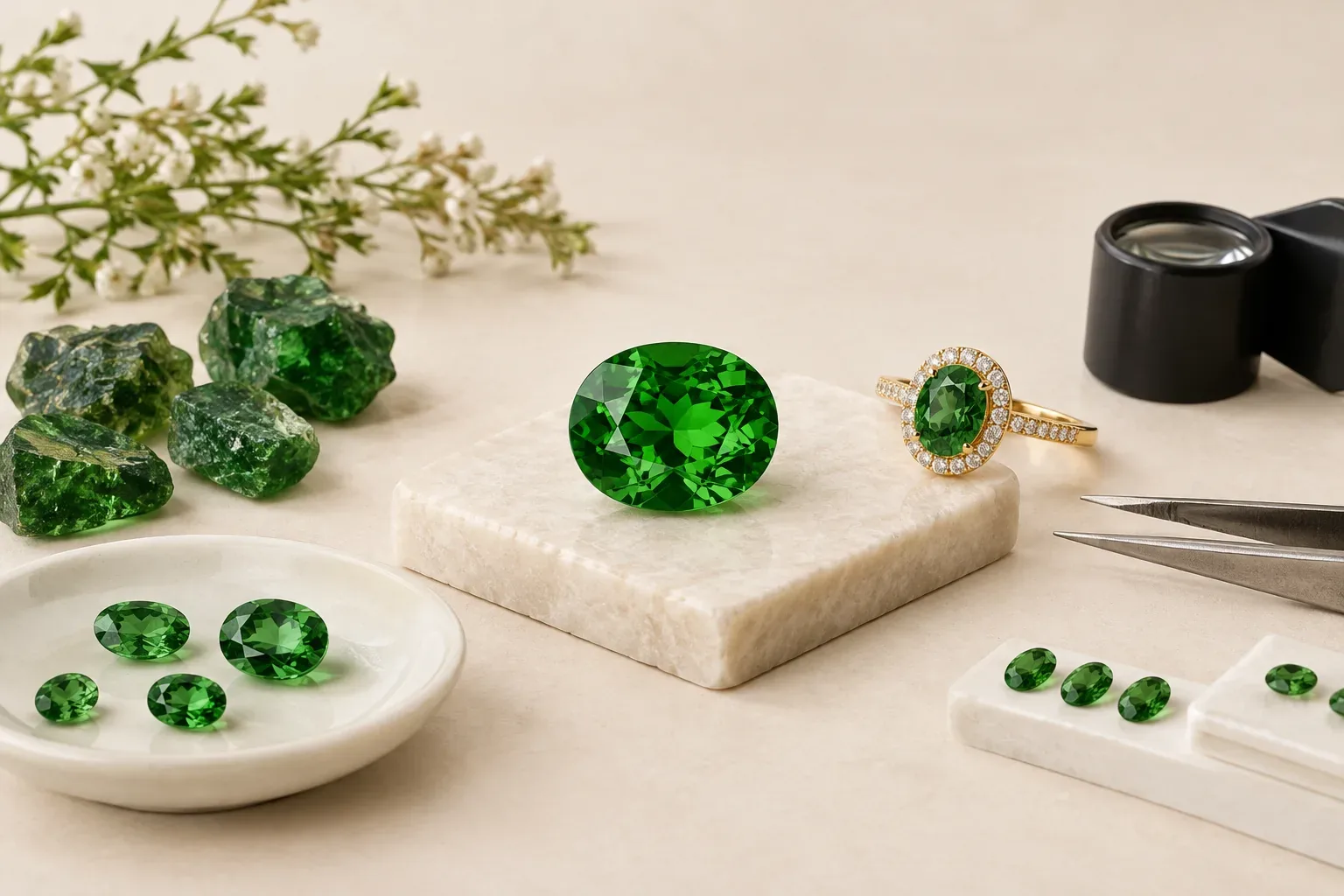
Meaning at a glance
This tsavorite garnet treatment guide explains the buyer intent behind treatment questions, outlines decision criteria and trade-offs, explains what disclosures the law and gemological practice emphasize, gives practical verification limits without a laboratory, and offers safe care and gifting guidance.
What this guide covers and why it matters
The core aims of a treatment guide are to let you distinguish natural from altered material, weigh price and durability trade-offs, and to know when independent verification is necessary. The Gemological Institute of America (GIA) identifies treatments, disclosure, detectability, durability and special care as distinct consumer questions for gemstones, which is the framework used below. The U.S. Federal Trade Commission (FTC) further explains that consumers need clear written distinctions among natural, lab-created, treated and imitation materials and that sellers should provide meaningful disclosure.
Historical evidence and cultural context
The approved sources for this guide do not provide a documented lineage of tsavorite as an ancient cultural motif or attribute its meanings to historical societies. In other words, we do not have, in the referenced material, reliable historic claims linking tsavorite specifically to named cultures or classical periods.
What the sources do confirm is that contemporary gem and jewelry interest in colored gemstones is shaping modern styles and consumer questions. Market reports cited by industry publishers show growing demand for gemstone rings, necklaces and other colored-stone pieces in recent trends, which places tsavorite alongside other green and colored gems in current jewellery assortments. These observations come from trade research compiled by Imaginaire Digital and Professional Jeweller, which report trends for engagement rings, gemstone rings, necklaces, and other categories where colored gems are commonly used.
Documented history versus modern personal interpretation
Because the approved references do not record ancient or cultural meanings for tsavorite specifically, any historical symbolism ascribed to the stone in modern listings or lore should be treated as contemporary interpretation rather than documented cultural history. Modern sellers, designers, and wearers frequently attach personal or marketable meanings to gemstones; those personal meanings are legitimate for the wearer but are not the same as historically documented cultural attributions.
When a seller or brand describes a tsavorite as symbolic of renewal, prosperity, or another quality, understand that such statements are modern interpretations aimed at storytelling and marketing unless they cite independent historical sources. The consumer protection guidance from the FTC emphasizes transparent and meaningful disclosure rather than persuasive or unverifiable storytelling.
Common enhancements in the gem trade and disclosure expectations
The GIA explains that treatments and enhancements exist across many gem types and that disclosure and detectability vary by material and treatment. The FTC requires clear written distinctions among natural, lab-created, treated and imitation materials and expects sellers to provide accurate information to consumers.
For practical shopping, treat any broad claim about a gemstone’s untreated status as something to verify. Ask the seller for written confirmation of whether the stone has been treated, and if so, what treatment was applied. If a seller claims the stone is untreated or natural, request a dated, written statement or a gemological report from an accredited laboratory that specifically addresses treatments.
What you can reasonably verify without a laboratory
There are a few verifications you can do yourself or with a trusted local jeweler, but many treatment claims need professional equipment to confirm. You can reasonably confirm the seller’s written disclosures, inspect the mounting for signs of fracture-filling (for example, glue or unusual surface residue may be visible to a jeweler), and assess obvious durability concerns such as loose settings or chips.
Visible color consistency, surface appearance, and the quality of the setting and mounting are verifiable with a loupe and careful inspection. Price and provenance claims can be evaluated by comparing multiple offers and requesting invoices or purchase history. However, whether a stone has been treated in ways that are not visible—such as some forms of filling, diffusion, or irradiation—often requires a gemological laboratory report or a qualified gemologist using specialized instrumentation. GIA’s guidance makes clear that detectability and the need for expert testing are central to consumer questions about treatments.
Decision criteria and practical trade-offs for shoppers
Decide first what matters most to you: absolute natural, visual quality, durability, or budget. Treated stones can be more affordable or offer different visual results, while untreated stones may command a premium. The FTC’s disclosure guidance means you are entitled to honest, written statements about those treatments, which should inform your price expectations and aftercare planning.
If you want an untreated stone, insist on a recent lab report that names the gem and states whether treatments were detected. If you accept treated gems, ask which treatment was used, how stable that treatment is over time, and whether special care is required. Balance the cost savings against potential needs for future care or restoration, and remember that some treatments affect repair and cleaning options.
How tsavorite typically appears in jewelry (market context)
Industry trend reports show growing consumer interest in gemstone jewelry across categories such as engagement rings, necklaces, and rings more broadly. Imaginaire Digital and Professional Jeweller identify strong demand for engagement rings and gemstone rings and reference broader trends for sculptural jewelry, charm clusters, and birthstone necklaces. Within that market context, green gemstones like tsavorite are used by designers as center stones, accents, or pavé in fine and fashion jewelry depending on design and budget.
When evaluating a piece, consider whether the stone is used as a focal center gem or as accents, how the color pairs with metal and other stones, and the workmanship of the setting. Those aesthetic and construction factors often have more immediate impact on daily wear and long-term value than marketing language about symbolism.
Care guidance and safe handling
The GIA emphasizes that durability and special care are important consumer considerations for any gemstone. For practical care, handle gemstones gently, store them separately from harder stones that could scratch them, and avoid exposure to harsh household chemicals which can compromise settings and some surface treatments. Regularly check the setting for loose prongs or movement and have any necessary repairs performed by a qualified jeweler.
When in doubt about cleaning methods or whether a particular treatment requires special handling, consult the seller’s disclosures and a qualified jeweler. Some treatments change how a stone responds to steam, heat, or ultrasonic cleaning; because detectability varies, professional guidance protects the stone and the mounting.
Selection and gifting guidance
When buying tsavorite as a gift, be explicit with the seller about your priorities: natural versus treated, budget, and whether you need a gemological report for reassurance. Ask for written disclosure that accompanies the piece, and keep that documentation with the gift. If you are gifting to someone who values provenance or untreated material, a lab report or paperwork that confirms the seller’s claims is an appropriate part of the purchase.
Respect the recipient’s preferences for care and symbolism. If the recipient prefers low-maintenance pieces, choose settings and stones that are robust and come with clear aftercare instructions. If you plan to insure the gift, keep receipts and lab reports handy, because insurers often require documentation that reflects what was represented at sale. The FTC guidance reinforces that clear written information helps both buyers and recipients make informed choices.
When to get an expert opinion or laboratory report
If you are buying a higher-value piece or if the seller makes specific claims about being untreated, color origin, or rare provenance, obtain a current report from an accredited gemological laboratory. The GIA and other labs can detect many treatments that are not visible to unaided inspection. A qualified independent appraisal or lab report gives you a record to rely on for resale, insurance, or future care decisions.
Remember that some verification tasks—such as detecting low-level treatments—are beyond unaided visual inspection and require specialist instrumentation and experience. Use written seller disclosures as your first line of defense and a laboratory report when you need technical confirmation.
Final practical checklist
Before you buy, ask for written disclosure about treatments, request a dated lab report for higher-value purchases, inspect the setting and stone closely or have a trusted jeweler inspect it, and confirm return policies and insurance options. Keep the paperwork with the piece and follow the seller’s and jeweler’s care recommendations. If a seller declines to answer treatment questions directly or to provide documentation, consider that a reason to pause the purchase.
Frequently asked questions
Are tsavorite garnets commonly treated?
The approved references used for this guide do not provide a clear, sourced statement that tsavorite is commonly or uncommonly treated. The GIA notes that treatments exist across gemstone types and that detectability varies. For any specific stone, ask the seller for written disclosure and, for higher-value purchases, request a gemological laboratory report that addresses treatments.
What disclosure am I legally entitled to when buying a gemstone?
According to the Federal Trade Commission, consumers should receive clear, written distinctions among natural, lab-created, treated, and imitation materials. Ask for explicit, dated documentation that states whether a stone has been treated and what treatment was applied.
Can I tell if a tsavorite is treated by looking at it?
Some treatments produce visible signs that a trained jeweler can spot, but many require specialized instruments to detect. The Gemological Institute of America explains that detectability varies, so written disclosures and laboratory reports are the reliable ways to confirm treatment status.
Should I request a laboratory report?
If the piece is high-value, the seller claims the stone is untreated, or you need confirmation for insurance or resale, obtain a current report from an accredited gemological laboratory. Lab reports provide the technical verification that visual inspection alone often cannot.
How should I care for a tsavorite to protect its appearance?
Follow the seller’s and jeweler’s care recommendations. The GIA points out that durability and special care are key consumer considerations. As a general practice, handle gemstones gently, store them separately from harder stones, avoid harsh chemicals, and have settings inspected periodically by a qualified jeweler.
Sources and further reading
- Imaginaire Digital — Imaginaire Digital
- Professional Jeweller / PRYA Jewellery Search Insights — Professional Jeweller / PRYA Jewellery Search Insights
- Gemological Institute of America — Gemological Institute of America
- Federal Trade Commission — Federal Trade Commission