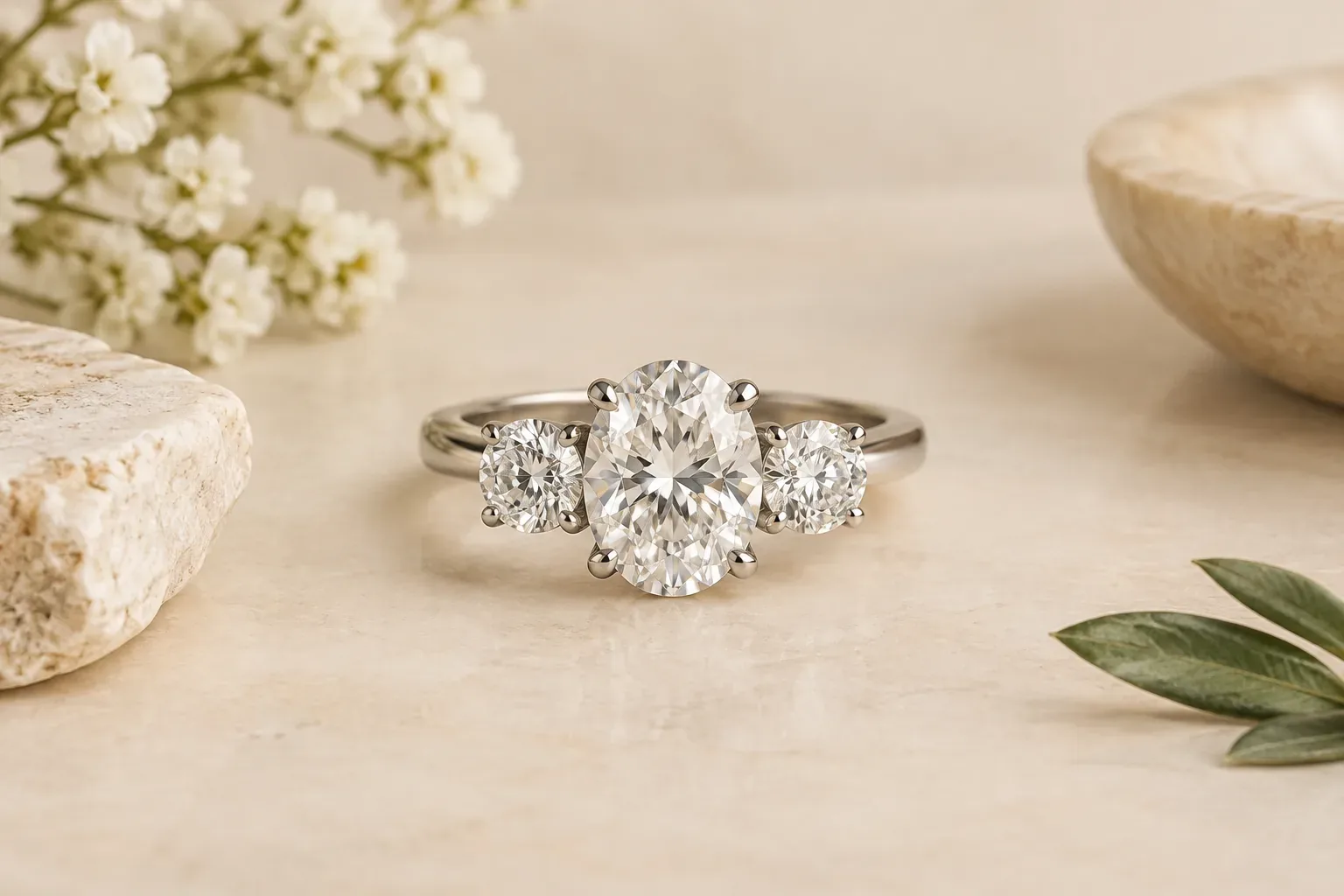
Meaning at a glance
Three‑stone engagement ring styling balances the visual footprint of three stones with finger width, shoulder and band proportions, and lifestyle needs; use clear decision criteria—stone sizes and shapes, spacing, mounting height, and metal width—to choose a look that suits the wearer, and rely on gemological reports and professional appraisal for verification.
Quick answer
For styling a three‑stone engagement ring with correct finger coverage and proportion, match the combined visual width and vertical presence of the three stones to the wearer’s finger width and hand proportions, choose side stones that support rather than overpower the center stone, and select a band and setting height that balance comfort, durability and the intended visual emphasis.
What the historical evidence shows (and what it does not)
The approved reference set for this article does not include primary historical studies that trace the three‑stone setting to a specific culture or ancient period. Because those sources do not document a precise cultural origin, this guide does not assert a single historical birthplace for the motif.
Contemporary industry publications and trend reports emphasize modern preferences and design directions rather than ancient symbolism. For example, 2026 market visibility and trend commentary show strong consumer activity around engagement rings and evolving tastes in forms and colored gemstones (Imaginaire Digital; Jewelers Mutual). Those sources support understanding how three‑stone settings are used today but do not provide historical origin claims.
Documented meanings versus modern personal interpretation
Where you read or hear specific, named historical meanings for three‑stone rings, treat those as cultural interpretations that should be sourced to a particular tradition or researcher. The sources used here do not record authoritative historical symbolism for the motif, so any ‘traditional’ meaning presented elsewhere should be verified against primary historical scholarship.
In modern practice, buyers commonly assign personal meanings to three‑stone rings—such as representing past, present and future—but those are contemporary personal interpretations rather than universal, documented historical meanings. Jewelry trend reporting for 2026 shows that consumers are also choosing rings for versatility, color and craftsmanship instead of only for symbolic formulas (Jewelers Mutual; Imaginaire Digital).
How the three‑stone motif and gemstones appear in contemporary jewelry
Today’s three‑stone engagement rings appear across a range of styles: matching shapes for a symmetrical look, a larger center with smaller flanking stones for emphasis, or mixed shapes and colors for visual contrast. Industry trend sources note growing interest in colored gemstones and fluid, modern forms, which often influence how designers execute three‑stone compositions (Jewelers Mutual; Imaginaire Digital).
Materials and treatments matter for appearance and care. The Gemological Institute of America (GIA) explains that many gemstones undergo treatments that affect durability and appearance, and that these treatments should be disclosed. The Federal Trade Commission (FTC) advises clear labeling for natural, lab‑created, treated, cultured and imitation materials, a distinction that shapes how three‑stone rings are marketed and priced.
Styling for finger coverage and proportion: practical guidance
Begin by assessing the wearer’s finger width and hand proportions visually or with a simple measurement of finger width across the proximal phalanx. A ring that covers too much of a narrow finger will appear heavy; a very small ring on a broad hand may look delicate or lost. Aim for a balance where the stones occupy roughly one third to one half of the visible finger width when the hand is at rest, adjusting preference for subtlety or statement accordingly.
Decide the visual role of the side stones. If you want the center stone to remain dominant, choose side stones significantly smaller or of lower profile. For a more integrated, bandlike effect, choose larger side stones that sit close to the center and to each other so the three stones read as a continuous plane across the finger.
Shape choices affect perceived coverage. Round and oval stones tend to read as more compact across the finger than elongated marquise or emerald cuts at the same carat weight. If horizontal coverage is a priority, opt for stones whose combined widths fill the intended span; if vertical presence (height) is more important, select shapes and settings that add crown height or use taller prongs.
Match band width and shoulder design to the stones’ scale. A delicate 1.5–2.0 mm band can work with small side stones and a modest center stone, while wider bands visually support larger three‑stone arrangements and improve durability for active wearers. Avoid extremely thin bands with large, heavy three‑stone mounts unless reinforced at the shoulders.
Practical trade‑offs to weigh
Brilliance versus coverage: Larger side stones increase overall sparkle and coverage, but they can reduce the visual emphasis on the center stone. Decide whether the ring should read as a trio or as a singular focal point with accents.
Durability versus style: Low‑profile settings are less likely to snag and are better for active lifestyles, while high‑set or cathedral mounts can create striking vertical presence but require more care and adjustment during daily tasks.
Cost and authenticity: Substituting smaller or lower‑grade side stones for size, or using lab‑created stones, can achieve a desired footprint at a lower price, but consumers should expect transparent disclosure under FTC guidance and should be comfortable with the material choices on their own terms.
Selection and gifting guidance: respectful, practical steps
Start with the wearer’s lifestyle and existing jewelry. If the recipient prefers low maintenance and often uses their hands, favor lower profiles, sturdier bands and settings that tuck stones closer to the finger. If they value visible sparkle and frequently wear special pieces, allow for larger side stones and higher settings.
Communicate about materials and disclosures. Ask the seller for clear written disclosures of whether stones are natural, lab‑created, treated or imitations, as the FTC recommends. Request gemological reports for diamonds and high‑value colored stones when available, and keep receipts and certificates with the ring.
Choose symbolism with consent. If you plan to attach a symbolic interpretation—such as past, present and future—ask whether that resonates with the wearer. Many people appreciate a thoughtful explanation, but others prefer functional or aesthetic choices without symbolic layering.
Care, verification and what only an expert can confirm
For everyday care, follow guidance based on gemstone treatments and durability. The GIA highlights that treated or fragile gems require different handling than durable stones like diamonds and sapphires. Clean three‑stone rings according to the most fragile stone in the grouping and avoid ultrasonic cleaners for stones known to be treated or brittle without professional advice.
What you can verify yourself: visible mounting construction, metal hallmarks, and whether a seller provides written disclosures and gemological reports. The FTC requires clear labeling practices, so documented disclosures are your first verification tool.
What requires a professional: identifying treatments, distinguishing natural from lab‑created stones, and grading. Only a qualified jeweler, appraiser, or gemological laboratory can reliably determine many stone characteristics. If provenance, treatment history, or precise grades matter to you, obtain a report from an accredited lab and an independent appraisal.
A concise decision checklist
Decide the visual goal: trio unity or center emphasis. Choose side stone sizes and shapes to support that goal. Match band width and setting profile to the stones and the wearer’s lifestyle. Confirm material disclosures and request lab reports when value or treatment matters. Balance cost, appearance and durability, and get professional verification when you need definitive identification or grading.
Conclusion
Styling a three‑stone engagement ring is a practical exercise in proportion, comfort and personal preference. Use the measurable criteria described here—finger width, combined stone width, band proportion and setting height—alongside clear disclosure and lab reports to make a confident choice. Remember that modern meanings are personal rather than universally historical, and that some technical truths about stones require expert testing to verify.
Frequently asked questions
How do I measure finger width for three‑stone coverage?
Measure the finger across the widest visible point (the proximal phalanx) while the hand is relaxed. Compare that width to the combined visible width of the three stones as shown by the retailer or measured in millimetres. Aim for the stones to occupy roughly one third to one half of the visible finger width as a starting point, adjusting up or down for personal preference.
Should the side stones match the center stone?
Matching side stones produce a formal, symmetrical look, while smaller or contrasting side stones emphasize the center or create visual interest. Choose matching stones if unity is desired, and contrasting shapes or colors if you want the ring to read as a composed triptych.
Are three‑stone settings harder to maintain than solitaire rings?
They can be, because there are more stones, prongs and junctions that require inspection. Lower‑profile settings and secure prongs reduce risk. Clean according to the most fragile stone in the trio and consult a jeweler for regular maintenance.
Can I verify whether the stones are natural or lab‑created myself?
Not reliably. Visual inspection can identify obvious imitations, but definitive identification of natural versus lab‑created stones, or detection of many treatments, requires a gemological laboratory or qualified professional. Ask the seller for written disclosures and laboratory reports as recommended by the FTC.
What should I ask a jeweler before buying a three‑stone ring?
Request written disclosures on material type and treatments, ask for gemological reports for high‑value stones, verify metal hallmarks, confirm mounting security and repair policies, and discuss warranty or insurance options. If you have specific proportion or comfort needs, ask to try similar widths and heights in person.
How should I clean a three‑stone engagement ring?
Use a gentle, non‑abrasive cleaner and a soft brush, avoiding ultrasonic cleaners if any stone is known or suspected to be treated or fragile. The GIA advises cleaning according to the least durable stone in the setting and to consult a professional for stones with uncertain treatment histories.
Sources and further reading
- Imaginaire Digital — Imaginaire Digital
- Jewelers Mutual — Jewelers Mutual
- Gemological Institute of America — Gemological Institute of America
- Federal Trade Commission — Federal Trade Commission