Meaning at a glance
Sword jewelry meaning combines documented historical uses as markers of rank, protection, and identity with later and personal symbolic readings; this article separates museum-backed history from modern interpretations and explains how the motif and gemstones appear in jewelry, plus practical guidance for selection and gifting.
What the historical record shows (museum-backed evidence)
Jewellery and personal ornament have long served as visible signs of social position, affiliation, and belief, and museums and curatorial research make that continuity clear. The Victoria and Albert Museum’s exhibition material and related writing describe how jewellery changes meaning with social context and use, recording examples in which objects that resemble weapons or borrow elements from weapons functioned as status markers, badges, or ritual items rather than literal tools of combat. Referencing that body of work helps us read sword motifs as part of a broader pattern in which small-scale representations of larger objects appear in jewellery to communicate identity or role.
Across different times and places, artisans reduced martial forms into miniature devices suitable for collars, brooches, rings, pendants, and hat-pins. In those contexts the miniature blade could act as an emblem: a sign of military office, a token of chivalric affiliation, or an element of costume that recalled a life-stage or achievement. Museums document many such transformations of object to symbol without suggesting a single universal meaning; the V&A emphasizes changing social contexts for jewellery rather than an immutable symbolism.
Separating documented historical meanings from modern interpretations
Documented historical meanings rely on provenance, inscriptions, contemporary texts, and how an object was displayed or used in life. When curators identify a brooch shaped like a sword as a regalia piece or a hat-pin worn by soldiers, that is a historical reading grounded in evidence. The V&A’s approach to jewellery history repeatedly stresses this reliance on context: similar forms may mean different things when worn by a magistrate, a bride, or a member of a regiment.
Modern interpretations—whether romantic, political, or personal—are legitimate but distinct. Contemporary wearers often read sword imagery as a symbol of personal strength, protection, justice, or defiance, or adopt it for fantasy, cosplay, or aesthetic reasons. Those readings reflect present-day values and individual intent rather than documented historical usage. A single object may carry both documented historic associations and new personal meanings for its wearer, but it is important not to conflate the two when discussing provenance or curatorial interpretation.
How the sword motif appears in jewelry
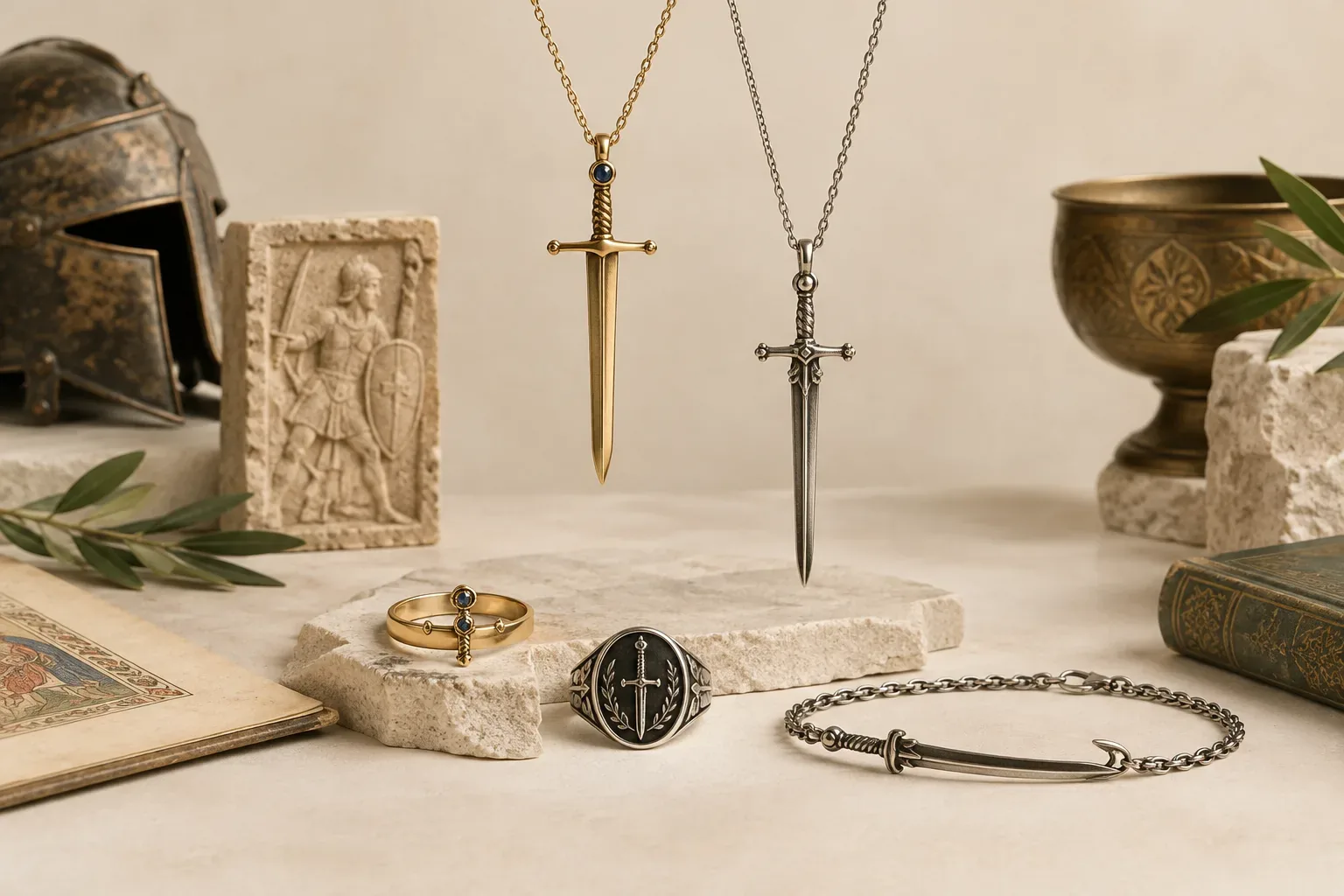
The sword motif appears in jewellery through direct miniature representations, stylized elements, and hybrid designs that combine blade shapes with other symbols. Miniature blades and scabbards can be rendered as pendants, charms, or brooches. Hilt forms and cross-guards are often simplified into decorative rings or as the central motif of pendants where the blade is reduced to a thin bar of metal or a line of stones.
Designers also combine the sword form with other motifs such as crowns, laurel wreaths, moons, or gemstones. In many modern pieces the sword is a framing device for a gemstone; gem placement can echo historic practices in which gems indicated status or were chosen for durable wear. The Victoria and Albert Museum’s reference material on gemstones underscores how particular stones and cuts have circulated in jewellery across periods, shaping how motifs like blades are set and embellished.
Materials and scale vary widely. Smaller, delicate sword pendants may be crafted in gold, silver, or plated metals and set with accent stones. Larger statement pieces can incorporate enamel, filigree, or figurative scenes on scabbards. Where a motif evokes a specific cultural sword type, the design may include distinctive hilt shapes, guards, or pommels that point to a geographic or stylistic tradition; such references should be read with attention to provenance and maker notes when available.
Gemstones, treatments, and what to check
Historical uses of gemstones in jewellery are well documented and serve practical and decorative roles. Museums like the Victoria and Albert Museum maintain accessible guides to gemstone types and their histories in jewellery, tracing how certain stones were chosen for color, hardness, or perceived value. When sword motifs include gems, those stones may be purely decorative or chosen to evoke color associations—ruby for red, sapphire for blue—or birthstone and affiliation choices by modern wearers.
When buying gem-set sword jewellery, verify disclosures about treatments and imitations. The Federal Trade Commission sets consumer guidelines indicating sellers should disclose treatments, synthetics, or simulants and should not misrepresent what a stone is. For any piece where value or durability is a concern, request written details about metal purity, gemstone identity, and any treatments, and consider independent appraisal for high-value items.
Choosing, wearing, and gifting sword jewelry respectfully
Select a piece with attention to the recipient’s history and values. If the recipient has a military connection, a piece that references a specific regiment or ceremony may be appropriate and meaningful; when you lack that specificity, choose a more general or stylized design to avoid inappropriate appropriation of ceremonial forms. The V&A’s curatorial emphasis on context is a useful reminder: an object’s meaning is shaped by who wears it and how they wear it.
Consider scale, metal, and daily use. A delicate sword pendant in sterling silver suits everyday wear and layering, while heavier, ornate pieces may be better for occasional use and require more care. If gifting a gem-set item, check gemstone disclosures and the seller’s return policy and include care instructions. Personalization—such as simple engraving of a date or initials—can make a symbolic piece feel bespoke without falsely imposing historical claims.
Be mindful of cultural and religious sensitivities. Swords are part of ritual and regalia in some traditions; avoid adopting overtly sacred forms as costume or novelty without understanding their significance. When in doubt, choose designs that emphasize universal personal qualities like courage or perseverance without co-opting specific sacred symbols.
Care, authentication, and ethical considerations
Basic care follows standard practices for metal and gems: store pieces away from harsh chemicals, clean according to the metal and gemstone type, and repair broken mounts promptly. If a sword motif includes moveable parts or filigree, periodic inspection by a jeweller will extend its life. For guidance on gemstones and their care, consult authoritative references and the seller’s information; the Victoria and Albert Museum’s resources on gemstones are a useful starting point.
Authentication and ethical sourcing matter for higher-value pieces. Seek written confirmation of metal purity and gemstone identity, and ask about sourcing and treatment disclosures. The Federal Trade Commission advises consumers to expect accurate descriptions of gemstones and to be alert to treated or synthetic stones that should be disclosed. If ethical sourcing is important to you or the recipient, request supplier policies on sourcing and fair practice.
Putting meaning into practice: wearing the motif today
Modern wearers choose sword jewellery for many reasons: as a private reminder of resilience, as part of a historical reenactment, or for aesthetic and fashion reasons. Whether you wear a tiny dagger charm for daily symbolism or a large statement pendant for an occasion, be explicit about the meaning you intend when gifting or choosing a piece to avoid confusion. Documented historical meanings can enrich a piece’s narrative, but contemporary intent completes it.
If you’re researching a specific antique sword-themed piece, consult museum catalogues, maker’s marks, and provenance records. For contemporary purchases, use seller-provided documentation and consider professional appraisal for insurance or resale. A thoughtful choice balances documented context, personal resonance, and respectful attention to cultural associations.
Closing note
Sword jewelry meaning is not a single fixed message. Museums such as the Victoria and Albert Museum show how similar forms have carried different social and ceremonial functions across time, and contemporary wearers bring new personal or aesthetic layers to the motif. By distinguishing documented historical uses from present-day interpretations, and by following practical guidance on materials, disclosure, and respectful selection, you can choose or gift sword-themed jewellery that is both meaningful and well-considered.
Frequently asked questions
What is the historical meaning of sword jewelry?
Historically, the sword motif has most often functioned as a marker of role, rank, or affiliation and as a ceremonial reference rather than carrying a single universal symbolic meaning; museums note that jewellery meanings change with context.
Does sword jewelry always mean violence or aggression?
No; while blades reference martial forms, documented uses in jewellery often emphasize authority, ceremony, identity, or protection, and modern wearers commonly interpret the motif as personal strength or style rather than literal aggression.
Can sword motifs be religious or sacred?
In some traditions swords are part of ritual regalia; whether a motif is sacred depends on its specific design, provenance, and cultural context, so research and sensitivity are recommended before adopting clearly ritual forms.
How should I check the gemstones in sword jewelry?
Ask the seller for written details about gemstone identity and any treatments, and consult independent appraisal or the seller’s certification for high-value pieces; the Federal Trade Commission advises transparency about treatments and synthetics.
Is sword jewelry appropriate as a gift?
Sword-themed pieces can be meaningful gifts when chosen with attention to the recipient’s background and preferences; opt for stylized or neutral designs if you lack specific cultural or ceremonial knowledge.
What metals are good for everyday sword pendants?
Durable metals such as sterling silver, gold (in tested purities), and certain plated alloys are common; choose according to wearer sensitivity, care willingness, and the piece’s intended frequency of wear.
How can I avoid cultural appropriation when buying sword jewellery?
Avoid purchasing or wearing items that mimic clearly sacred or ceremonial regalia from a culture you are not part of, seek designs that are stylized or contemporary, and ask sellers about provenance when a piece references a specific tradition.
Where can I learn more about gemstones in jewelry?
Museum resources such as the Victoria and Albert Museum’s A–Z of Gemstones provide historical and identification context, and consumer guidance from government sources explains disclosure practices for treatments and synthetics.
Sources and further reading
- Bedazzled: A History of Jewellery — Victoria and Albert Museum
- An A-Z of Gemstones — Victoria and Albert Museum
- Buying Gemstones, Diamonds, and Pearls — Federal Trade Commission