Meaning at a glance
This article explains the documented history and changing contexts of the crown motif, separates cultural and religious evidence from later popular interpretations, and gives practical guidance for choosing and wearing crown-themed jewelry today.
What the crown has represented in documented history
Museum collections and curatorial research show that crowns and crown-like head ornaments have long been used to signal status, office, or sacred function in many societies. Objects resembling crowns appear in ancient regalia, funerary dress, and ceremonial portraiture across different regions; the Victoria and Albert Museum frames this long view of jewellery as an element whose meaning shifts with social context and use over time (Victoria and Albert Museum).
In late medieval and early modern Europe, crowns and coronation regalia were public markers of royal authority and dynastic legitimacy. Tiaras and circlets were part of court pageantry and portraiture that communicated rank. By the nineteenth century, European jewelers and patrons reused crown imagery and shapes in decorative jewellery as part of broader changing fashions and ideas about display, memory, and identity described in museum histories (Victoria and Albert Museum).
Outside Europe, many societies developed their own head ornaments with symbolic roles tied to spiritual leadership, territorial rule, or ritual office. Where specific ceremonial headgear is conserved or documented, curators and historians treat those objects as evidence of social or religious practice rather than as a single universal meaning (Victoria and Albert Museum).
How institutions distinguish history from later meanings
Curators and scholars distinguish an object’s use and cultural context from later reinterpretations or aesthetic revivals. The Victoria and Albert Museum’s work on the history of jewellery emphasizes that meanings change: a crown-shaped brooch made in the nineteenth century for sentimental display carries different evidence than a medieval coronation diadem used in ritual. Museum provenance, manufacture marks, contemporary descriptions, and how an item was worn or displayed are the primary evidence used to determine historical meanings (Victoria and Albert Museum).
That same scholarship shows that nineteenth- and twentieth-century revivals—when designers borrowed royal motifs for popular jewellery—are a distinct phenomenon. Those later uses often reflect fashion, personal sentiment, or political symbolism current at the time of re-use rather than the original ceremonial role of an older crown.
Documented historical meanings versus modern personal interpretations
Documented historical meanings are the functions and associations that can be traced by evidence such as where and how an object was used, who made or owned it, and contemporary writings or inventories. For crowns these documented meanings include insignia of office, dynastic emblem, or sacred attribute when used in ritual or state ceremony. Museums catalogue those roles based on archival and material evidence (Victoria and Albert Museum).
Modern personal interpretations are individual or cultural re-readings that developed after the original use. Examples include wearing a crown motif to signal self-confidence, personal achievement, empowerment, or fashion affiliation. These are legitimate contemporary meanings, but they are not the same as the crown’s documented ceremonial uses. Wherever possible, treat historical meanings and modern interpretations as separate layers rather than interchangeable facts.
How the crown motif, gemstones, and related traditions appear in jewellery
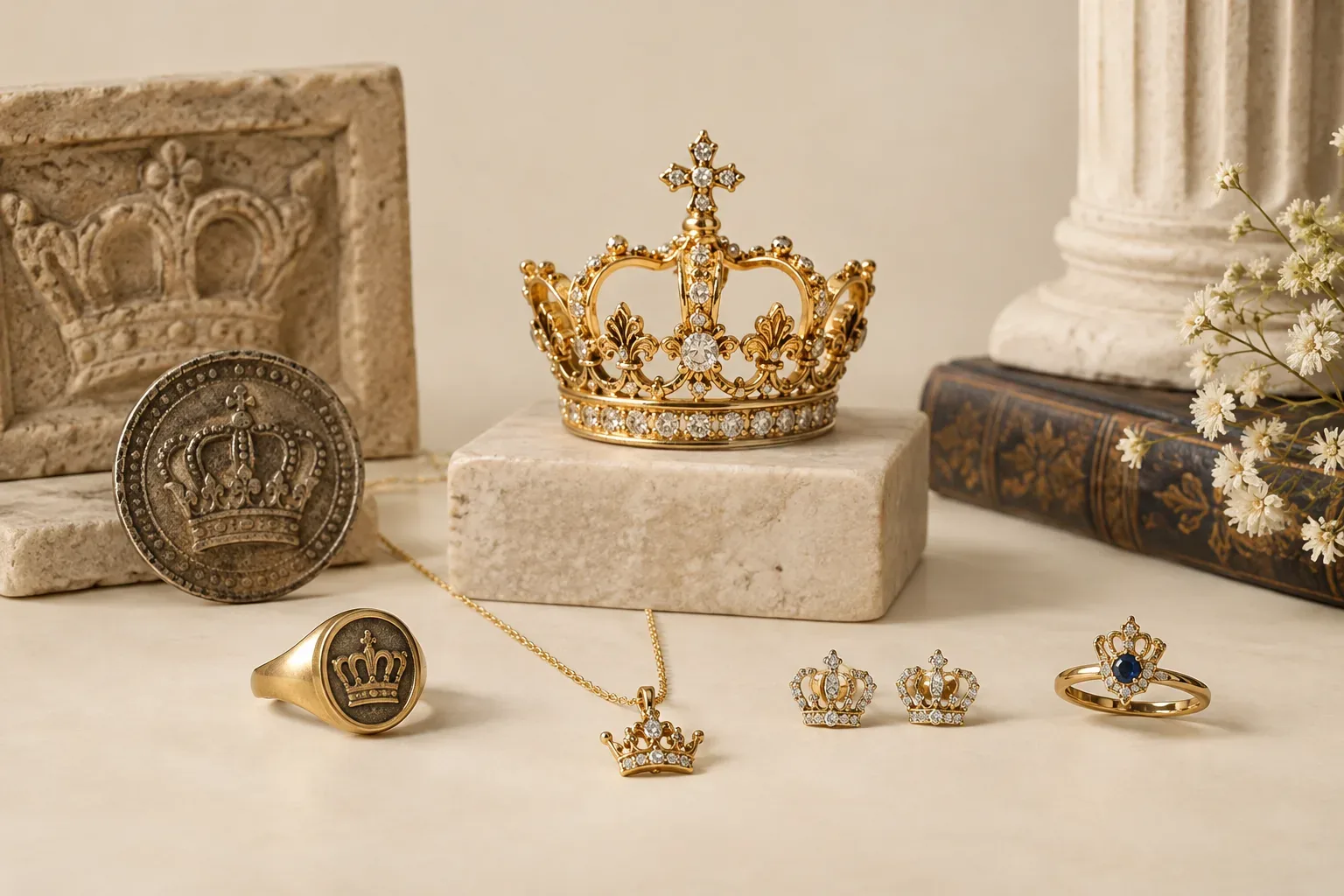
The crown motif appears in a wide range of jewellery forms: pendants and lockets that reproduce a tiny circlet, signet-style seal pendants with a crowned monogram, brooches and tiara-like headpieces, rings with a coronet profile, and charms used in bracelets. The motif is adaptable: it can be literal and three-dimensional, stylized into a simplified outline, or suggested through a pattern of points and arches that recall a crown’s silhouette.
Gemstones historically associated with regalia—such as rubies, emeralds, sapphires, diamonds and pearls—also appear frequently in crown-themed jewellery. The Victoria and Albert Museum’s resources on gemstones explain how specific stones were prized for color, hardness, or symbolic value and how those preferences changed over time and place (Victoria and Albert Museum). When jewellery makers evoke crown regalia, they often use these stones or their imitations to suggest the look of historic royal pieces.
Design traditions can carry additional meaning. Seal-style pendants and signet rings that include crowning motifs can reference lineage and identity in ways that echo but do not replicate official heraldic seals. Tiaras and coronet-inspired headbands remain staples of bridal and formal wear in many cultures, where they function as decorative markers rather than legal insignia.
Practical guidance for choosing and gifting crown jewelry respectfully
When selecting crown-themed jewellery for yourself or as a gift, begin by considering the recipient’s cultural and personal background. In some places and families, crown symbolism may have political, dynastic, or religious connotations; in others it is simply an attractive decorative motif. If you are unsure, ask about preferences or choose a design that emphasizes personal meaning—such as an initial beneath a small coronet—rather than explicit national or state symbols.
Match the object to how it will be worn and maintained. A delicate tiara-style headband suits occasional formal wear. A crown pendant or signet-style necklace works well for everyday layering and is less likely to raise concerns about formality or protocol. If you select gemstone-set pieces, consider durability and wearability: stones like diamonds and sapphires handle daily wear better than softer gems.
If the giver or receiver values historical authenticity or antique style, look for pieces with clear provenance or reputable documentation. Museums and reputable dealers describe an object’s date, place of origin, and prior ownership in ways that help buyers understand what they are buying (Victoria and Albert Museum). If authenticity matters, seek professional appraisal and condition reports.
Material, treatment and certification notes to know before buying
Treatments, imitations, and enhancements are common in gem-set jewellery. The Federal Trade Commission provides guidance on how gemstones, diamonds, and pearls may be treated or imitated and explains consumer rights and disclosure expectations (Federal Trade Commission). Ask sellers to disclose treatments, whether stones are natural, lab-grown, or simulated, and request written confirmation when buying at higher price points.
Consider ethical sourcing and metal quality. If conflict-free or traceable supply chains matter to you, ask about sourcing and look for sellers who provide transparent statements. For precious metals, check for standard stamps and, where appropriate, seek independent testing or certificates. For everyday wear, sterling silver and plated metals are common for crown motifs, while gold and platinum are typical for heirloom-quality pieces.
Styling and wearing crown jewelry respectfully
Let context guide how you wear crown motifs. For formal events and ceremonies, a tiara or statement coronet brooch can be appropriate when it aligns with local customs. For day-to-day wear, choose smaller, simpler motifs that read as personal symbols rather than public emblems. Avoid designs that replicate national coronation regalia or that include state insignia when you are uncertain about local sensitivities.
Layering crown pendants with other pieces allows the motif to become part of a personal story rather than a singular declarative statement. Where a crown is worn to mark an achievement or milestone, consider pairing it with an accompanying inscription, card, or explanation so the intended meaning is clear to the recipient without presuming it will be read the same way by others.
A final note on research and continued learning
If you encounter an antique crown piece or a family heirloom, consult museum catalogues, reputable dealers, and conservation specialists before drawing conclusions about its original use. The Victoria and Albert Museum’s work on the changing social contexts of jewellery is a useful model for separating an object’s documented history from subsequent reinterpretations (Victoria and Albert Museum).
For practical consumer questions about gemstones, treatments, and disclosure standards consult the Federal Trade Commission guidance to understand what sellers should tell you and what certification you can request (Federal Trade Commission). Taking a careful, evidence-led approach will help you appreciate both the historic layers and the contemporary meanings a crown motif can carry.
Frequently asked questions
Does a crown motif always mean royalty?
No. Historically a crown or circlet could indicate royal or official use, but the motif has also been repurposed across periods as a decorative or sentimental symbol. Context and provenance determine whether a specific object was actually part of royal regalia.
Are certain gemstones traditionally used in crown jewellery?
Gemstones such as diamonds, rubies, sapphires, emeralds and pearls feature frequently in historical regalia and in crown-themed jewellery because of their color, durability, and historic prestige. The Victoria and Albert Museum’s resources describe how gemstone preferences and uses changed over time (Victoria and Albert Museum).
How can I avoid buying treated or imitation stones unintentionally?
Ask sellers for written disclosure about treatments and for certificates when appropriate. The Federal Trade Commission outlines consumer expectations for disclosure and advises buyers to request information on treatments, whether gems are natural, lab-grown, or simulants (Federal Trade Commission).
Is it appropriate to give crown jewellery as a gift in every culture?
Not necessarily. Crown imagery can carry political or dynastic meanings in some contexts. Consider the recipient’s cultural background and personal values, or choose a subtler design that emphasizes personal rather than state associations.
Can men wear crown-themed jewellery?
Yes. Crown motifs appear on many kinds of jewellery that are not gender-specific, including signet rings, pendants, and cufflinks. Choose scale and material that match the wearer’s style and comfort.
How should I care for crown jewellery with small settings or filigree?
Delicate settings often trap dirt and require gentle cleaning and periodic inspection by a jeweller. For valuable or fragile pieces, seek professional conservation or repair advice rather than attempting aggressive home cleaning.
Sources and further reading
- Bedazzled: A History of Jewellery — Victoria and Albert Museum
- An A-Z of Gemstones — Victoria and Albert Museum
- Buying Gemstones, Diamonds, and Pearls — Federal Trade Commission