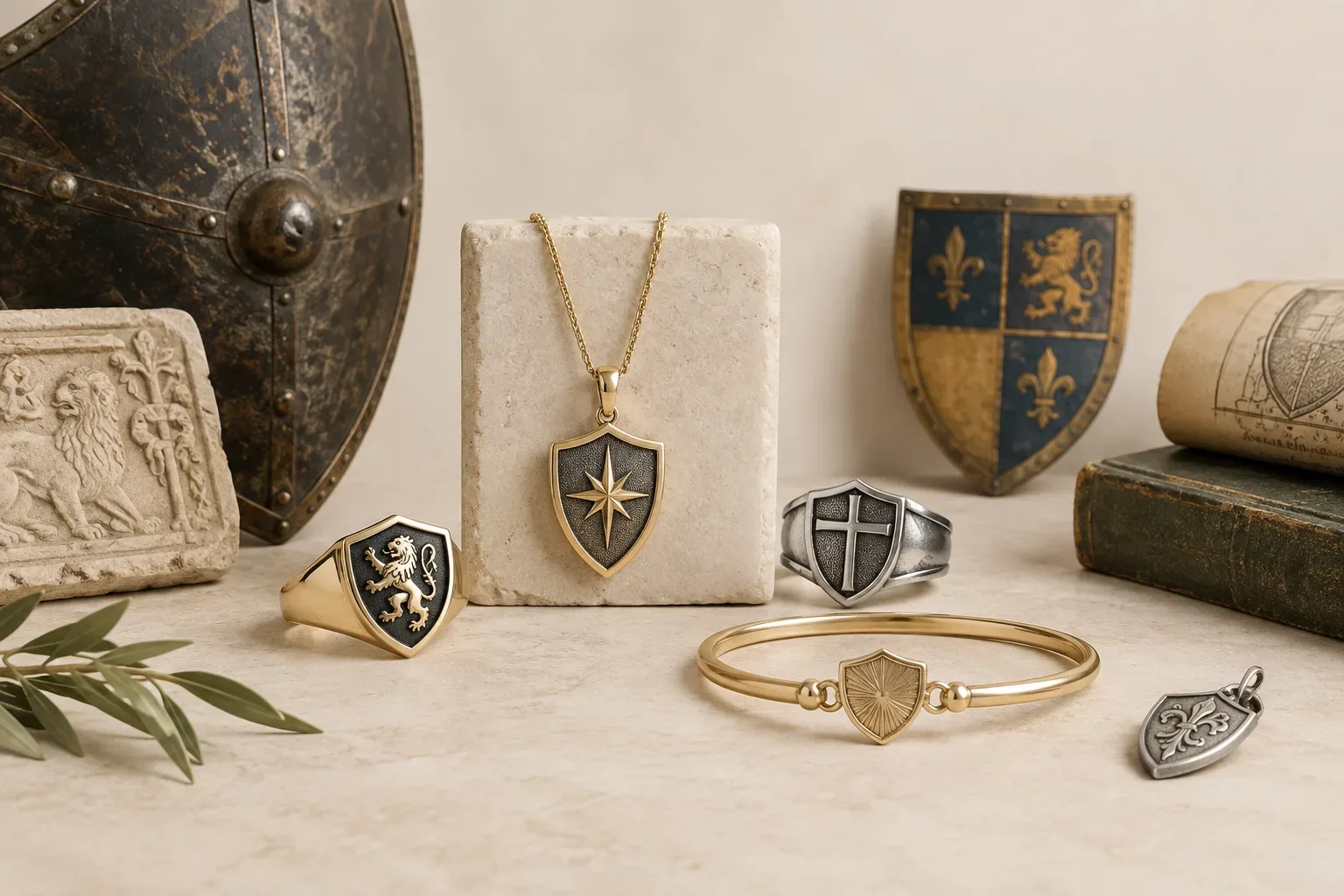
Meaning at a glance
Shield jewelry meaning encompasses documented historical uses of defensive and heraldic imagery and a range of modern personal interpretations; museums record the motif's changing social contexts, while contemporary wearers choose shield pendants or rings for protection, strength, and identity—so choose materials and inscriptions thoughtfully and verify gemstone treatment and authenticity before buying.
Documented history, by culture and period
Scholars and museum curators describe jewelry as an evolving medium that borrows imagery from armour, heraldry, and emblems of rank; the Victoria and Albert Museum (V&A) frames much of jewellery history in terms of changing social contexts and the reuse of motifs over time. In Europe, for example, objects and decorative motifs that reference shields appear in medieval and later contexts where heraldry and family emblems were important markers of identity and status, and the V&A collections and commentary note how such imagery moved between functional objects, clothing, and personal adornment.
Earlier classical societies also used motifs drawn from martial imagery, including helmets and decorative devices associated with military prestige, again showing how visual language from armour and protection entered personal ornament. The V&A's surveys of jewellery history highlight this cross-over between public symbols (shields, armour, crests) and private jewellery, but the meaning attached to any single piece depended on time, social rank, and the object's use.
Across different periods the motif shifted in emphasis: in some medieval and early modern European contexts a shield-shaped plaque could explicitly carry heraldic arms or serve as a signifier of lineage; in other periods small pendants or seals borrowed the shield outline as a formal shape without the same heraldic content. The V&A's work places these changes within broader social trends in taste, patronage, and symbolism rather than treating the shield as having a single fixed meaning.
Documented historical meanings versus modern interpretations
Documented historical meanings are grounded in specific uses and contexts. When a pendant or brooch carries a coat of arms on a shield-shaped plate, that is a heraldic, identity-based use, and museum documentation treats such pieces as records of family, office, or allegiance. When exhibitions or catalogues identify shield-shaped jewellery as drawing from armouric forms, that is an observation about source imagery and social function rather than an assertion that every wearer intended a talismanic protection function. Those kinds of context-specific readings are the kind of evidence represented in the V&A's historical discussions.
Modern interpretations, by contrast, often emphasize psychological and symbolic readings that developed later or independently of documented historic intentions. Contemporary wearers and designers commonly describe shield motifs as symbols of protection, resilience, or courage. These are valid personal and cultural meanings today, but they are not necessarily continuous with every historic use. It is important not to conflate a modern protective or empowerment message with every historic specimen: museums record particular historical functions, while popular symbolism can grow afterward and vary by individual or community.
How the shield motif, gemstones, and traditions appear in jewelry
The shield motif appears in jewellery in several visual forms. Designers sometimes use the silhouette of a shield as the basic pendant or plaque shape, which can then be engraved with initials, heraldic devices, religious symbols, or decorative patterns. Shield outlines also form the frames for cameos, miniatures, or inset stones. The V&A's overview of jewellery history notes that shapes and silhouettes borrowed from other material cultures—armor, badges, or ceremonial objects—recur in jewellery as a way to signal association or status.
Gemstones may be used within shield-themed pieces for emphasis or symbolism. Historically and in contemporary practice certain gems carry conventional associations, and the V&A's resource on gemstones provides historical context about how specific stones were valued, cut, and set. Modern makers might set a central sapphire, diamond, or onyx within a shield-shaped bezel to create a focal point or to add color and perceived virtue, but any symbolic meaning attached to a particular stone (for example, blue for loyalty, red for courage) is a layer of interpretation rather than an absolute.
Practical and respectful selection or gifting guidance
If you are choosing shield-themed jewellery as a gift, start by separating your intentions from likely historical associations. If you intend the piece as a sign of protection or encouragement, a small pendant or token with a personal engraving will communicate that directly. If heritage or lineage is important to the recipient, look for pieces that honestly reference heraldry only where appropriate and avoid implying antique provenance if the item is modern.
Respect cultural specificity: because shield shapes can be part of particular family, regional, or military heraldic systems, avoid using or gifting items that appropriat e or misrepresent those identities. If a design clearly echoes a specific crest or regalia, consult the recipient or a knowledgeable source before presenting it as a personal talisman. For a neutral but meaningful choice, select clean shield silhouettes with a simple inscription or an initial rather than borrowed armorial devices.
When jewellery includes gemstones, verify disclosure about treatments, imitations, and provenance. The Federal Trade Commission advises buyers to expect clear information on whether stones are synthetically produced, treated, or imitation, and to ask sellers about any enhancements. If budget is a concern, consider alternative stones or lab-grown options but make sure the seller discloses that status; honest disclosure protects both buyer and giver and preserves the sentiment behind the gift.
Consider scale and wearability for everyday symbolism. A small pendant worn near the heart, a signet-style ring, or cufflinks with a shield motif will read differently than a large statement brooch. Think about the recipient's daily activities and metal sensitivities when choosing materials, and choose an engraving or short message that aligns with the meaning you want to convey.
Care, authenticity, and buying notes
Ask sellers for clear information about metal quality, gemstone treatment, and any hallmarks. The V&A's resources on gemstones and jewellery history underline how materials, cutting, and setting practices have changed over time; knowing whether a stone is natural, enhanced, or lab-grown affects value and long-term care. The Federal Trade Commission's guidance emphasizes that sellers should disclose treatments, synthetics, and imitation stones, and that buyers should request certifications or clear written statements when provenance or authenticity is important.
For antique or heritage pieces, seek provenance documentation and conservation histories. Museums classify and interpret objects based on concrete evidence such as maker's marks, documented ownership, and stylistic comparison; when shopping in the market, expect comparable documentation for pieces sold as historically significant. For modern designer or bespoke shield jewellery, ask about warranties, metal karat or purity, and the maker's policies on resizing or engraving.
Conclusion
Shield jewelry meaning is best understood as layered: documented historical uses tied to heraldry, identity, and decorative borrowing from armouric forms are recorded and interpreted by museums such as the Victoria and Albert Museum, while contemporary wearers and makers create new personal meanings emphasizing protection, resilience, and support. When choosing or gifting shield jewellery, be deliberate about which layer of meaning you intend, verify materials and disclosure per the Federal Trade Commission's guidance, and select a form, scale, and inscription that respect the recipient's identity and practical needs.
Frequently asked questions
Does shield jewelry historically mean protection?
Historically, shield imagery in jewellery most often signals association with armouric forms, heraldry, or identity rather than a universal talismanic protection meaning; museum documentation treats such uses as context-dependent. Modern wearers commonly adopt the shield as a personal symbol of protection, but that is a later and individual interpretation.
What gemstones work well in shield-themed pieces?
Any durable gemstone can be used in a shield design; historically and today stones like sapphires, onyx, and diamonds are chosen for their color, contrast, or durability. Use the Victoria and Albert Museum’s gemstone guidance for historical context, and follow seller disclosure about treatments when choosing stones.
How can I avoid cultural appropriation when gifting shield jewelry?
Avoid using or gifting items that clearly reproduce specific family crests, military insignia, or regional heraldic devices without the recipient’s knowledge or permission. If a design echoes a particular heritage or emblem, consult the recipient or a specialist before presenting it as a personal symbol.
Should I worry about treated or synthetic stones in shield jewelry?
Sellers should disclose treatments, synthetics, and imitations; the Federal Trade Commission advises buyers to ask for clear information. Treated or lab-grown stones can be excellent choices if they are honestly represented and fit your budget and aesthetic.
Is a shield pendant appropriate for everyday wear?
Yes, small shield pendants, signet rings, or simple shield-shaped studs are appropriate for daily wear provided they are sized and finished for comfort. Consider metal allergies, chain strength, and whether the recipient wants a visible statement or a discreet token.
How should I care for antique shield jewellery?
For antique pieces, seek conservation advice and provenance information; avoid aggressive cleaning that could damage old settings or delicate gemstones. Museums and experienced antique dealers recommend professional cleaning and documentation rather than home remedies for historically significant items.
Sources and further reading
- Bedazzled: A History of Jewellery — Victoria and Albert Museum
- An A-Z of Gemstones — Victoria and Albert Museum
- Buying Gemstones, Diamonds, and Pearls — Federal Trade Commission