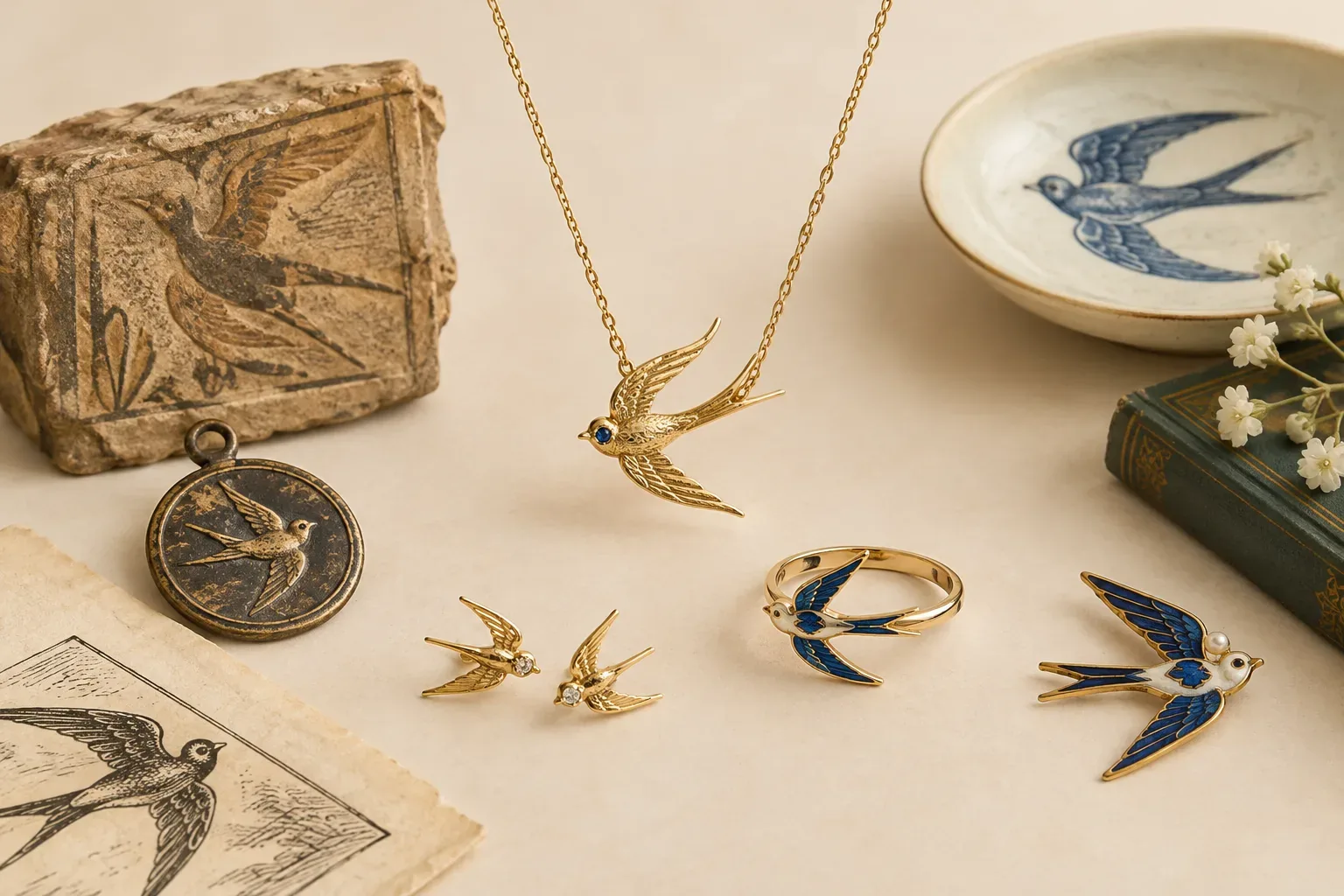
Meaning at a glance
This article explains the documented history and changing contexts of the swallow motif, separates cultural and museum-documented meanings from modern personal interpretations, and offers practical guidance for choosing and gifting swallow jewelry.
Short answer
Swallow jewelry meaning is best understood as a set of historically recorded uses and evolving personal associations rather than a single universal symbol. Museum documentation shows jewellers have used the swallow motif in decorative and sentimental contexts over time, while contemporary wearers often adopt the motif for themes such as safe journeys, new beginnings or loyalty. This article explains the evidence museums provide, distinguishes historically documented meanings from modern interpretations, describes how swallow designs and gemstones appear in jewelry, and gives practical guidance for choosing or gifting a swallow piece today.
What the historical evidence shows
Documentation held and interpreted by the Victoria and Albert Museum shows that bird motifs, including small passerine forms often identified in collections as swallows or martins, appear across European jewelry traditions and changing social contexts. The V&A's research and exhibition programming on the history of jewellery explain how motifs move through styles, techniques and tastes, and how particular shapes are used for decorative and sentimental purposes rather than carrying a single fixed meaning.
Which cultures and periods are documented?
Museum collections surveyed by the Victoria and Albert Museum place swallow and small-bird motifs in a number of European decorative traditions. The V&A frames these motifs within broader jewellery history, showing examples where bird imagery appears in late antique, medieval, Georgian and Victorian contexts as jewellers employed representational motifs, enamel work and gem inlays to convey aesthetic and sentimental values. Where the V&A identifies a swallow specifically in an object label or catalogue, its documentation is careful to place that object in a precise period and production context rather than asserting a single cultural meaning for all swallow imagery.
Documented historical meanings versus later interpretations
The primary documentary evidence in museum catalogues and exhibitions supports two kinds of historical claims: first, that swallow shapes were used as part of a broader vocabulary of animal and bird motifs in jewellery design; and second, that jewellers and owners sometimes employed bird imagery for sentimental or decorative reasons. The V&A describes how jewellery's social functions change over time and how motifs are reinterpreted in different eras. Beyond this museum-documented use, many widely repeated associations—for example, the swallow as a strict symbol of a particular religious virtue or as a universally recognized maritime token—are later popular interpretations and modern cultural extensions rather than single, continuous meanings shown in primary historical catalogues.
How jewellers made swallow motifs and what materials were used
Historical and curatorial writing collected by the Victoria and Albert Museum shows that jewellers used the same set of techniques and materials they used for other small representational motifs when depicting swallows. These techniques include goldsmithing, engraving, enamel, and the setting of small gemstones or seed pearls to model feathers and eyes. The V&A's overview of gemstones and jewellery history explains how particular stones and materials have been chosen for their colour, hardness and availability, and how treatments or imitations have long been part of gem use.
Gemstones and treatments to know about
When swallow motifs include gemstones, museum catalogues and gemstone guides show a range of choices: coloured stones to suggest plumage, pearls and seed pearls for delicate highlights, and opaque stones for contrasting backgrounds. The Victoria and Albert Museum's A–Z of Gemstones explains how material properties and historical preferences shape those choices. For modern buyers, government guidance from the Federal Trade Commission reminds consumers to expect disclosure about treatments, synthetics, and imitations when purchasing gemstone-set jewellery, so that appearance and value are properly understood.
Modern personal and commercial interpretations
In contemporary practice the swallow motif often carries personal meanings that vary by wearer, designer and culture. Some people choose swallow jewellery to evoke ideas of new beginnings, freedom, homecoming, resilience or loyalty; others select it because they appreciate the motif's visual lightness and movement. These personal and commercial meanings are valid as modern interpretations but should be distinguished from the narrower claims that are documented by museum catalogues. The Victoria and Albert Museum's approach to jewellery history demonstrates how motifs gain and lose associations as they travel through time and taste.
How the motif appears in modern jewellery designs
Contemporary jewellers translate the swallow motif into many forms: small stamped or cast charms for necklaces and bracelets, engraved or enamelled brooches, delicate stamped studs or dangle earrings, and gemstone-set pendants. Designers may render the bird as a stylised silhouette, a naturalistic miniature, or an abstract suggestion of wing and tail. When set with gems, the swallow can be outlined in pavé stones, highlighted with a single cabochon eye, or shown in mixed materials such as silver bodies with gold accents.
Choosing and buying swallow jewellery: practical guidance
Decide first what meaning matters to you. If you want a piece because of a documented historical association, examine museum catalogues or reputable dealer descriptions that cite provenance or period. If you want a personal symbol—for example, a reminder of travel or a new job—choose a visual style that matches the sentiment, whether minimal and modern or richly detailed and vintage-inspired. Consider metal and gemstone durability for daily wear: solid gold and platinum endure best, while sterling silver is more affordable but requires occasional polishing.
Verifying materials and value
Ask sellers for clear information on materials and treatments. The Federal Trade Commission advises buyers that disclosures are essential for treated, synthetic, or imitation gemstones, and that accurate descriptions protect both value and expectations. Request documentation or a written statement about metal purity, gemstone type, and any enhancements. Museum research shows that similar-looking historical motifs can vary greatly in making and materials, so provenance and maker information matter if historical authenticity is important to your purchase.
Gifting guidance and cultural sensitivity
When giving swallow jewellery as a gift, be explicit about the intended meaning rather than assuming a single symbolic reading. Share why you chose the motif—whether it is a wish for safe travels, a celebration of a new start, or simply a design that appealed to you. If the recipient values historical authenticity, prefer pieces with clear provenance or museum-backed reproductions. Be mindful that meanings shift across cultures and individuals; a short note explaining your personal intention avoids miscommunication and shows respect for differing interpretations.
Care and longevity
Treat swallow pieces as you would similar jewellery: clean according to the metal and stone, store to avoid scratches, and have prongs, clasps and enamel checked by a jeweller if the piece is vintage or handmade. For gemstone-set swallows, follow care guidance appropriate to the gem's hardness and porosity as explained in gemstone references such as the V&A's A–Z of Gemstones.
Frequently asked questions
Does a swallow motif always mean safe return or loyalty?
No. Museum documentation indicates that swallow imagery appears in jewellery for decorative and sentimental reasons, and meanings can shift by period and owner; modern associations such as safe return or loyalty are contemporary or personal interpretations rather than universal historical facts.
What materials should I look for in durable swallow jewellery?
For everyday wear, choose durable metals such as gold or platinum; sterling silver is affordable but needs care. For stones, consider hardness and treatment; the V&A's gemstone guides explain properties, and the FTC recommends asking sellers about any treatments, synthetics or imitations.
How can I verify a vintage swallow piece is authentic?
Look for provenance, maker's marks, and credible documentation from dealers or museums. The Victoria and Albert Museum emphasizes object-level cataloguing for historical claims. For gemstones and metals, request written descriptions of materials and any lab reports, and consider a professional appraisal.
Is it appropriate to gift swallow jewellery with a symbolic message?
Yes, but be explicit about your intended meaning when gifting. Because swallow symbolism varies across cultures and individuals, a short note explaining your sentiment helps avoid misunderstanding and makes the gift more meaningful.
Sources and further reading
- Bedazzled: A History of Jewellery — Victoria and Albert Museum
- An A-Z of Gemstones — Victoria and Albert Museum
- Buying Gemstones, Diamonds, and Pearls — Federal Trade Commission