Meaning at a glance
The hummingbird motif in jewelry has shifting meanings rather than a single universal symbolism: museums and jewellery historians show that animal and bird motifs have long been used and reinterpreted across periods, Victorian and modern naturalist fashions helped popularize small bird imagery in wearable forms (as described by the Victoria and Albert Museum), and contemporary wearers attach personal meanings. This article separates museum-documented historical context from modern, personal, and popular interpretations, explains how the motif and related materials appear in jewellery, and gives practical, respectful advice for choosing or gifting hummingbird pieces.
What museum and jewellery history sources actually document
The Victoria and Albert Museum's materials on jewellery history explain two broadly useful points: firstly, that animal and bird imagery is a recurring motif in jewellery across many periods; and secondly, that meanings and uses of motifs shift depending on social context and fashion. The V&A's 'Bedazzled' exhibition material places such motifs in changing social and technological contexts, showing how naturalism, sentimentalism, and revival styles influenced what people wore and why. Those same sources also provide practical overviews of gem materials and their historic uses in ornamentation in the V&A's A–Z of Gemstones.
What the V&A documentation does not do is to offer a single authoritative, across-the-board history for the hummingbird motif tied to every culture. Instead, scholarly museum accounts make the more cautious point that designers reuse and reinterpret animal forms. For example, nineteenth- and early twentieth-century naturalist fashions in Europe and North America made small bird forms, dragonflies, and insect motifs popular in brooches and pendants, while later twentieth- and twenty-first-century tastes revived and reinvented those motifs for fashion, souvenir, and fine jewellery markets. The V&A frames these shifts as part of wider trends in style, technology, and taste.
Distinguishing documented historical meanings from modern interpretations
Documented historical meanings rely on surviving objects, maker records, and contemporary writings. Museum collections and catalogues can show that a brooch or pendant featuring a bird was made in a particular place and time and that it used certain techniques, but they do not always provide the wearer’s private intention. The V&A emphasises that context—who commissioned the piece, how it was worn, and contemporary symbolism—matters when interpreting meaning.
Modern personal interpretations are common and legitimate but should be distinguished from historical claims. Today people might wear hummingbird jewellery to symbolize joy, resilience, a memory of a loved one, or a love of nature. Many contemporary designers and retailers promote those associations. These are meaningful to the wearer but are not necessarily direct continuations of any single historical or cultural symbolism recorded by museums. Treat modern interpretations as personal or cultural choices rather than universal, historically fixed meanings.
How the hummingbird motif appears in jewellery
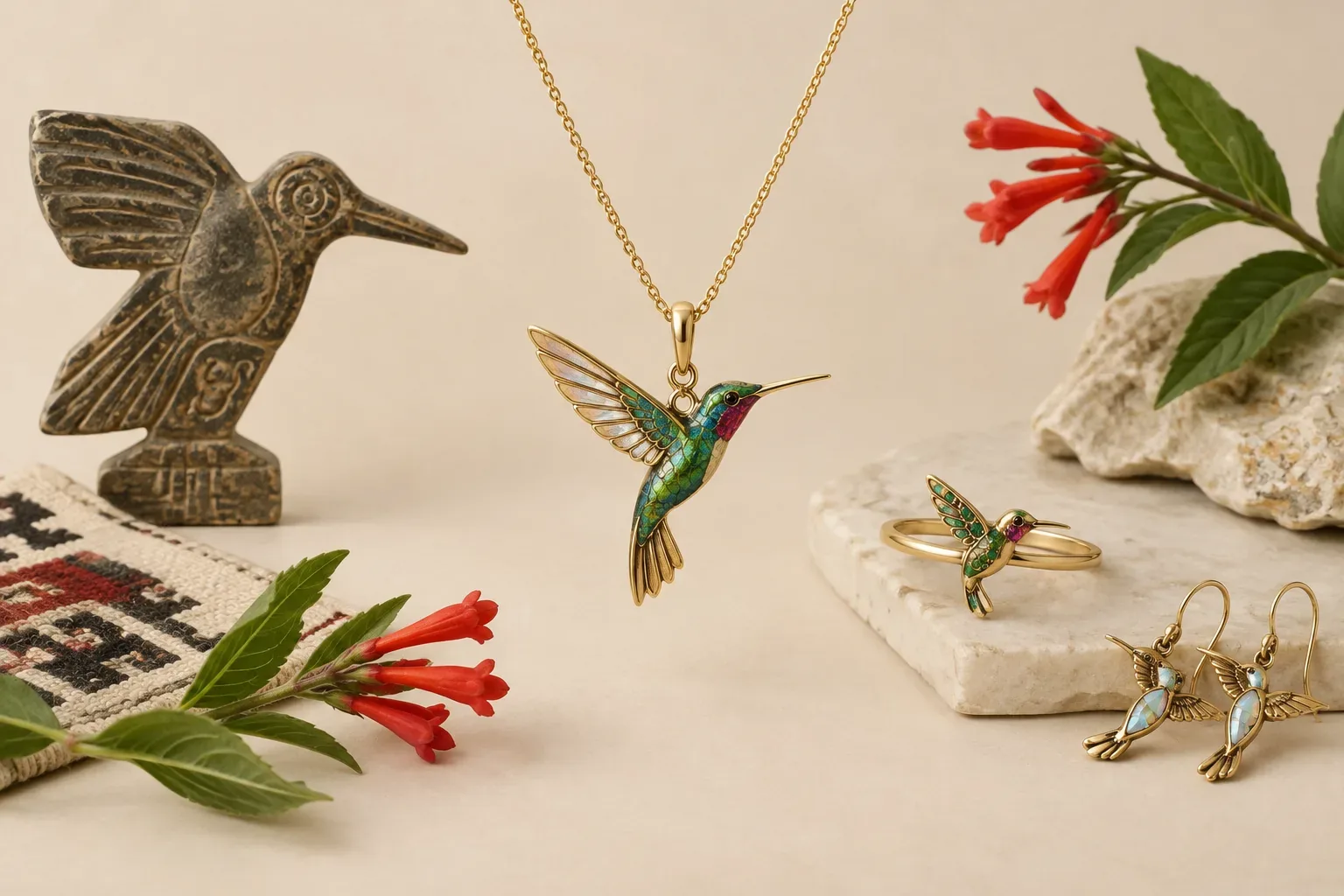
Designers use a range of traditional and modern techniques to represent hummingbirds in jewellery. Enamel is commonly used to capture the bird’s vivid, iridescent colours; cloisonné and painted enamels give stable, high-contrast colour fields. The V&A's jewellery histories discuss enamel as a long-standing technique for adding colour and pictorial detail to metalwork, allowing small motifs to be rendered clearly at a wearable scale.
Gemstones and carved materials are another route. Small faceted or cabochon stones can serve as bodies or eyes; thin iridescent materials such as opal and treated shell are sometimes used to suggest the shimmering plumage associated with hummingbirds. Metalwork techniques—piercing, chasing, filigree, and granular decoration—allow fine wings and beaks to be suggested in gold, silver, or alloys. Contemporary makers also employ lost-wax casting and CAD-assisted microcasting to reproduce delicate, anatomically suggestive shapes.
Beyond technique, several jewellery formats commonly feature the motif. Brooches and pins highlight three-dimensional modelling and were historically a popular format for small animal forms. Pendants and necklaces offer a front-facing motif suspended over the chest, often paired with a gemstone or enamel backdrop. Rings and earrings may take a stylized or simplified hummingbird shape so the motif reads at small scale. Designers sometimes combine the bird with botanical elements—flowers or leaves—to evoke feeding behaviour and add narrative context.
Materials, gemstone choices, and consumer cautions
The V&A's A–Z of Gemstones provides a museum-perspective overview of gemstone materials and their historical uses, which helps explain why designers choose certain stones to suggest a hummingbird’s colour palette. Bright greens and blues are often represented with emerald, tourmaline, or treated stones, while opal or iridescent shell can be chosen for shimmer. Where bright, stable colour is required, modern makers may use coloured enamel or lab-created stones for consistency and cost control.
Practical consumer caution is important. The Federal Trade Commission offers clear guidance about disclosures for treated, imitation, and synthetic gemstones. If colour treatments, coatings, assembled stones, or simulants are used to achieve iridescence or vivid hues, those facts should be disclosed to buyers. Always ask for written descriptions of materials, any treatments, and the metal fineness stamp or hallmark when purchasing hummingbird jewellery, especially for higher-value items.
Practical and respectful selection and gifting guidance
Choose with the recipient’s relationship to the motif in mind. A hummingbird design can be a safe, personal gift when you know the recipient appreciates nature-inspired designs. If the recipient has a stated cultural or spiritual connection to a hummingbird image, ask about preferred makers or community sources to avoid inadvertent appropriation. When in doubt, select pieces from makers who state a respectful provenance or who collaborate with communities that hold cultural associations with the motif.
Consider format and lifestyle. A brooch or statement pendant suits someone who wears occasion jewellery, while a small pendant or stud earrings suit everyday wear. Metal and gemstone choices should match the recipient’s allergies or preferences; for example, choose nickel-free or sterling silver settings for sensitive skin. For higher-value gemstones, request certification or independent appraisal if provenance or authenticity matters.
Budget and craftsmanship matter. Hand-enamelled, hand-engraved, or hand-carved pieces will generally cost more than cast mass-market items. If you want a sentimental or heirloom quality, look for solid construction, secure stone settings, and clear metal hallmarks. Gift inscriptions, lockets that combine imagery with a private photograph, or commissioning a bespoke piece allow the wearer to carry a more specific, personal meaning.
Be transparent about materials and story. If the piece is made using lab-created stones, alloys, or assembled components to achieve iridescence, disclose that to the recipient. Transparency is both a consumer protection principle supported by the FTC’s guidance and a sign of respect for the recipient’s right to know what they receive.
Wearing and styling hummingbird jewellery today
Treat the motif as an element of personal storytelling rather than a declaration of universal meaning. Many contemporary wearers layer a small hummingbird pendant with plain chains for a subtle effect, or pair a bird brooch with outerwear as a conversational accent. For formal occasions, a finely modelled or gem-set hummingbird brooch can sit on a lapel or near the shoulder for an elegant, slightly vintage nod to naturalist jewellery traditions.
When selecting ready-to-wear pieces, examine scale and detail in photographs or in person. Small-scale hummingbird forms need clear lines or distinctive colour contrast to be legible when worn. If you want a piece to read immediately as a hummingbird from a distance, favour slightly larger pendants or brooches and strong enamel or contrasting gemstone accents.
Conclusion
Hummingbird jewellery meaning is best approached as historically situated and personally adopted. Museums such as the Victoria and Albert Museum document how bird and animal motifs have been used and reinterpreted across periods, and their material guides help explain the technical choices designers make. Modern wearers often assign personal meanings—joy, resilience, memory, or a love of nature—but these should be treated as contemporary, individual interpretations rather than universally documented historical facts. By asking about provenance, disclosing materials, and choosing respectfully, you can select or gift hummingbird jewellery that is both beautiful and considerate.
Frequently asked questions
Is the hummingbird a universal symbol in jewellery?
No. There is no single universal meaning for hummingbird motifs. Museum research stresses that animal imagery is reinterpreted across cultures and periods. Modern wearers attach personal meanings such as joy or resilience, but those are contemporary, not universal historical facts.
What materials best capture a hummingbird’s colours in jewellery?
Enamel and iridescent materials like opal or treated shell are commonly used to suggest hummingbird colours, and coloured gemstones or lab-created stones can provide bright hues. The Victoria and Albert Museum’s gem resources explain how different materials have been used historically to create colour in jewellery.
How can I avoid cultural appropriation when buying hummingbird jewellery?
If the motif has acknowledged cultural or spiritual significance to a particular community, research makers who work with or belong to that community, or ask for provenance. Choosing pieces made by or in collaboration with those communities is the most respectful approach.
Should I be concerned about treated or synthetic stones in hummingbird pieces?
Yes. The Federal Trade Commission advises that sellers disclose treatments, synthetics, and simulants. Ask for written information about any treatments or lab-created components so you understand what you are buying.
Is a hummingbird pendant suitable as an everyday piece?
It can be. Choose a scale and metal appropriate for daily wear—solid settings, secure bails, and hypoallergenic metals if the wearer has sensitive skin. Smaller, simpler pendants and studs tend to be more comfortable for everyday use.
Sources and further reading
- Bedazzled: A History of Jewellery — Victoria and Albert Museum
- An A-Z of Gemstones — Victoria and Albert Museum
- Buying Gemstones, Diamonds, and Pearls — Federal Trade Commission