Meaning at a glance
Eagle jewelry meaning draws on long-standing associations of the bird with authority, sight, and status documented in jewelry history; museums record shifting uses across periods, while many contemporary wearers adopt personal interpretations—this article separates documented historical contexts from later meanings and offers practical guidance for selecting and gifting eagle pieces.
Short answer
Eagle jewelry meaning is best understood as a motif with long, changing contexts: museum scholarship describes the eagle as an emblem that has been used to signal authority, rank, and prestige across many periods and settings, and modern wearers layer new personal meanings—strength, freedom, vision—on top of those histories. This article explains the documented evidence for the motif, distinguishes historical uses from later popular interpretations, describes how the eagle appears in jewelry and gemstones, and gives practical guidance for respectful selection and gifting.
What the historical evidence shows
Museum research and exhibitions treating jewellery as social material make clear that motifs such as the eagle have been reused and reinterpreted across time. The Victoria and Albert Museum frames jewellery as an object type whose meanings change with social context and use; that perspective underlies how we read any repeated motif, including birds of prey. The V&A’s work on jewellery history emphasizes shifts in who wore certain motifs, how they signalled rank or allegiance, and how manufacturing techniques changed the form of motifs without necessarily fixing a single meaning.
Because the eagle motif appears in different artefacts and periods that museums collect and describe, the safest historical claim is that it functioned as a symbol of authority, status, or power in some contexts and as a decorative natural form in others. The precise symbolic content varied by time, place, patron, and object type; museum documentation often links an emblem’s meaning to the social role of the wearer rather than to a single universal definition.
Distinguishing documented historical meanings from modern interpretations
Documented meanings. Museum catalogues and curatorial notes tend to connect motifs to specific social practices: an eagle on a ceremonial ornament or a piece associated with official dress is interpreted as an emblem of authority or rank within that context. The Victoria and Albert Museum’s studies of jewellery emphasize that motifs are best read against their provenance, ownership, or function, and that the same motif can carry different connotations in different objects.
Modern personal interpretations. Contemporary wearers commonly read the eagle as a symbol of ideas such as freedom, vision, resilience, or patriotism. Those contemporary meanings are valid personal or cultural interpretations but are not the only historical meanings and should not be presented as universal or historically fixed. When choosing or interpreting eagle jewelry today, it helps to separate what is documented about a particular historical object (what museums record) from newer, personally meaningful associations.
How the motif and related materials appear in jewelry
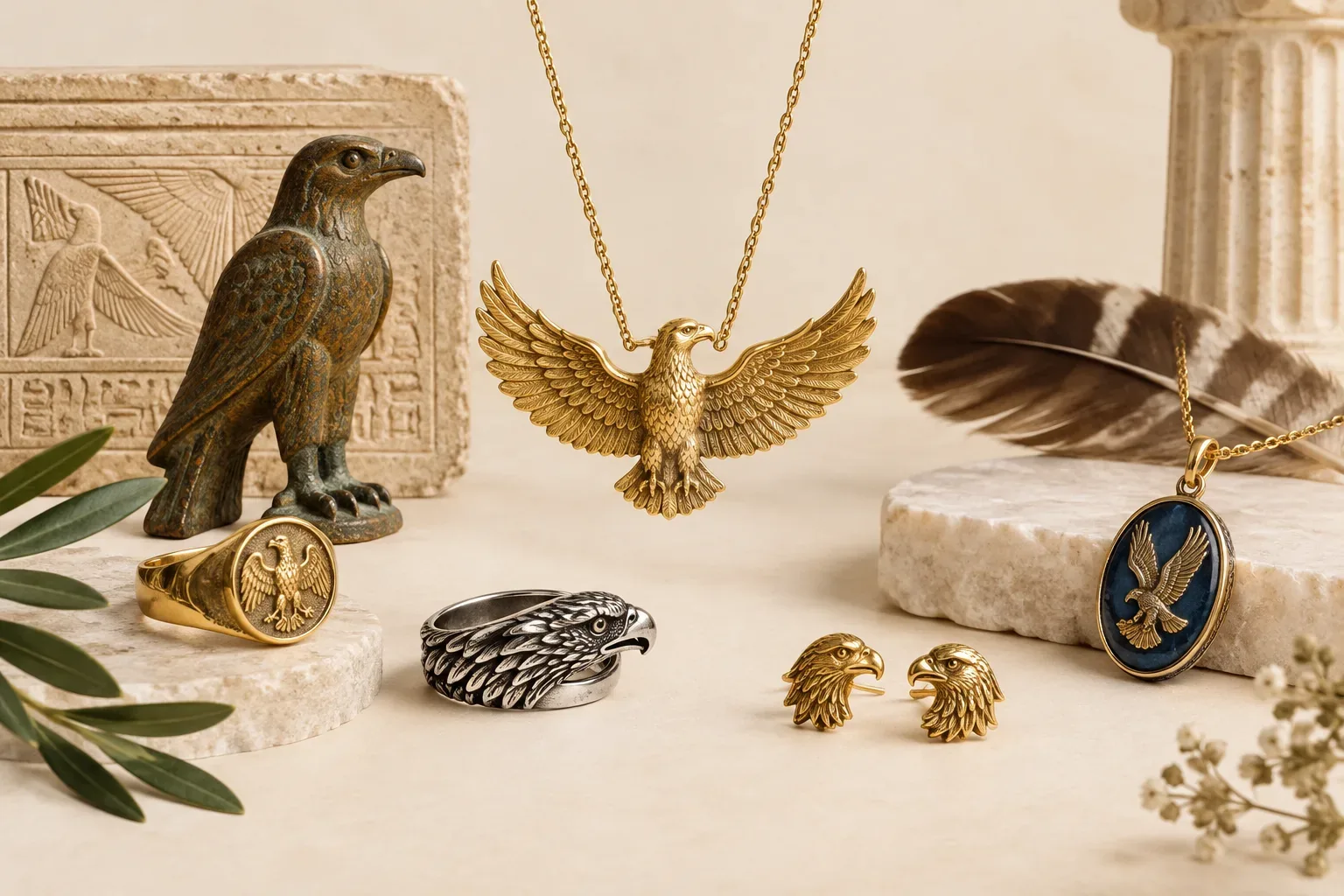
Forms and techniques. The eagle motif appears in many jewellery types: pendants, brooches, rings, lockets, and signet-style pieces all carry bird imagery. Museum collections and exhibitions note changes in technique over time—enamelling, casting, carving, and gem-setting all alter how a bird is represented and worn. An eagle rendered in high relief on a brooch communicates a different visual language from a tiny incised bird on a signet ring or a cameo profile with avian detail.
Gemstones and ornament. Gemstones and cuts have been used to emphasize parts of the motif—garnets or diamonds for eyes, coloured gems for plumage highlights, or cabochons and intaglios to create depth. The Victoria and Albert Museum’s A–Z of Gemstones provides historical context for how particular stones were prized, set, and marketed at different times; gem choice can signal period tastes as much as symbolic intent. In modern pieces, the use of specific stones may be chosen for their colour, affordability, or marketed symbolic associations rather than for a direct historical link to the eagle motif.
Tradition and reproduction. Museums document how revival styles reuse motifs from earlier periods: neoclassical, Victorian, and other revival fashions often borrowed animal imagery and adapted it to contemporary jewellery forms. That practice explains why a single private collection may include eagle motifs whose visual styles and intended messages come from widely separated eras and fashions.
Practical and respectful guidance for choosing or gifting eagle jewelry
Match context and intent. Before buying, think about why the eagle motif appeals: is it for historical interest, a personal attribute you want to acknowledge, aesthetic preference, or a cultural or national association? If the piece is a historical object or a faithful reproduction, learn its provenance and period interpretation—museum records such as those described by the Victoria and Albert Museum can help you understand how that object functioned in its original context.
Ask about materials and treatments. When gemstones or pearls are present, confirm whether stones are natural, treated, or synthetic and whether any enhancements are disclosed. The Federal Trade Commission explains that sellers should clearly disclose treatments, imitations, and synthetics. For higher-value purchases, request written information on treatments and certification where applicable.
Consider scale and occasion. Larger, highly detailed eagle motifs tend to read as statement pieces and can evoke ceremonial or historical references; small, stylized birds are more subtle and versatile for daily wear. Choose a scale that suits the recipient’s wardrobe and lifestyle rather than assuming a large motif is inherently more meaningful.
Respect cultural and symbolic sensitivities. Because motifs can carry national, military, or religious associations in some contexts, check whether a particular eagle design is historically or culturally specific—if so, be sensitive to that specificity when gifting. When in doubt, ask the seller for provenance information or consult trustworthy museum resources on symbolism and use.
Care and conservation. Follow standard jewellery-care guidance for metals and gemstones to preserve detail: store pieces carefully, avoid harsh chemicals, and seek professional cleaning and repair for fine or antique items. For gemstone identification and historical context, museum resources such as the V&A’s A–Z of Gemstones are useful starting points; for legal and consumer protections regarding representation of materials, consult guidance from the Federal Trade Commission.
Final note on interpretation
Eagle jewelry meaning is layered: museums document how the motif has been used in specific social and material contexts, while modern wearers bring new personal and cultural associations. Use museum research to ground historical claims, and treat personal meanings as legitimate contemporary layers that do not replace historical evidence. If you collect or gift eagle pieces, combine respect for provenance with clear communication about what the motif means to you or the recipient.
Frequently asked questions
Does the eagle motif always mean the same thing in jewellery history?
No. Museum documentation shows that the eagle motif has been used in different periods and contexts to signal authority, status, or simply as decoration. The Victoria and Albert Museum stresses that meanings change with social context, so an eagle on one object may have a different function or message than the same motif on another.
Can an eagle piece be connected to a specific culture or nation?
Sometimes, but not always. Some eagle designs are historically specific and tied to particular institutions or national iconography. Others are generic decorative birds. If cultural specificity matters, look for provenance information and museum or seller documentation before assuming a national or cultural association.
How should I verify gemstones or treatments in an eagle-themed piece?
Ask the seller for written disclosure of any treatments, enhancements, or imitations. The Federal Trade Commission advises buyers to request clear information on whether stones are natural, treated, or synthetic. For high-value stones, seek a report from a recognised gemological laboratory.
Is it appropriate to gift eagle jewellery with military or national associations?
Be mindful. Because certain eagle motifs can carry military, governmental, or national meanings, check whether a design is associated with specific groups and consider the recipient’s feelings about such associations before gifting.
How can I find the historical meaning of a particular eagle jewellery piece?
Start with provenance—when and where it was made and who owned or wore it—and consult museum catalogues or exhibition records. The Victoria and Albert Museum’s resources on jewellery history are useful for contextual information. If the piece is signed or hallmarked, use those details to narrow its origin.
What scale of eagle motif is best for everyday wear?
Smaller, stylised eagle motifs tend to be more versatile for daily wear while larger, highly detailed pieces function as statement or occasion jewellery. Choose based on the recipient’s style, comfort level, and clothing choices rather than assuming that a large design conveys more meaning.
Sources and further reading
- Bedazzled: A History of Jewellery — Victoria and Albert Museum
- An A-Z of Gemstones — Victoria and Albert Museum
- Buying Gemstones, Diamonds, and Pearls — Federal Trade Commission