Meaning at a glance
Explain the documented history and changing contexts of the star chart motif, separate cultural or religious evidence from later popular interpretations, and give practical guidance for choosing and wearing the motif in modern jewelry.
What the historical evidence shows
Museum surveys of jewellery history identify celestial and star motifs appearing repeatedly across many eras. The Victoria and Albert Museum’s overview of jewellery history traces such designs from ancient and classical contexts through medieval and Renaissance Europe to the high ornament of the 18th and 19th centuries, showing that references to the heavens are a recurring visual vocabulary in decorative arts. The V&A positions these motifs in changing social and technological contexts, not as a single continuous religious or symbolic meaning but as a design language adapted to each period.
In the ancient and classical worlds, makers used star and celestial imagery alongside other natural motifs. In medieval and Renaissance Europe, celestial symbols often appeared in devotional contexts, illuminated manuscripts, and heraldry, but they were also used purely decoratively. During the Renaissance and later, increasing interest in astronomy and navigation fed renewed attention to celestial imagery in personal ornament. By the Victorian era, lapidaries, romantic literary references and growing access to gemstones and mechanics produced elaborate pieces that combined sentiment, scientific curiosity and fashion.
The V&A’s resources show that the same visual motif — a star, a cluster of points, or a miniature map of constellations — could mean different things in different places and eras. Museums record the motifs and materials, but interpreting a particular piece’s original meaning requires context: who commissioned it, where and when it was made, and how it was used.
Keeping documented cultural meanings separate from modern interpretations
Documented historical meanings are what contemporary makers, patrons, or viewers left behind in records, inscriptions, or known cultural practices. For example, where a star motif appears in a devotional medieval object, contemporary evidence such as textual descriptions or inventories can support reading it in a religious context. Where a star motif appears in a fashionable Victorian brooch, trade catalogues, portraiture, and jewellery-making practice documented by institutions such as the V&A help explain its social context and likely meanings for its original owner.
Modern interpretations include new or revived layers of meaning that are not necessarily continuous with historical uses. Contemporary star-chart jewellery sold as a 'map of the night you met' or marketed as an 'astrology talisman' are meaningful to modern wearers and givers, but that personal or commercial meaning is a later overlay, not necessarily the same as the motif’s historical uses. Separating the two matters for historians and for respectful wearing: a museum’s documentation supports claims about past use and style, while modern symbolic claims should be presented as contemporary rather than historical facts.
How the star chart motif and related gemstones appear in jewelry
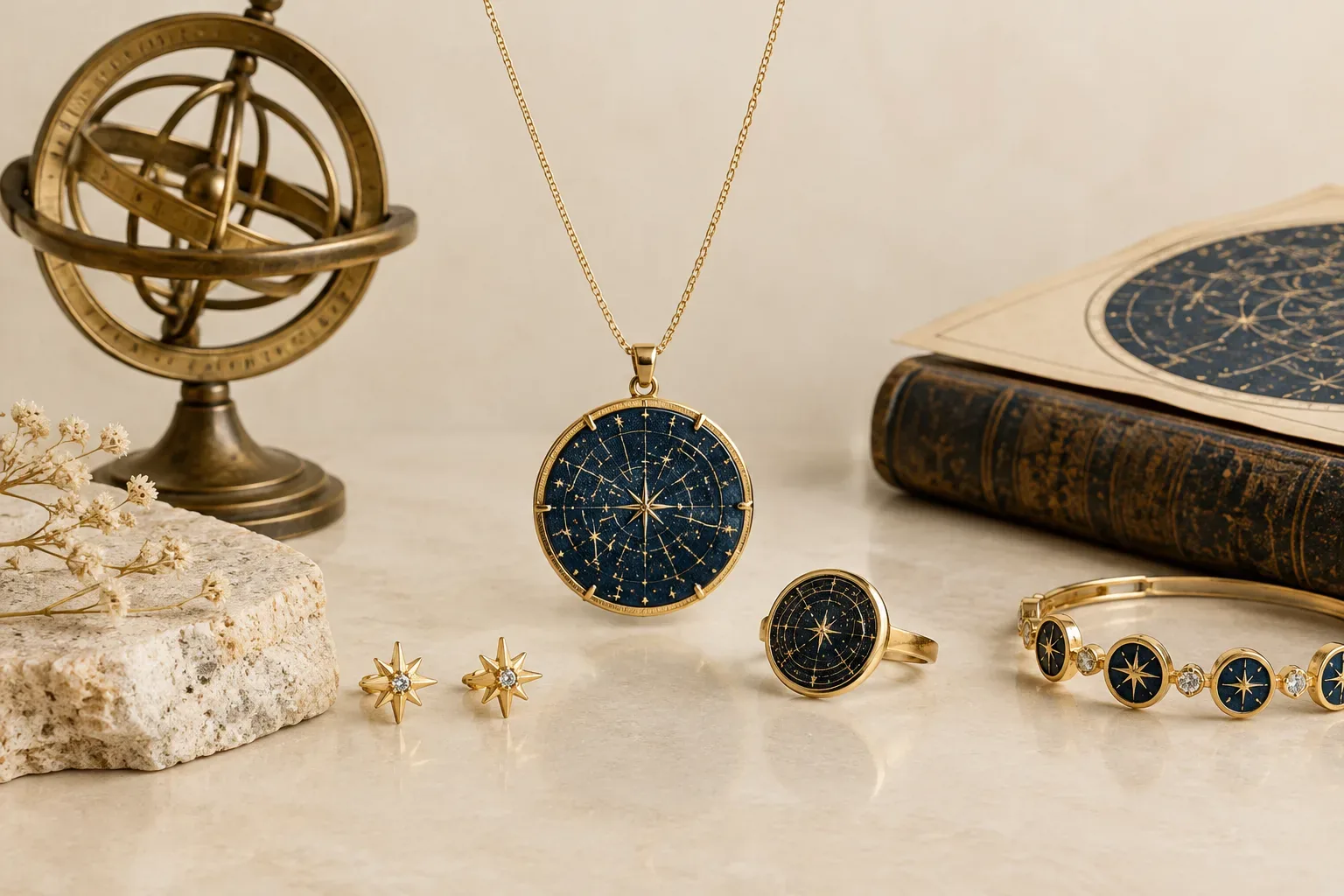
The star chart motif appears in many forms: simple starburst motifs stamped or set with a central stone, clusters of small stones representing constellations, engraved celestial maps on lockets or pendants, and contemporary printed or laser-etched star maps on discs or bars. Historically, jewelers used metalwork, enamelling, and gem-setting techniques to suggest points of light and map-like arrangements; museums such as the V&A document examples across media and centuries.
Gemstones commonly associated with celestial motifs include diamonds, rock crystal, moonstone, and sapphires because of their brilliance, clarity, or colour. The V&A’s A–Z of Gemstones explains long-standing associations between certain materials and visual effects: clear or highly refracting gems were used to suggest starlight while blue stones could allude to the night sky. In later designs, pearls and iridescent stones such as opal or moonstone were chosen for their lunar connotations.
Contemporary makers add new techniques: printed star maps that recreate the sky at a specific date, laser engraving to reproduce constellation patterns inside gemstone-like glass or crystal, and mixed-media pieces combining metal, stones, and photographic or digital elements. These modern processes create personalisable objects that intentionally link a specific moment in time to an ornament.
Documented craftsmanship and material information you should know
Museum documentation shows historical techniques and materials; for modern pieces, institutional guidance on gemstones helps with identification and provenance. The Victoria and Albert Museum’s A–Z of Gemstones is a reliable starting point for understanding which materials historically carried certain visual or symbolic associations. For issues such as treatments, synthetic stones, and imitations, government guidance is essential: the Federal Trade Commission advises sellers to disclose treatments, enhancements, and whether a stone is synthetic or simulated. When assessing star chart jewelry, look for clear information about materials, treatments and the production method used to create the star motif.
As the FTC notes, disclosure practices affect value and meaning for buyers. For example, a nineteenth-century brooch set with natural diamonds is materially different from a contemporary piece that uses treated or synthetic stones to achieve a similar 'starry' effect. Both can be meaningful, but transparency about the materials helps buyers make informed choices.
Choosing or gifting star chart jewelry: practical and respectful guidance
Decide what kind of meaning you want the piece to carry. If you want historical resonance, look for documented antique pieces or contemporary designs that deliberately reference a specific historical style; search museum catalogues or reputable dealers and seek provenance information. If you want a personal or commemorative object, choose a design that permits personalisation, for example an engraved star map or a pendant set with stones chosen for colour or birth month.
Check material disclosures and ask about treatments and origin. Use the FTC’s guidance as a baseline: reputable sellers should tell you if gems are dyed, heated, irradiated, laboratory-grown, or simulated. This is especially important if you value natural materials or if the piece is intended as a significant financial gift.
Respect cultural and religious meanings. If a design explicitly references sacred symbols from a living tradition, learn how that symbol is used within the community before adopting it as fashion. Where the star motif has multiple historical uses, consider whether a historically informed interpretation matters to the recipient. If unsure, a neutral explanation such as 'inspired by historic celestial motifs' is better than asserting a definitive ancient meaning.
Practical considerations of wear and care matter. Stones that catch light well will show fingerprints and require occasional cleaning; delicate engraving or inlay can be damaged by heavy wear. Ask about repair options, warranties, and recommended maintenance when you buy.
How to research a star chart piece you already own
Start with any maker’s marks, hallmarks or inscriptions. Museums like the V&A emphasise the importance of provenance and documented context in understanding jewellery. If your piece has hallmarks, they can indicate metal content and where and when the work was assayed. Photographs and detailed notes about where and how the piece was acquired also help professionals offer informed opinions.
Consult specialists for valuation or conservation needs. If you suspect your piece is antique or especially valuable, a qualified jewellery historian, independent appraiser, or conservation professional can provide a clearer picture. For questions about materials and treatments, request a certificate from a reputable gem-testing laboratory or ask the seller for their documentation.
Conclusion
The star chart motif in jewellery has a layered history: visible in various cultures and periods as a decorative, scientific, devotional or fashionable design element, and reinterpreted in modern times as personalised commemoration or astrological symbolism. The Victoria and Albert Museum’s work on jewellery history and gemstones helps us place those motifs in context, while the Federal Trade Commission’s guidance directs buyers to seek clear material disclosures. Approaching star chart jewelry with attention to documented context, material transparency, and respect for living cultural meanings will help you make informed and meaningful choices whether you are buying, gifting, or wearing such pieces.
Frequently asked questions
Does star chart jewelry historically represent astrology?
Not universally. Historical uses of star and celestial imagery vary by time and place. Museums such as the Victoria and Albert Museum show that celestial motifs were used decoratively, in devotional contexts, and as symbols tied to specific fashions or scientific interests. Modern astrological readings applied to star-chart jewellery are contemporary interpretations rather than a single continuous historical meaning.
Can a modern personalised star map be treated as a historically accurate object?
A personalised star map can accurately reproduce the appearance of the night sky at a given time using astronomical data, but that is different from being a historical artifact. Such items are modern creations that use contemporary techniques for personal commemoration; they do not inherit historical provenance or the original cultural contexts documented by museums.
What gemstones should I look for if I want a 'starry' effect?
Stones that reflect or refract light strongly—traditionally diamonds and rock crystal—or stones with optical effects such as moonstone or opal are commonly used to suggest starlight. The Victoria and Albert Museum’s A–Z of Gemstones explains why different materials have been associated with celestial imagery. Ask sellers about material origin and any treatments to understand the piece fully.
How do I know if a stone is treated or synthetic?
Reputable sellers should disclose treatments and whether a gem is laboratory-grown or simulated, as advised by the Federal Trade Commission. Request written disclosure or certification, and consider an independent laboratory report for higher-value purchases.
Is it culturally insensitive to wear celestial symbols from another tradition?
It can be sensitive depending on the symbol and its current cultural or religious role. If a design explicitly references a sacred symbol used by a living community, learn about its meaning and use before wearing it. When in doubt, choose pieces described as 'inspired by' historic or cultural motifs rather than asserting a specific sacred meaning.
How should I care for star-chart jewellery with engraving or small settings?
Delicate engraving and small stone settings require gentle care. Clean according to the materials—in general, avoid harsh chemicals and use a soft cloth or brush for light cleaning. Ask the seller or a professional jeweller about recommended maintenance and check whether the piece has a warranty or repair options.
Sources and further reading
- Bedazzled: A History of Jewellery — Victoria and Albert Museum
- An A-Z of Gemstones — Victoria and Albert Museum
- Buying Gemstones, Diamonds, and Pearls — Federal Trade Commission