Meaning at a glance
Documented museum collections and curatorial research show that celestial map motifs in jewelry have appeared at different times to express cosmology, status, scientific interest, or devotional ideas; modern meanings are more personal and varied. This article separates what is evidenced in the historical record from later interpretations and offers guidance for choosing and gifting celestial map jewelry today.
Quick answer
Celestial map jewelry meaning is best understood as historically contingent rather than universal: museum collections and curatorial research demonstrate that makers and wearers have used stars, maps, and astronomical diagrams in jewelry for a range of documented reasons — to signal learning or status, to reference cosmology or devotional ideas, or to adopt fashionable motifs tied to scientific interest — while many contemporary meanings are personal, aesthetic, or inspired by popular astrology rather than by a single long-standing symbolic system.
What the historical evidence shows (and where it comes from)
The strongest published evidence for the historical roles of celestial imagery in jewellery comes from museum collections and interpretive exhibitions. Institutions that curate long-term jewellery holdings trace changes in taste, technology, and social context across centuries. The Victoria and Albert Museum, for example, documents how jewellery styles and motifs shift with changing social meanings and cultural priorities and how gemstones themselves carry different values in different eras.
From surviving objects and catalogue notes, curators observe that celestial imagery — stars, suns, moons, armillary spheres and stylized diagrams — appears at multiple moments in the history of jewellery. In some periods, such imagery signalled an interest in cosmology, natural philosophy, or navigation as fashionable signifiers of learning and status. In other contexts, celestial motifs could be folded into devotional programmes, mourning jewellery, or courtly ornament, with meanings framed by local religious and social practices. The V&A’s exhibitions and articles present these changes as part of a wider history of jewellery, where form and motif respond to social, technological, and aesthetic conditions rather than representing a single, unchanging symbolism.
Separating documented historical meanings from modern interpretations
Documented historical meanings are those that curators and historians attribute to objects based on provenance, contemporaneous writings, inventories, and patterns across collections. For example, when a jewelled diagram of the heavens appears in a Renaissance court collection along with books and instruments, curators reasonably interpret that object as reflecting learned interests and social display. When a star motif appears in a memento mori or devotional object, museum records place it within the religious and funerary practices of the period. These kinds of contextual readings are part of the museum methodology summarized in V&A materials that chart jewellery’s changing social roles.
By contrast, many modern claims about celestial map jewellery — such as fixed spiritual powers, universal astrological prescriptions, or ancient occult lineages — are contemporary interpretations unless specifically tied to historical evidence. Today’s consumers often read celestial maps as talismans for guidance, protection, destiny, or romantic connection; these are personal or community meanings layered onto the motif. That layering is valid as individual or cultural practice, but it should be kept separate from claims about historical universality. The V&A’s approach underscores this distinction by showing how contexts change meanings over time.
How the celestial map motif and related gemstones appear in jewellery
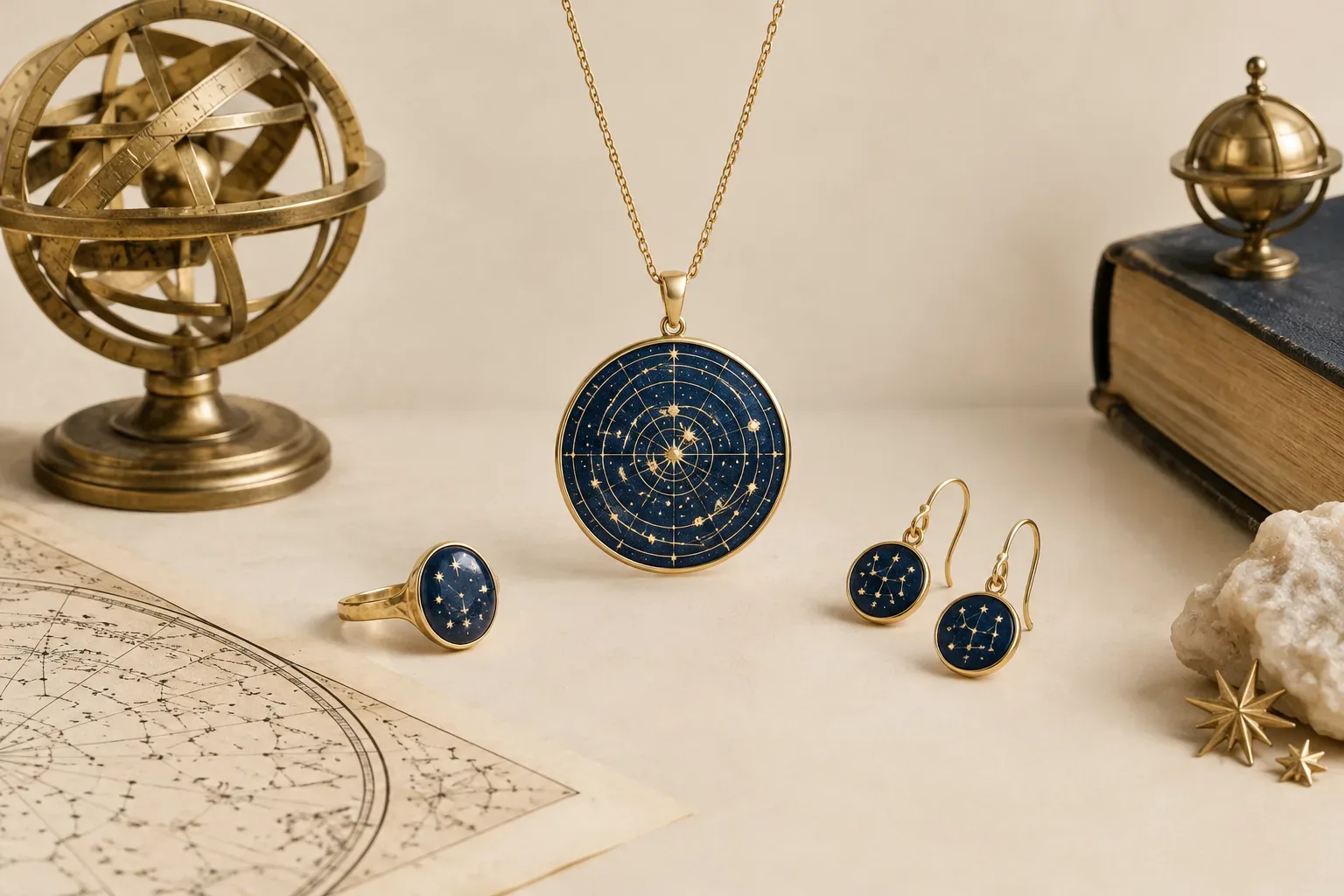
Craft techniques and materials shape how celestial maps and star motifs are translated into jewelry. Makers have used engraving, enamelling, miniature painting, intaglio and relief work to depict maps or symbolic constellations on metal surfaces and miniature panels. Jewelry designers have also suggested celestial forms through jewel arrangement, using diamonds or contrasting stones as stars set into a dark field, or by inlaying mother-of-pearl, lapis-lazuli-like materials, or dark enamels to evoke the night sky.
Gemstones historically associated with sky and star imagery are treated differently in different periods and markets. Museum resources that catalogue gemstones emphasize that individual stones acquire meaning through use and fashion as much as through supposed inherent properties. In jewellery design, optical phenomena in stones are sometimes used for celestial effect: stones with asterism (a star-like reflection) or iridescence may be selected because their appearance evokes star fields or celestial glows. The Victoria and Albert Museum’s guides to gemstones provide context on how stones have been identified and used across periods, showing that choice of gem is as much about availability, technique, and taste as about symbolism.
Practical guidance for selecting or gifting celestial map jewellery
Start with questions about the recipient and the intended meaning. Consider whether you want to reference historical associations such as learning, travel, or commemoration, or whether the gift should express a contemporary personal meaning like guidance, wonder, or aesthetic preference. If you aim to reference a historical form (for example, a locket or a map-engraved pendant), look for reputable descriptions or museum examples and consider linking your gift to that historical reference; the V&A’s catalogues and related histories can be useful starting points for research.
Respect cultural and religious contexts. If a motif derives from a specific cultural or religious practice, learn about that background and avoid using sacred symbols as mere decoration. When in doubt, choose designs that explicitly present themselves as modern reinterpretations rather than unverifiable reproductions of sacred objects. The process of researching a motif is discussed in depth in our practical guide to researching jewelry symbols and in our gift-selection article, both of which can help you decide whether a design is culturally appropriate.
Ask retailers about materials, treatments, and origin. The Federal Trade Commission advises consumers to seek clear disclosure from sellers about gemstone treatments, imitations, and metal content. If the piece’s meaning relies on a particular stone or technique — for example, an asteriated star sapphire or historically treated enamel — verify whether the stone is natural, treated, or synthetic and whether the seller discloses enhancements. Accurate disclosure helps you assess durability, care needs, and long-term value.
Choose an appropriate form and finish for the recipient’s lifestyle. A delicate, museum-style miniature may be beautiful but impractical for everyday wear. Consider alternatives such as a robust pendant that echoes a celestial map in relief or a ring set with a dark stone and scattered small diamonds to suggest stars. When commissioning a custom piece, provide the maker with reference images and an explanation of the intended meaning so the final object respects both aesthetic and symbolic aims.
Think about provenance and conservation. For antique celestial pieces, provenance affects both meaning and ethical considerations. If purchasing a vintage or historic object, ask for documentation of origin and any restoration history. Museums such as the V&A emphasize the importance of context in understanding historical objects; owning an object without context risks misinterpreting its original purpose.
Wearing and caring for celestial map jewellery
Care requirements depend on materials and techniques. Enamel, miniature painting, and certain surface finishes require gentle handling and professional maintenance. Gemstone care varies by type; consult authoritative gemstone guidance when cleaning or storing pieces. If a piece contains a historically rare or delicate inlay, consider professional conservation advice rather than home repair.
When displaying the motif publicly, be mindful of how you explain its meaning. If the piece references a specific culture’s astronomical practices or an element of religious devotion, allow room for that provenance in conversation rather than adopting a simplified or sensationalized narrative.
Final thoughts
Celestial map motifs in jewellery carry layered meanings that change with time and context. Museum documentation and gemological guides show that these motifs have been used for many different ends — intellectual display, devotional imagery, fashionable reference to scientific discovery, and aesthetic ornament. Contemporary wearers often add personal or community meanings that are valid today but should be distinguished from documented historical uses. By researching provenance, asking sellers for clear gemstone and treatment disclosures, and choosing designs that respect cultural origins, you can select or gift celestial map jewellery in an informed and considerate way.
Frequently asked questions
What exactly is ‘celestial map’ jewellery?
Celestial map jewellery refers to pieces that incorporate star charts, constellations, suns, moons, or schematic representations of the heavens in their design. Historically, such motifs could be literal depictions of astronomical diagrams or stylized star imagery. Today the term also covers modern reinterpretations that use the night-sky aesthetic for personal or decorative reasons.
Does celestial map jewellery always have astrological meaning?
No. While some wearers today connect celestial motifs to astrology, the historical record shows a variety of documented uses — including indicators of learning, fashionable references to science or navigation, devotional meaning, or purely decorative taste. Associations with astrology are often modern or personal interpretations unless explicitly documented for a specific historical object.
How can I verify if a gemstone used in a celestial piece is authentic or treated?
Ask the seller for full disclosure about the stone’s origin and any treatments. The Federal Trade Commission recommends that consumers request written information about gemstone treatments, whether a stone is synthetic or natural, and the metal content. Reputable dealers should provide this information or refer you to an independent gemological report.
Is it cultural appropriation to wear celestial motifs from another tradition?
Celestial imagery appears in many cultures, often with specific symbolic or religious meanings. It is respectful to learn the provenance of a motif and to avoid presenting sacred or culturally specific symbols as mere fashion items. If a motif is tied to a living religious practice, consider whether adopting it for decoration could be insensitive, and when appropriate choose a design that acknowledges its origin or selects a neutral modern reinterpretation.
How should I care for an enamelled or painted celestial pendant?
Delicate techniques such as enamelling and miniature painting need gentle handling, limited exposure to moisture and heat, and professional cleaning or conservation when necessary. For general care, store such pieces separately to avoid abrasion and consult a jewellery conservator for repair rather than attempting aggressive cleaning at home.
Sources and further reading
- Bedazzled: A History of Jewellery — Victoria and Albert Museum
- An A-Z of Gemstones — Victoria and Albert Museum
- Buying Gemstones, Diamonds, and Pearls — Federal Trade Commission