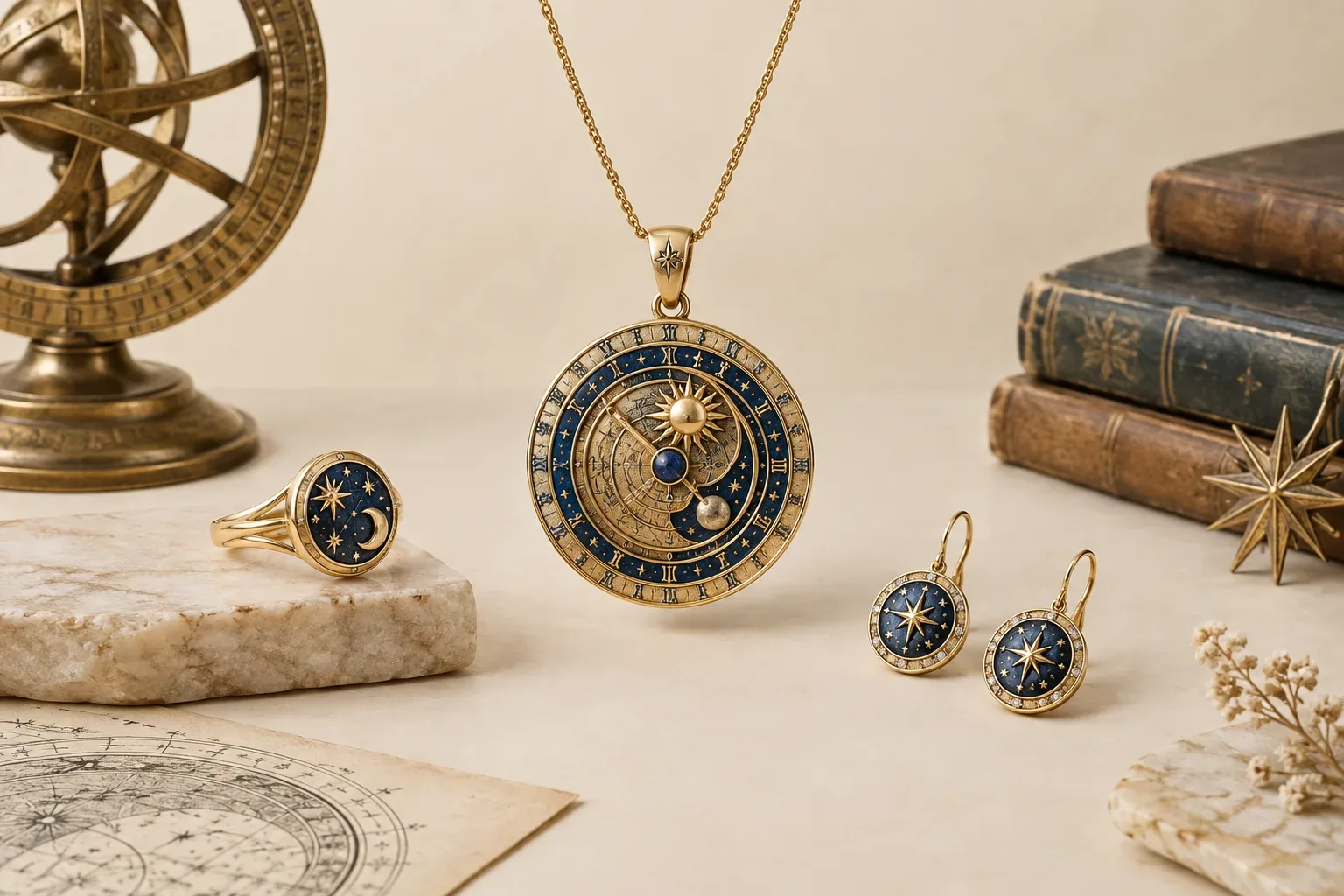
Meaning at a glance
Astronomical clock jewelry meaning arises from a documented history of jewellery borrowing scientific and celestial imagery in changing social contexts; clear historical evidence is limited to broader trends recorded by museum collections and gem catalogues, while many specific symbolic readings are modern and personal. Practical selection should consider materials, disclosure, and respectful cultural context.
What the historical evidence actually shows
The strongest, documented evidence for the use and meaning of astronomical or scientific motifs in jewellery comes from museum catalogues and collections that record changing social contexts for ornament. The Victoria and Albert Museum (V&A) frames jewellery history as a record of shifting tastes, technologies, and ideas, noting that makers have long taken inspiration from the sciences and the natural world as part of broader cultural fashions. The V&A does not present a single, universal meaning for any motif but shows how motifs acquire different connotations in different eras as styles, technologies, and audiences change.
From the Renaissance on, European collectors and makers showed increased interest in instruments of astronomy and navigation, and that interest influenced decorative arts. Later, the Industrial Revolution and the scientific improvements of the eighteenth and nineteenth centuries brought instruments and mechanical forms into public view; museum interpretation records these broader trends rather than assigning a single symbolic meaning to each item. The V&A’s account of jewellery history emphasizes this changing social context—how motifs of science and celestial imagery appear, disappear, and are reframed according to taste, technology, and patronage.
Gemstone use and conventional associations are also documented in museum resources. The V&A’s A–Z of Gemstones summarizes how particular stones have been used and valued, and how their color, rarity, and trade history shaped their presence in jewellery. These gemstone histories help explain why certain stones—those evoking the sky, night, or light, for example—are commonly paired with astronomical motifs, but again they do not prove a single, universal symbolic meaning.
Separating documented historical meanings from modern personal interpretations
Documented historical meanings are best understood as contextual: museums and collections record that celestial and scientific imagery was sometimes used to signal learning, modernity, navigation, or fashionable interest in the sciences, but these are contextual readings rather than fixed meanings. For example, when a late nineteenth-century brooch features an astrolabe-like dial or a watch movement, museum interpretation records that it reflects contemporary fascination with instruments and precision. Those records do not imply a single spiritual or emotional content across all objects bearing similar motifs.
Modern popular interpretations—such as reading an astronomical clock motif as meaning destiny, cosmic order, or personal fate—are generally contemporary layers added by wearers, designers, and retailers. These symbolic readings are valid as personal or marketing choices but should be distinguished from the historical record. The V&A supports this distinction by treating jewellery as an object of changing social meaning rather than as a repository of immutable symbolism.
Across cultures, meanings will also differ. The V&A’s broad approach to jewellery history warns against assuming that a motif recorded in one culture or period carried the same meaning in another. When considering a piece with astronomical imagery, treat historical statements as contextual descriptions (who made it, when, and why) and modern symbolic claims as personal or contemporary.
How the astronomical clock motif appears in jewellery (motifs and materials)
Designers and makers use a range of visual elements to invoke astronomical clocks: dial faces, zodiac rings, sun and moon imagery, star motifs, miniature gearwork or exposed movement parts, and astrolabe or armillary-style rings. These elements may be literal miniature dials or stylized references that suggest celestial mechanics rather than functioning timekeepers.
Gemstones and metals are chosen to support the motif’s visual and symbolic associations. Stones with deep blue tones such as sapphire or lapis-like materials are commonly used to evoke the night sky; high-contrast materials like white enamel, mother-of-pearl, or diamonds are used to suggest stars or the glow of the moon. The V&A’s guidance on gemstones explains historical preferences and practical properties of stones, which helps explain why certain gems are repeatedly paired with celestial designs. Metalwork—gold for warmth and permanence, silver for cool luminosity, and visible movement parts in mixed metals—also plays a role in conveying the motif.
Techniques range from straightforward enamel and stone setting to mechanically inspired construction. Some modern pieces incorporate actual watch movements or repurposed watch parts as decorative elements; historically, watch cases and fob watches sometimes became the basis for pendants and brooches, reflecting the close relation between timekeeping instruments and personal ornament documented in jewellery histories.
Practical and respectful guidance for choosing or gifting astronomical clock jewellery
Consider first what you mean to communicate. If you wish to reference historical associations—such as appreciation of science, craftsmanship, or navigation—frame the gift in that context rather than assuming a metaphysical message. If you prefer a personal or romantic meaning—such as measuring time together—make that explicit so the recipient understands your intent.
Material authenticity and disclosure matter. The U.S. Federal Trade Commission (FTC) provides consumer guidance on gemstones, diamonds, and pearls and requires disclosure of treatments and imitations. When buying stone-set astronomical pieces, check the seller’s statements about whether gemstones are natural, treated, or synthetic, and ask for documentation or certification for high-value stones. This protects both buyer and recipient and preserves the piece’s integrity as a meaningful object.
Respect cultural and personal beliefs. Because astronomical and timekeeping imagery can intersect with religious or cultural symbolism in some communities, avoid assuming a motif is neutral. If giving to someone from a different cultural background, ask discreetly or choose wording in a gift note that explains your intended meaning and invites conversation.
Match scale and wearability to the recipient’s lifestyle. Intricate pieces with exposed movement parts or large pendants suit collectors and wearers who enjoy statement jewellery, while subtle dials, small star studs, or signet-style pieces suit everyday wear. Consider maintenance: delicate enamel, tiny gears, or vintage watch movements may need specialist care.
If authenticity of age or provenance matters, buy from reputable dealers, request condition reports, and if possible consult museum resources or a trusted appraiser. For contemporary pieces, ask the maker about materials and production techniques to ensure the piece aligns with your values—whether that means sustainably sourced stones, handcrafted metalwork, or a clear materials disclosure as recommended by consumer guidance.
Frequently asked questions
What does astronomical clock jewelry mean?
There is no single historical meaning; museums show that such motifs have reflected changing interests in science, timekeeping, and the celestial world, while many personal or spiritual meanings are modern interpretations.
Is astronomical clock jewellery religious?
Not inherently. While celestial imagery can have religious significance in some cultures, the motif is often secular in jewellery history, used to signify learning, modernity, or aesthetic interest; check cultural context before assuming sacred meaning.
Which gemstones are traditionally used with celestial motifs?
Museum gemstone guides note that blue stones (such as sapphire or lapis-like materials), white or iridescent materials (mother-of-pearl, moonstone), and bright stones (diamonds) are commonly paired with celestial designs because of their visual associations with sky, moon, and stars.
How can I be sure a gemstone in an astronomical piece is authentic?
Follow consumer guidance: buy from reputable sellers, request written disclosure of treatments or synthetics, and ask for certification for high-value stones; the Federal Trade Commission recommends clear disclosure of treatments and imitations.
Is it appropriate to give astronomical clock jewellery as a romantic gift?
Yes, if you communicate your intended meaning. Many modern givers use time and celestial motifs to symbolize shared time or wonder, but clarity avoids misunderstandings since historical meanings are varied.
How should I care for delicate astronomical jewellery that includes watch parts or enamel?
Delicate constructions and vintage movements often need specialist care; ask the seller about maintenance, store pieces safely, and consult a qualified conservator or jeweller for cleaning and repairs.
Sources and further reading
- Bedazzled: A History of Jewellery — Victoria and Albert Museum
- An A-Z of Gemstones — Victoria and Albert Museum
- Buying Gemstones, Diamonds, and Pearls — Federal Trade Commission