Meaning at a glance
This spinel authenticity guide defines natural, lab-created, treated, and imitation spinel; explains practical tests and their limits; gives care and gifting advice; and directs shoppers to seek qualified gemological testing for definitive answers.
Direct answer — what this guide delivers
This spinel authenticity guide gives short definitions for natural, lab-created, treated, and imitation spinel, practical decision criteria you can use when shopping, the trade-offs between price and certainty, safe care tips, and an explicit statement of what only a qualified jeweler or gemological laboratory can reliably verify. Use home checks for red flags and documentation and reserve conclusions about origin or subtle treatments to a laboratory.
Definitions: natural, lab-created, treated, and imitation
Natural spinel means a crystalline mineral formed in the earth. Lab-created spinel is a synthetic material produced by human manufacturing processes to match the chemistry and crystal structure of natural spinel. Treated spinel refers to natural stones altered by processes such as heating or other modifications intended to improve color or clarity. Imitation spinel is a non-spinel material made to look like spinel, typically glass, resin, or a different gemstone that has been cut or colored to resemble spinel.
These categories are important for value and care. The Federal Trade Commission stresses clear seller disclosure among natural, lab-created, treated, and imitation materials, so written and verbal disclosures are consumers’ primary protection when buying gemstones.
Historical evidence and cultural context
Gemological and museum records show that spinel has been part of jewelry collections and royal regalia for centuries, although it was often recorded under other names before gemology could reliably separate species. The precise historic names and uses vary by region and period, but authoritative gemological literature documents examples in European and Asian collections.
Modern gemological institutions catalogue these historical occurrences and correct earlier misidentifications; these corrections are part of the documented history discussed in professional gemological sources. The careful separation of what museum records show from later interpretations is why a scientific approach matters when discussing authenticity.
Documented historical meanings versus modern personal interpretations
Documented historical meanings are the associations recorded by historical sources and preserved in museum and gemological literature. For example, older inventories and crown-collection descriptions sometimes list spinel alongside or under the name of other red gems; those listings are documentary evidence of use and value, and that is the kind of historical meaning that researchers treat as factual.
Modern personal interpretations—what wearers, influencers, or gift recipients feel a spinel 'means' today—are distinct. Contemporary meanings vary widely by culture, personal belief, and fashion context. Unlike documented historical intentions, these modern interpretations are subjective and should be treated as personal symbolism rather than objective fact.
How spinel appears in jewelry (styles, settings, and market trends)
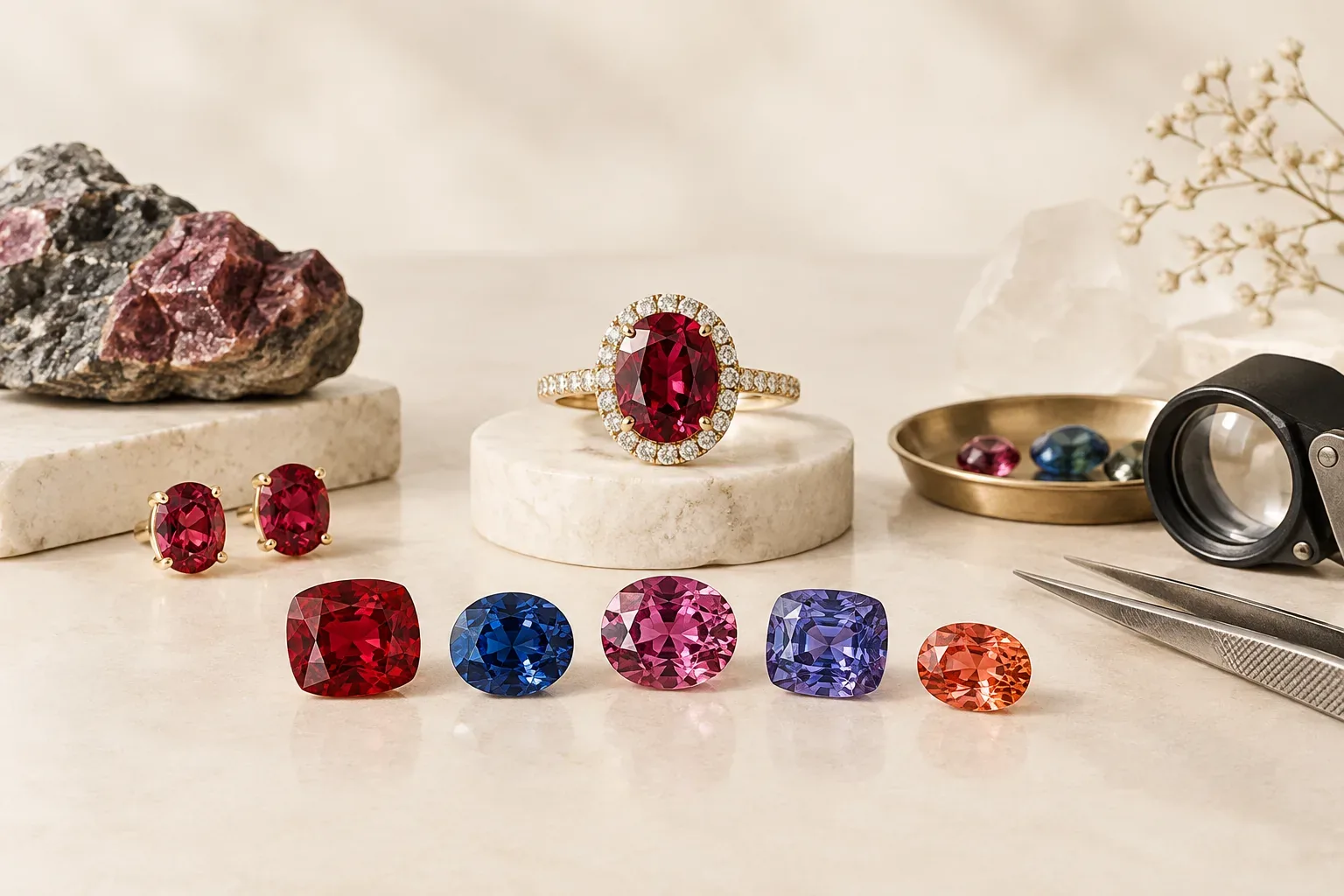
Spinel appears in a wide range of jewelry: solitaire rings, cluster settings, studs, pendants, and multi-stone designs. Gemstone rings and necklaces featuring colored stones are in strong consumer demand, and industry trend reports indicate continued interest in gemstone rings and sculptural designs that showcase colored gems, which often include spinel among other choices.
Retail and editorial trends also show that designers place spinel in both classic settings—prong-set solitaires or halo rings—and in more contemporary sculptural or clustered arrangements. Sellers often market spinel by color family (red, pink, blue, violet) and by narrative—birthstone-style promotion or ethical sourcing stories—so color and context are common selling points.
Practical authenticity checks a shopper can do without a lab
Start with documentation: ask the seller for written disclosure of whether the stone is natural, lab-created, treated, or an imitation. The Federal Trade Commission requires clear distinctions and written disclosure practices, and a reputable seller will provide straightforward answers and, when available, certificates from recognized labs.
Examine the piece visually under a 10x loupe or magnifier. Look for bubbles or flow lines that indicate glass or other simulants, and note inclusion types. Natural spinel typically presents different inclusion patterns than glass or many common imitations. Check how the stone responds to strong light; unnatural fluorescence or odd surface features can be warning signs.
Assess price and provenance. If a stone of exceptional color and size is offered at a very low price, ask questions about origin and testing. Price alone is not proof, but extreme bargains should prompt further verification.
What requires a jeweler or gemological laboratory
Certain determinations cannot reliably be made at home. Identifying whether a stone is lab-grown or natural, determining specific treatments (for example, whether heating has altered color), or establishing geographic origin normally requires instruments such as refractometers, spectrometers, and sophisticated inclusion analysis—which are available only to qualified jewelers or gemological laboratories.
The Gemological Institute of America emphasizes that detectability, disclosure, and the limits of consumer testing are central to the trade in gemstones. If the seller’s documentation is incomplete or if you need a definitive answer for insurance, resale, or emotional peace of mind, obtain a report from a recognized gemological laboratory.
Trade-offs when choosing natural versus lab-created or treated spinel
Natural spinel typically carries a price premium for comparable size and color when compared to lab-created equivalents, but lab-created spinel offers consistent color and value for buyers prioritizing budget and ethical sourcing narratives. Treated natural stones can provide a middle ground: improved aesthetics at a lower price than untreated natural material, but with reduced resale value compared to completely natural, untreated stones.
Decide what matters most for you: budget, ethical traceability, rarity, resale value, or aesthetics. Sellers and retailers often position lab-created stones as affordable options and natural untreated stones as investment or heirloom pieces; current market reporting shows a healthy consumer interest in both segments.
Selection and gifting guidance (practical and respectful)
When selecting spinel as a gift, start with the recipient’s style and lifestyle. For everyday wear, choose durable settings and a color the recipient already wears. When the choice is symbolic, ask whether the recipient prefers natural, lab-created, or budget-friendly options; many people care about sustainability and traceability, while others prioritize the beauty of the stone alone.
Request and keep written disclosures and any lab reports when you buy. If the piece is a surprise, secure documentation from the seller and keep it with the gift. For engagement or heirloom-quality gifts, consider a laboratory report to support future insurance and resale needs.
Care and maintenance
Gemological guidance underscores that different treatments and materials require different care. Clean spinel with warm soapy water and a soft brush for routine cleaning and avoid harsh chemicals or steam cleaners unless you have written confirmation that a specific stone and its treatment are compatible with such methods.
Store spinel separately from softer gems to avoid scratches and have high-value pieces inspected periodically by a qualified jeweler. The Gemological Institute of America recommends following care guidance tailored to the stone’s treatment status and mounting.
When to get a professional report and how to choose a lab
Obtain a professional gemological report when you need a definitive determination of whether a stone is natural, lab-grown, or treated, when you are insuring or appraising a high-value purchase, or when buy-sell confidence hinges on independent verification. Seek a lab with recognized credentials and ask what tests the report covers.
A reputable report should describe the stone’s identity, whether treatments are present, and any notable characteristics. If a seller resists providing documentation or a laboratory report for a high-value item, treat that resistance as a red flag.
Summary: practical next steps for buyers
Use this spinel authenticity guide to form clear questions before you buy: is the spinel natural, lab-created, treated, or an imitation; can the seller provide written disclosure or a lab report; and what trade-offs are you willing to accept between price and certainty. Do home checks for obvious red flags, rely on seller documentation for purchase decisions, and obtain laboratory testing for definitive answers.
Frequently asked questions
How can I tell if a spinel is natural without a lab report?
You can perform basic checks: request written disclosure from the seller, inspect the stone with a 10x loupe for telltale inclusions or signs of glass such as bubbles, compare price to market expectations, and ask for any available certificates. These steps help identify red flags but cannot conclusively prove natural origin or detect subtle treatments; a laboratory report is required for definitive identification.
Are lab-created spinels a good alternative to natural spinel?
Lab-created spinels offer predictable color and often a lower price for similar-looking material, making them a practical alternative when budget and consistency are priorities. Decide based on the recipient’s preferences and whether you want natural rarity or engineered affordability. Be sure the seller discloses the stone is lab-created.
What tests do gemological labs use to authenticate spinel?
Recognized gemological labs use a combination of optical and instrumental tests—such as refractive index measurement, spectroscopy, inclusion analysis under high magnification, and other specialized methods—to determine if a spinel is natural, lab-grown, or treated. A lab report will state the tests performed and the conclusions reached.
How should I care for a spinel ring?
For routine care, clean spinel with warm soapy water and a soft brush, rinse, and dry with a soft cloth. Avoid harsh chemicals and get professional advice if the stone has an unusual treatment before using steam or ultrasonic cleaners. Store spinel separately from softer gems to prevent scratches and have high-value pieces inspected by a jeweler periodically.
What documentation should I ask for when buying spinel?
Ask for written disclosure of whether the stone is natural, lab-created, treated, or an imitation, any available laboratory report, and receipts that detail the seller’s claims. The Federal Trade Commission recommends clear distinctions and disclosure; a reputable seller will provide this information without hesitation.
Sources and further reading
- Imaginaire Digital — Imaginaire Digital
- Professional Jeweller / PRYA Jewellery Search Insights — Professional Jeweller / PRYA Jewellery Search Insights
- Gemological Institute of America — Gemological Institute of America
- Federal Trade Commission — Federal Trade Commission