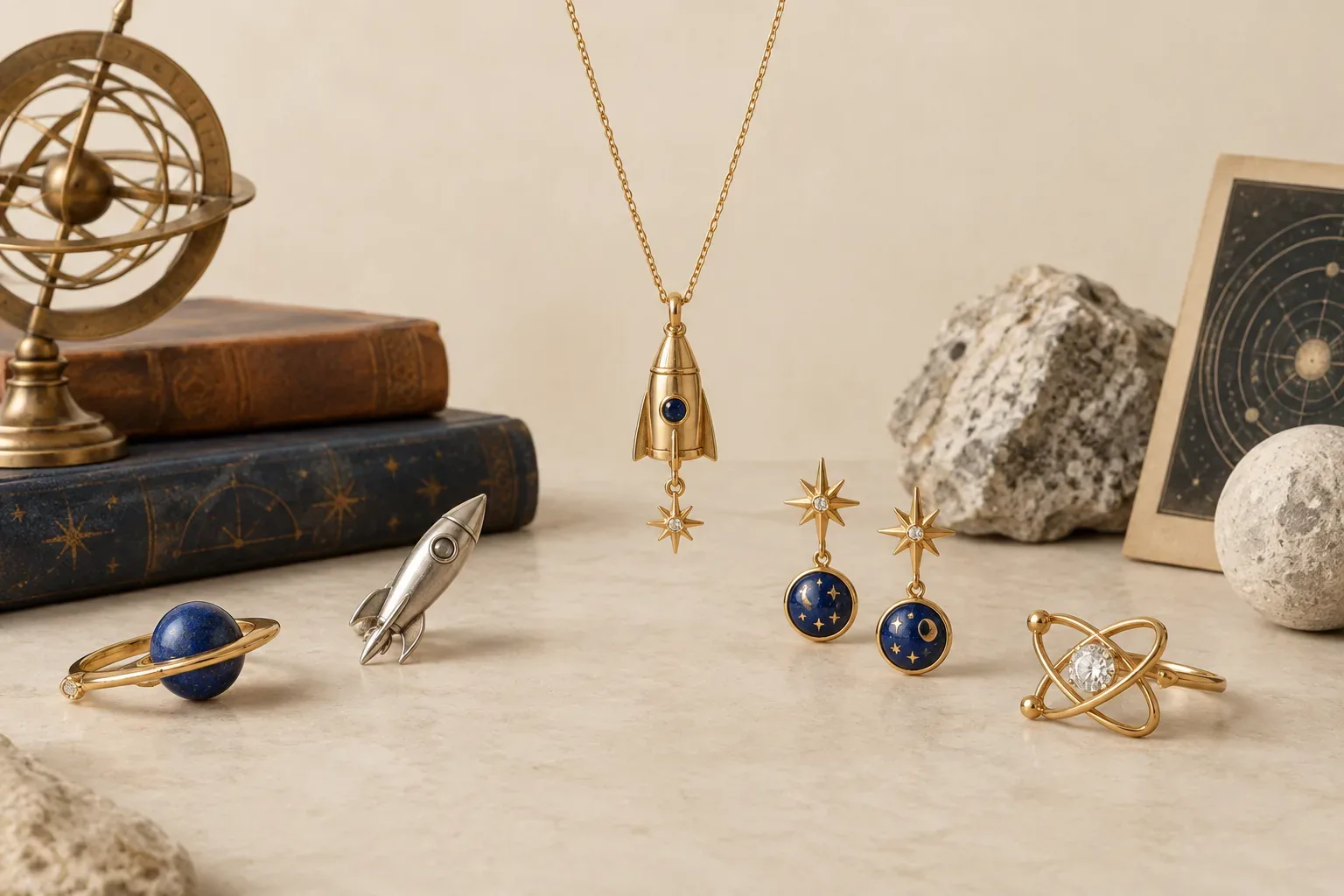
Meaning at a glance
Spacecraft jewelry meaning is best understood as a modern motif that arose with science fiction and the Space Age; scholarly museum histories show that jewelry motifs follow contemporary technology and cultural interests, while modern wearers imbue spacecraft designs with personal symbolism such as exploration, innovation, or memory. Practical selection focuses on the recipient's interests, material and gemstone disclosure, and respectful context.
Quick answer
Spacecraft jewelry meaning is not an ancient or religious symbol documented across historical cultures; it is a modern motif that emerged alongside public interest in space exploration and science fiction. Museum histories emphasize that jewelry often reflects contemporary technologies and social interests, and modern interpretations of spacecraft imagery—exploration, futurism, ambition, memory—are personal or cultural rather than rooted in long-standing ritual meaning (Victoria and Albert Museum).
Historical evidence and cultural contexts
There is no documented tradition of spacecraft imagery in premodern jewelry because the objects and ideas named 'spacecraft' are products of the modern era. Histories of jewelry collected and interpreted by museums show that motifs evolve as societies adopt new technologies and narratives; examples in those histories include how aviation, industrial forms, and later consumer technologies became visible in ornament as they entered public life (Victoria and Albert Museum).
When considering historical evidence, it is important to separate two kinds of claims. Curatorial and museum histories document which motifs appear at particular times and why, linking design to technology, fashion, and social change. These documented links are different from retrospective or symbolic readings assigned by later audiences, which may be meaningful but are not the same as historically established religious or communal symbolism.
Documented meanings versus modern interpretations
Documented meanings in jewelry are those recorded by contemporaneous sources or preserved in museum interpretation that link a design to a known social function, ritual use, or explicit cultural intent. For spacecraft motifs there is no premodern documented ritual or religious meaning; museums treat such motifs as part of modern stylistic trends that reflect cultural fascination with technology and exploration (Victoria and Albert Museum).
Modern interpretations are diverse and personal. Wearers and designers today may give spacecraft pieces meanings such as a celebration of scientific achievement, a nod to childhood interest in space, a symbol of personal ambition or exploration, or a memorial for someone who worked in aerospace. These contemporary layers of meaning are valid for the individual or community that chooses them, but they should not be presented as universal historical facts.
How the spacecraft motif, gemstones, and tradition appear in jewelry
Designers and makers apply the spacecraft motif across standard jewelry forms: pendants and charms that mimic rockets or satellites, brooches and pins with stylized orbital shapes, cufflinks and rings engraved with schematic lines, and contemporary pieces using enamel, metalwork, and pavé setting to suggest stars and engines. Museum collections and exhibitions that trace jewelry history note that motifs reflect the visual language of their time and are executed using the prevailing materials and techniques (Victoria and Albert Museum).
Gemstones and materials used with spacecraft motifs vary by style and price point. Designers may use bright enamels and inexpensive simulated stones in playful or costume pieces, while higher-end pieces often employ precious metals and genuine gemstones set to represent stars, planet-like spheres, or glowing engines. The Victoria and Albert Museum's guide to gemstones explains how different stones have been used historically and what qualities—color, hardness, optical effects—make them suitable for particular settings and decorative roles (Victoria and Albert Museum).
Because spacecraft jewelry is a modern and largely popular-culture-driven tradition, makers often combine contemporary techniques such as laser engraving, enamel work, and mixed metals. The context—whether a novelty souvenir, a designer statement piece, or a commemorative pin—affects the materials and the way gemstones or simulated stones are used.
Practical and respectful selection or gifting guidance
Start with the recipient’s relationship to spacecraft imagery. Choose a piece that matches their aesthetic and the meaning you intend: a playful charm for a casual fan, a refined pendant or lapel pin for a professional in aerospace, or a custom piece incorporating dates or initials for a commemorative gift. Personal meaning matters more than presumed universal symbolism.
Pay attention to materials, manufacturing, and disclosure. The U.S. Federal Trade Commission advises consumers to ask about gemstone treatments, imitations, and the precise materials used in jewelry before purchase; sellers should disclose artificially treated or synthetic stones and any relevant treatments (Federal Trade Commission). If the gift is for someone who values natural stones or strict provenance, ask the seller for documentation and consider reputable dealers who follow clear disclosure practices.
Consider wearability and allergies. Select appropriate metals for contact with skin, such as sterling silver, gold, or hypoallergenic alloys, and check for nickel content if the recipient has known sensitivities. Also think about how the piece will be worn: a large brooch may be striking but impractical for daily wear, while a small pendant or ring may better suit everyday symbolism.
Respect cultural and professional contexts. If you are gifting a piece that references specific organizations, missions, or insignia, ensure you are not inadvertently appropriating official emblems or implying endorsement. For personal memorialization—such as remembering someone who worked in aerospace—be explicit with the recipient about your intent so the gesture is received as respectful rather than presumptive.
Care, authenticity, and ethical notes
Spacecraft-themed jewelry spans inexpensive mass-market items to handcrafted and fine-jewelry pieces. Care instructions depend on materials: precious metals and gemstones require different cleaning methods than plated metals and enamels. Museum resources on materials and gemstones provide basic context for how stones behave and how they have traditionally been treated in setting and conservation (Victoria and Albert Museum).
When authenticity or value matters, follow the Federal Trade Commission’s guidance: verify whether stones are natural, treated, or synthetic, and ask for written disclosures from the seller. For higher-value purchases, seek independent appraisals or buy from dealers with verifiable reputations (Federal Trade Commission).
Conclusion
Spacecraft jewelry meaning is best treated as a modern symbol whose documented history lies in fashion, design, and popular culture rather than in ancient ritual. Museum scholarship shows that jewelry motifs follow contemporary technologies and social interests, while individuals and communities today add personal symbolism tied to exploration, memory, or identity (Victoria and Albert Museum).
When you choose or give spacecraft jewelry, focus on honest material disclosure, clear intent, and the recipient’s tastes and values. That approach respects both the modern origins of the motif and the personal meanings wearers assign to it.
Frequently asked questions
Is spacecraft jewelry an ancient symbol?
No. There is no documented ancient or premodern tradition of spacecraft motifs in jewelry. Museum histories show that motifs reflect contemporary technologies and social ideas, and spacecraft imagery is a product of the modern era tied to science fiction and the Space Age (Victoria and Albert Museum).
What does a spacecraft pendant typically symbolize today?
Today a spacecraft pendant may symbolize exploration, innovation, aspiration, a childhood interest in astronomy, or a personal connection to aerospace work. These meanings are contemporary and personal rather than historically universal.
How can I be sure a gemstone in spacecraft jewelry is authentic?
Ask the seller about the gemstone’s origin and any treatments. The Federal Trade Commission recommends buyers request clear disclosure about whether a stone is natural, treated, or synthetic and to seek written documentation or an independent appraisal for higher-value purchases.
What materials are common for spacecraft-themed pieces?
Materials range from inexpensive base metals, enamel, and simulated stones in costume jewelry to precious metals and genuine gemstones in higher-end pieces. The choice of material affects durability, wearability, and symbolic weight.
Is it appropriate to gift spacecraft jewelry to someone who works in aerospace?
It can be appropriate if the gift is respectful of the recipient’s role and identity. Avoid implying endorsement of a specific organization by using official insignia without permission, and choose a style that fits the recipient’s taste and professional context.
Where should I look to learn more about the historical context of jewelry motifs?
Begin with museum resources and exhibition materials that discuss how jewelry reflects social and technological change. The Victoria and Albert Museum provides accessible histories of jewellery and information on gemstones that are useful starting points.
Sources and further reading
- Bedazzled: A History of Jewellery — Victoria and Albert Museum
- An A-Z of Gemstones — Victoria and Albert Museum
- Buying Gemstones, Diamonds, and Pearls — Federal Trade Commission