Meaning at a glance
Explain the documented history and changing contexts of the orbit motif, separate cultural or religious evidence from later popular interpretations, and give practical guidance for choosing and wearing the motif in modern jewelry.
What the historical evidence shows (and what it does not)
Museums and curators use the term ‘‘celestial motifs’’ to describe a long history of suns, moons, and stars in personal ornament. The Victoria and Albert Museum (V&A) documents examples of sun, moon and star representations in jewellery across many periods and places, and places those objects in changing social contexts rather than as a single unbroken meaning. Use of heavenly imagery appears in ancient, medieval and later European decorative traditions, and resurfaces with different emphases during revivals such as the Renaissance and the Victorian era, where astronomy and sentiment both influenced design, according to the V&A.
What the historical record does not show—based on the same museum literature—is a single and continuous ‘‘orbit’’ symbol that represents planets circling a central body in the way contemporary designers often depict with rings, arcs, or offset circles. The modern visual shorthand that looks like an orbit (a central gem with one or more encircling arcs) is a contemporary graphic device that borrows from older celestial elements but responds to modern astronomy, scientific imagery, and graphic design rather than documenting a fixed ancient religious or civic symbol.
Separating documented historical meanings from modern interpretations
Documented historical meanings: When museums like the V&A describe jewellery, they situate pieces in particular cultures, times and uses. For example, sun and moon pendants in medieval and early modern Europe often appear in devotional, calendrical, or heraldic contexts; in the Victorian period, celestial motifs could signify sentimental ideas such as constancy, watchfulness or memorialisation. These are contextual readings based on surviving objects and their recorded uses, not universal definitions.
Modern personal and designer interpretations: Contemporary ‘‘orbit’’ jewellery commonly borrows the language of astronomy, spaceflight and atomic-age graphics. Modern meanings tend to be personal or poetic—ideas such as ‘‘we orbit one another,’’ ‘‘a personal universe,’’ or ‘‘a central love with satellites of support’’—and are not documented historical attributions in the way museum catalogues describe older pieces. Designers and wearers invent new meanings all the time; such interpretations are valid as personal symbolism but should be distinguished from historically attested uses.
How the orbit motif, gemstones and traditions appear in jewellery
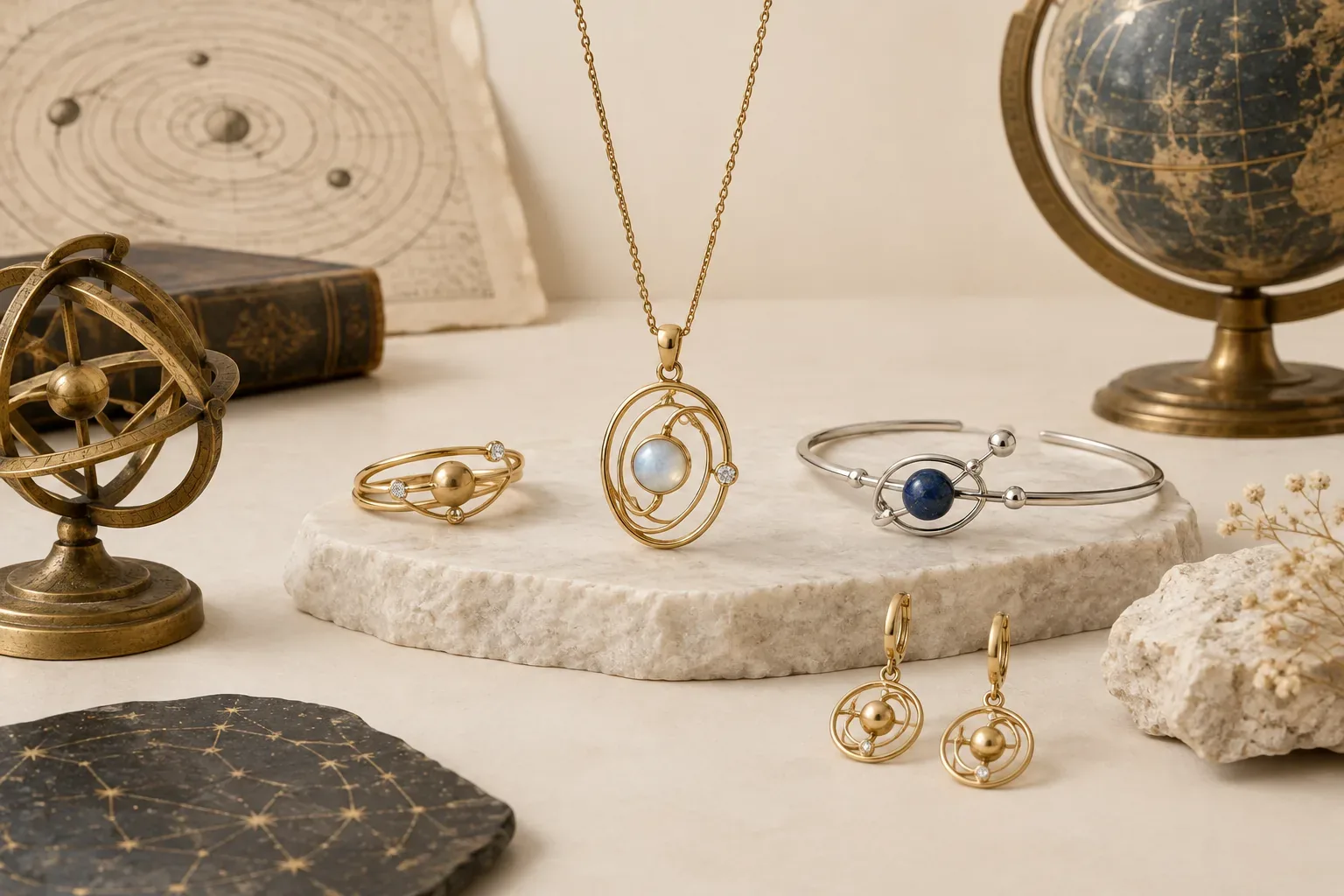
Design vocabulary: The contemporary orbit motif typically shows a central element—a round gem, pearl or metal disc—surrounded by one or more arcs, rings, small stones or floating elements that suggest motion or orbiting. Designers achieve the effect by suspending small stones on thin wires, offsetting bezels, linking crescents and circles, or engraving concentric lines. The motif can be literal (a circular ring around a central gem) or more suggestive (a string of small diamonds that seem to circle a cabochon).
Gemstone choices: Modern makers often select stones for optical or symbolic resonance: deep blue sapphires or lapis evoke the night sky, diamonds recall bright stars, moonstone or labradorite reference lunar sheen, and opal or tourmaline can suggest shifting color and planetary atmospheres. The Victoria and Albert Museum’s ‘‘An A–Z of Gemstones’’ provides identification and historical context for many stones that designers use to suggest celestial themes, and that resource is useful if you want background on particular gems.
Historic techniques and revivals: Historically, celestial motifs used the techniques and materials of their time—enamel, goldsmithing, stone inlay and later mass-produced stamped elements. The Victorian interest in astronomy and sentimental symbolism encouraged renewed use of stars, comets and moons in personal jewellery; this continuity of motif style is recorded and interpreted by museum collections and catalogues such as the V&A’s.
Practical and respectful selection and gifting guidance
Match the symbolism to the recipient: If you give orbit-themed jewellery as a symbolic gift, choose a meaning that the recipient will recognise or appreciate. For some people the motif will read as playful and modern—an acknowledgement of shared orbiting lives—while for others it might suggest solitude, science fandom, or cosmic spirituality. A short note explaining why you chose the motif can make your intention clear and respectful.
Consider materials and longevity: For everyday wear choose durable metals and secure settings. If the central idea relies on a particular stone, check its hardness and susceptibility to damage. The Federal Trade Commission (FTC) advises consumers to expect clear disclosure about treatments, synthetic stones, and imitations when buying gems, so ask retailers about enhancements such as heating, fracture filling or synthetic alternatives and request written confirmation of any claims before purchase.
Be aware of cultural and religious contexts: While celestial imagery is widespread, individual motifs may carry specific religious or cultural significance in particular communities. If the piece is explicitly tied to a cultural, spiritual or historic motif, take time to learn or ask about that meaning before wearing or gifting it. Treat any historically specific symbols with sensitivity rather than assuming broad meanings.
Verify authenticity and value: Ask the seller for provenance, hallmarking for metal purity, and gem reports when appropriate. The FTC’s guidance on buying gemstones, diamonds and pearls emphasises truthful disclosure about treatments and imitations; reputable dealers will provide condition reports or certificates for higher-value stones and explain maintenance needs.
Choose a style that suits everyday life: Orbit motifs span delicate pendants, statement rings and bracelet charms. For someone who prefers minimalist jewellery, select a small pendant with a single orbiting accent. For a collector or someone who likes statement pieces, look for larger asymmetric designs that highlight craftsmanship or unusual gem cuts. Practicality—comfort, durability, and the wearer’s daily activities—matters more than trendiness for a lasting gift.
Caring for orbit-themed jewellery and further reading
Caring basics: Clean and store jewellery according to the hardest gemstone in the piece; soft stones such as opal or moonstone need gentler care than sapphires or diamonds. Have settings and suspensions checked periodically so ‘‘orbiting’’ stones remain secure.
Research resources: For historical context on jewellery and how meanings change over time, consult museum publications and catalogues. The Victoria and Albert Museum publishes accessible essays and object records that put jewellery into cultural and chronological context. For consumer protections and practical buying advice about gem treatments and disclosure, the Federal Trade Commission’s consumer guidance is a reliable source.
Frequently asked questions
Does the orbit symbol have an ancient religious meaning?
No single, documented ancient ‘‘orbit’’ symbol exists that continuously carries a specific religious meaning. Museums such as the Victoria and Albert Museum document long histories of sun, moon and star imagery in jewellery with different cultural uses, but the contemporary graphic of a planet with surrounding rings is a modern visual development rather than a single ancient religious emblem.
What gemstones are commonly used in orbit-themed jewellery?
Designers commonly choose stones that suggest sky or light—deep blues such as sapphire or lapis, bright white diamonds or moissanite for ‘‘stars,’’ and moonstone or labradorite for lunar shimmer. The Victoria and Albert Museum’s A–Z of Gemstones is a useful reference for identification and historical context for these materials.
How should I verify a gemstone or treatment claims?
Ask the seller for written disclosure about any treatments, synthetics or imitations. The Federal Trade Commission advises consumers to expect truthful disclosure when buying gemstones, diamonds and pearls; reputable dealers will provide certificates or treatment statements where appropriate.
Is it appropriate to gift orbit jewellery to someone with strong religious or cultural beliefs?
Be sensitive. Celestial imagery can be purely decorative for many people, but if a motif references a specific cultural or religious symbol you are unsure about, ask or choose a more neutral design. A personal note explaining your intention can also help avoid misunderstanding.
How do I care for delicate orbit settings with suspended stones?
Have settings inspected regularly, avoid wearing delicate pieces during strenuous activity, and clean according to the most delicate material in the piece. Soft stones such as opal require gentler care than harder gems like sapphires or diamonds.
Where can I learn more about historical meanings of celestial jewellery?
Museum publications and catalogues are the best starting point; the Victoria and Albert Museum publishes accessible essays and object records that contextualise celestial motifs across periods and cultures.
Sources and further reading
- Bedazzled: A History of Jewellery — Victoria and Albert Museum
- An A-Z of Gemstones — Victoria and Albert Museum
- Buying Gemstones, Diamonds, and Pearls — Federal Trade Commission