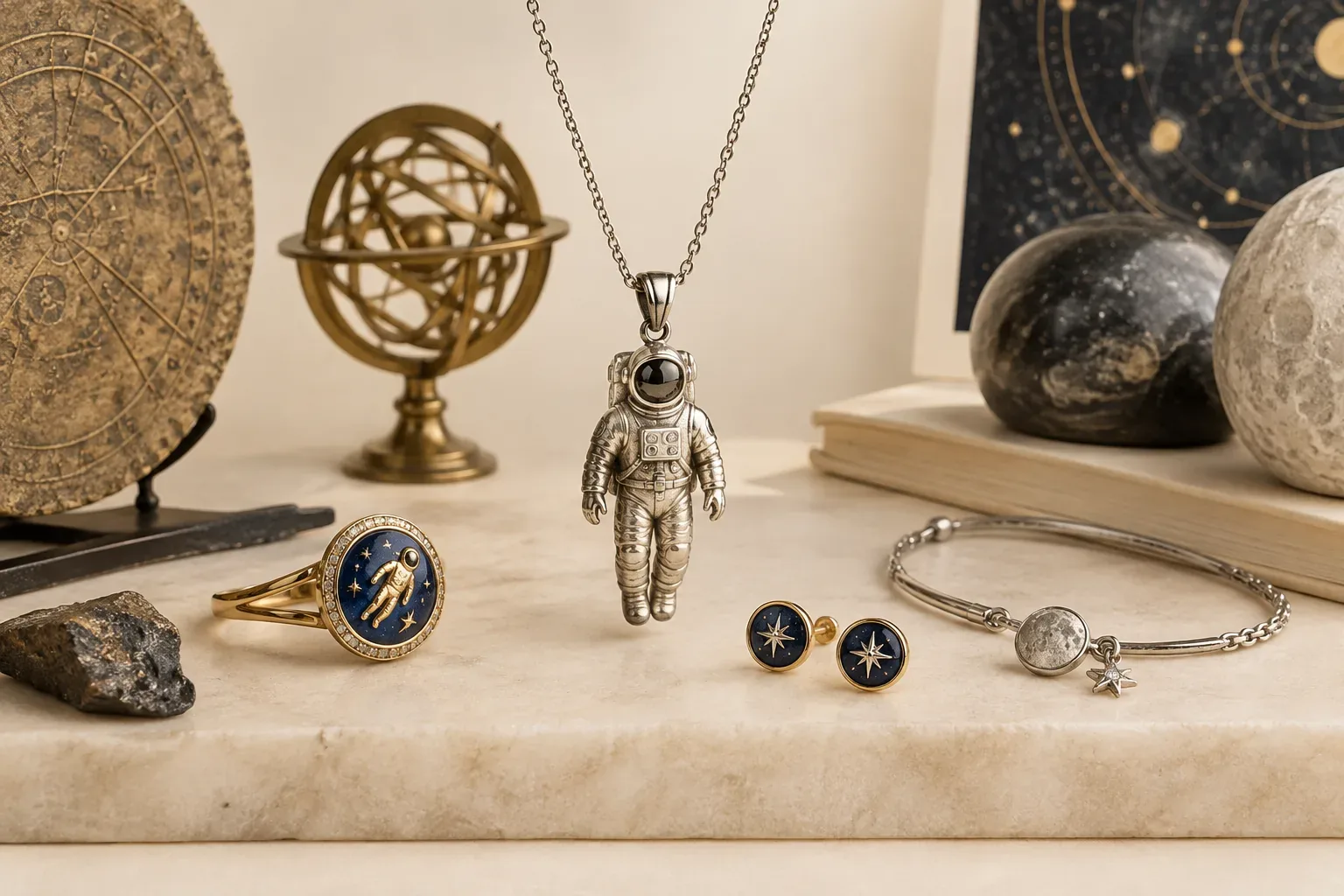
Meaning at a glance
Astronaut jewellery meaning is a modern, space-age phenomenon: its documented history and changing contexts come from 20th-century popular culture and jewellery trends rather than ancient religious traditions; today the motif is worn for personal reasons—celebration of exploration, STEM pride, memory, or aesthetic preference—and buyers should choose and gift such pieces thoughtfully with attention to materials and disclosure.
Brief direct answer
The astronaut jewellery meaning is primarily modern and contextual: it emerged as a space‑age motif in popular and decorative jewellery rather than as an ancient or religious symbol. Documented histories of jewellery show that motifs shift with social and technological changes, and astronaut imagery is best understood as a 20th‑ and 21st‑century expression of fascination with space, scientific endeavor, national and personal identity, and adventure.
Documented historical evidence and context
Scholars and curators who study the history of jewellery emphasise that design motifs reflect their moment — technologies, fashions and cultural narratives shape what appears in personal adornment. The Victoria and Albert Museum’s materials on the development of jewellery describe how changing social contexts produce new motifs and meanings rather than fixed, timeless symbolism.
Against that background, the astronaut motif belongs to the modern era. It arises from the cultural and technological phenomenon commonly called the space age: advances in rocketry, human spaceflight, and space science created new visual language that jewellers and manufacturers translated into charms, pins, pendants and other objects. Because this development is part of modern popular culture and material production, surviving examples and documentation are concentrated in 20th‑ and 21st‑century collections, catalogues and consumer markets rather than in earlier historical or religious sources.
The V&A’s broad scholarship on jewellery history supports the general principle that jewellery motifs are often contemporary reflections of their time. That framework explains why astronaut imagery first appears with the rise of mass media, commemorative merchandising, and later independent jewellery design responding to space exploration themes.
Separating documented history from modern interpretation
Documented history: the astronaut motif is a product of modern visual culture and jewellery practice. Museum histories point to the steady introduction of new themes into personal adornment as society changes. There is no archaeological or pre‑modern religious record that associates human figures in protective suits, rockets, or helmeted figures with ancient ritual or symbolic systems in the way traditional motifs like the cross, the ankh, or the mandala are documented.
Modern personal and cultural interpretations: contemporary wearers and makers assign a range of meanings to astronaut jewellery. These include admiration for scientific achievement and exploration, celebration of careers in aerospace or STEM fields, nostalgia for the era of early space missions, playful futurism, and personal metaphors for adventure, isolation, or boundary‑crossing. These are living, individual or community meanings rather than documented historical or religious uses, and they vary across people and contexts.
Because modern meanings are layered and subjective, it is important not to treat any single interpretation as universal. The same pendant may mean pride to one wearer, memory to another, and pure aesthetic preference to a third.
How the astronaut motif and related traditions appear in jewellery
Design forms: astronaut motifs show up in many conventional jewellery forms: pendants and charms shaped like helmets, rockets or tiny suited figures; lapel pins and brooches that reference mission insignia; cufflinks and tie pins with miniature silhouettes; and engraved lockets or rings incorporating star maps or mission dates. Designers use figurative and stylised approaches, from literal miniature helmets to abstracted starfields that allude to space.
Materials and techniques: metalwork, enamel, engraving and casting are common ways to render astronaut imagery. Contemporary makers often combine mixed metals, colorful enamel for visored helmets, and small stones to suggest stars. The V&A’s guidance on gemstones explains the historical and material contexts of stones jewellers choose, and curators note that designers use particular gems or treatments to reinforce a motif’s connotations—for example, iridescent stones for cosmic shimmer.
Gemstone choices and associations: designers may select stones for optical properties or cultural associations rather than any fixed symbolic meaning. Stones like moonstone and opal have historically been linked to lunar or luminous qualities in gemological literature, which designers may exploit to suggest a celestial connection. Lab‑grown gems, treated stones and diamonds are also used in space‑theme pieces for sparkle and durability; the material choices influence durability, price and care requirements.
Documented guidance on materials, treatments, and disclosure
When assessing astronaut jewellery for purchase, the practical facts about materials matter. The Federal Trade Commission advises consumers to seek clear disclosure from sellers about gemstone treatments, synthetics, and imitations. This guidance is not specific to space motifs but applies broadly to responsible jewellery transactions: ask whether a stone is natural or lab‑grown, whether treatments have been applied, and whether the metal is solid or plated.
Provenance and maker information can also be part of documented value. Museum and market scholarship on jewellery stresses the difference between mass‑produced novelty items and artisanal or historically significant pieces, so: request maker details, hallmarks and any documentation that supports the piece’s quality or special meaning.
Practical and respectful selection or gifting guidance
Match meaning to recipient: start by thinking about why you want to give or purchase astronaut jewellery. If it is to honour a career in aerospace or STEM, choose a piece that reflects that specificity — a subtle pin that can be worn at work, a custom pendant engraved with an achievement, or a piece made by a maker with connections to the field. If it is for a personal milestone or memory, consider a locket or ring that can be engraved or set with a meaningful stone.
Consider formality and wearability: everyday wearers may prefer durable metals and secure settings; formal or commemorative gifts can be more ornate. For recipients who work with uniforms or in environments where jewellery is restricted, select pieces that are small and unobtrusive or choose symbolic alternatives like embroidered patches or keepsake boxes.
Be culturally aware and respectful: astronaut motifs are largely secular and tied to popular culture, but the emotions they evoke can be profound. Avoid assuming that any single design communicates the same thing to every person. If the recipient is mourning, celebrating, or has particular political associations with space programmes, ask discreetly or choose a neutral design.
Check materials and disclosure: follow the FTC’s advice and ask for clear information about gemstones and treatments, metal content and maker guarantees before you buy. For valuable purchases ask for certificates and receipts. If you are buying vintage or bespoke pieces, request condition reports and provenance when available.
Personalise responsibly: engraving, choosing a birthstone or including a short message can make astronaut jewellery more meaningful. Keep engravings concise and avoid phrases that claim universal meaning; instead use private dates, initials or a short line that has significance for you and the recipient.
Wearing and caring for astronaut‑themed pieces
Care depends on materials. Use gentle cleaning for enamel and delicate stones, store mixed‑metal pieces separately to avoid scratches, and follow the maker’s care instructions for plated items. If a stone is identified as treated or synthetic, confirm care recommendations with the seller because some treatments change how a gem responds to heat, chemicals or ultrasonic cleaning.
For heirloom or sentimental astronaut pieces, consider documentation. A simple note about why the piece was given, who designed or made it, and any inscription meanings helps future owners understand the modern symbolic context of the object.
Final notes on meaning and use
Astronaut jewellery meaning is an example of how contemporary motifs are layered with personal, cultural and technological narratives. Curators who study jewellery history encourage us to see modern symbols as part of an ongoing conversation between maker, wearer and society, not as fixed emblems.
If you are researching a particular piece’s origin or meaning, consult maker marks, seller records and museum resources, and read about gemstones and material disclosure so you can separate factual details from later sentimental attribution. For general research techniques see our guidance on researching jewellery symbols and the linked related articles for practical next steps.
Frequently asked questions
What does astronaut jewellery typically symbolize?
Astronaut jewellery does not have a single, documented universal meaning. Historically it is a modern motif that reflects interest in space and technology; personally it can symbolize exploration, STEM pride, nostalgia, memory of someone connected to aerospace, or simply an aesthetic preference.
Is astronaut jewellery a religious symbol?
No documented religious tradition uses the astronaut motif. Religious jewellery tends to have long, traceable histories; astronaut imagery is a secular, modern cultural motif and its meanings are contemporary and individual.
Are there particular gemstones associated with space themes?
Designers often choose stones for optical effects or cultural associations rather than fixed symbolism. Historically described stones such as moonstone or opal may be used for their luminous qualities, and many makers also use diamonds, lab‑grown gems or treated stones for sparkle. For historical and gemological context, consult authoritative gemstone references.
How should I check the quality of astronaut jewellery before buying?
Ask the seller for clear information about metal content, gemstone origin and any treatments. The Federal Trade Commission advises consumers to request disclosure about synthetic stones, treatments and imitations. For valuable or vintage pieces request documentation, maker information and condition reports.
Can I personalise astronaut jewellery as a gift?
Yes. Personalisation such as engraving, choosing a meaningful stone or commissioning a bespoke piece can increase sentimental value. Ensure the chosen form suits the recipient’s lifestyle and confirm material and care needs before personalising.
Sources and further reading
- Bedazzled: A History of Jewellery — Victoria and Albert Museum
- An A-Z of Gemstones — Victoria and Albert Museum
- Buying Gemstones, Diamonds, and Pearls — Federal Trade Commission