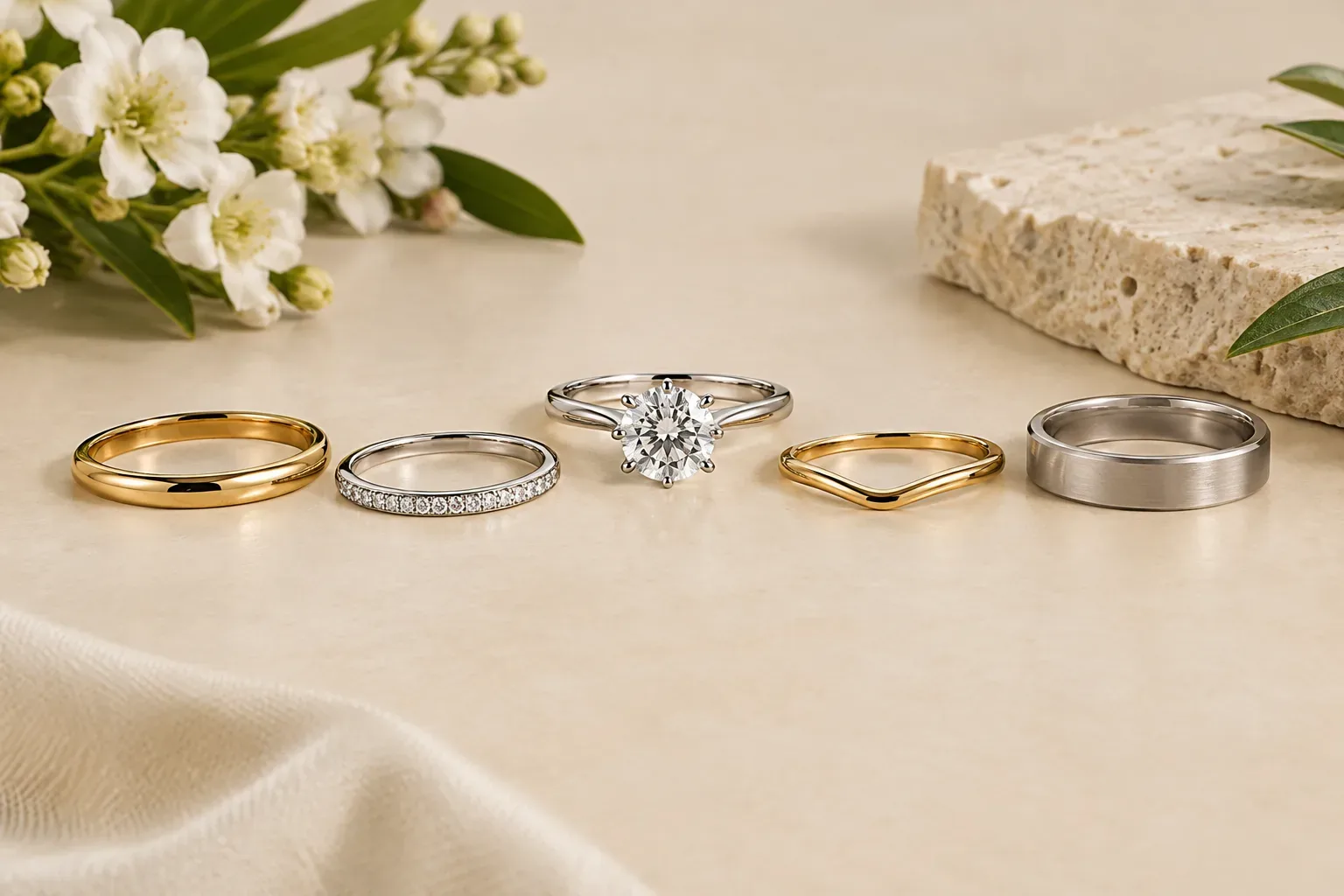
Meaning at a glance
Pairing a wedding band with a solitaire requires deciding whether to match profiles and metal or choose a complementary contrast, managing the gap between the solitaire setting and the band with contour, notched or low-profile bands, and confirming metal purity and gemstone treatments with a qualified jeweler or laboratory; this guide defines the key decision criteria, trade-offs, safe care steps, and verification limits.
Definitions and decision criteria
For clarity: a solitaire setting wedding band pairing means an engagement ring that features a single primary gemstone (the solitaire) paired with a separate band worn to mark the wedding. The key pairing decisions are: 1) shape: does the wedding band mirror the solitaire’s profile or sit flush; 2) gap: is there a visible space between ring shanks or an intentional channel (for example, to protect a high-set diamond); and 3) metal choice: do you match metal type and finish, or mix for contrast or practicality.
Use these buyer-focused criteria when deciding: visual harmony (do the rings read as one piece or as a deliberate stack?), comfort and wearability (will the setting catch on clothing or skin?), practicality (how will daily activities affect the stone and setting?), and maintainability (how easy is it to repair, re-plate or re-size without damaging the other ring?). Where facts about gemstone treatment, detectability and consumer disclosure matter, rely on written disclosures from the seller and verification from professionals rather than visual impressions alone.
What the documented evidence shows (modern market context)
Recent industry reporting documents current demand and styling more than deep historical meanings for the solitaire-plus-band combination. Imaginaire Digital’s 2026 UK search estimates identify strong interest in engagement-ring shapes such as ovals and other popular forms, indicating shoppers are actively seeking particular shapes when pairing bands.
Jewelers Mutual’s 2026 trends reporting shows consumer demand centering on fluid forms, modern stacking, colored gemstones and craftsmanship, which explains why many buyers now deliberately choose stacking looks—contrasting or sculpted bands—rather than insisting on a perfectly matched set.
Historical evidence and limits of documentation
If you are looking for documented historical meanings tied to specific cultures or periods for solitaire settings paired with wedding bands, the four approved sources for this article do not provide primary historical or cultural narratives. The sources are contemporary industry and consumer guidance documents that describe current market behaviour and regulatory expectations rather than ancient customs.
Because these sources do not supply detailed historical claims, this guide separates documented modern evidence from contemporary personal or cultural interpretations: market and care recommendations below are supported by the cited industry and regulatory sources, while any symbolic meanings offered are described as personal or cultural interpretations that you should verify with dedicated historical or ethnographic research where relevant.
How solitaire motifs and the gemstone itself appear in pairing choices
The solitaire motif presents visually in two main ways for band pairing: it can be the single visual focus that the band frames, or it can be one element in a deliberately stacked, mixed-ring composition. When the solitaire is high-set or uses prongs, the band must be chosen either to sit beneath the setting with a visible gap, to be contoured to the setting, or to be a shaped or notched band that cradles the stone.
Gemstones add their own demands. Modern disclosures about treatments, durability and care affect pairing choices: materials that have been treated or that are softer than diamond require more protection if the wearer prefers low-profile, flush-fitting bands. The Gemological Institute of America explains that treatments, disclosure, detectability and durability create distinct consumer questions; those answers should guide how protective or exposed you want the solitaire to be when paired with a band.
Shape and gap: practical pairing options and trade-offs
Flush or matching-profile bands are the simplest path to a seamless look: choose a band whose inside curve and outside profile follow the solitaire’s shank so the two rings sit flush. The visual payoff is a near-single-band appearance, but the trade-off is less flexibility; re-sizing or repair to either ring can alter the fit.
Contour or notched bands are cut or curved to fit around the solitaire’s basket or prongs. These are ideal for higher-set solitaires but require accurate fitment to avoid gaps where dirt can collect. The trade-off is higher initial cost and the need for a skilled jeweler to create or adjust the contour.
Stacked contrast bands—plain, hammered, milgrain or pavé—accept a visible gap and celebrate the space as a design element. This is the most versatile option for future changes: you can add or remove rings without altering the solitaire ring. The design trade-off is that a visible gap can collect dust or allow the solitaire to catch on fabrics, so consider a low-profile band or lifestyle adaptations if the wearer uses their hands frequently.
Metal choices: matching, mixing, and practical considerations
Decide whether to match metals for a unified look or mix metals for contrast or practicality. Matching the metal and finish simplifies future repairs and often creates the most cohesive appearance. Mixing metals—for example, a yellow-gold band with a white-gold or platinum solitaire—gives a contemporary, intentional contrast and is consistent with current trends toward gender-neutral and versatile styling noted by Jewelers Mutual.
Because sellers must make clear distinctions about materials, the Federal Trade Commission recommends written disclosures so consumers understand whether metals are plated, alloyed or re-finished. Confirm in writing whether a ring is plated or solid and ask how re-plating or polishing will be handled in the event of future wear. If you value long-term maintenance predictability, discuss repair and re-sizing options with the jeweler before purchase.
Care, verification and what only a professional can confirm
Practical care for paired rings depends on the materials: the GIA emphasizes that treatments and durability affect special care needs, so follow the specific care guidance provided for the gemstone and metal. Routine care options include cleaning with mild solutions recommended by the jeweler, regular checks of prongs and settings, and avoiding activities that can shock or abrade the stone and finish.
Several critical attributes cannot be reliably confirmed by sight or at retail without professional tools: whether a gemstone is natural or lab-grown, whether it has undisclosed treatments, the exact metal purity or whether plating covers a base metal. The FTC advises consumers to insist on written seller disclosures for these attributes, and the GIA explains that treatments and detectability create distinct verification needs. If those attributes matter to price or care, obtain a written report from a qualified jeweler or a gemological laboratory.
Selection and gifting guidance (practical and respectful)
If you are buying as a gift: decide whether a surprise is appropriate. For many couples, consultation produces the best long-term result because ring profile, finger size, and lifestyle needs are often personal. If you plan a surprise, borrow an existing ring for accurate sizing and be clear with the jeweler about return and re-sizing policies.
Respect family or cultural preferences by asking about cherished heirloom styles or metal types and whether the recipient has allergies to particular alloys. Jewelers Mutual’s trend reporting suggests many buyers now value gender-neutral choices and versatile stacking; consider a design that can evolve with additional bands or daily wear without compromising the solitaire.
Before completing a purchase, request and keep written disclosures about gemstone origin, treatments and metal composition. If the seller does not provide clear documentation, plan to obtain an independent appraisal or lab report to protect long-term value and to understand care needs.
Final practical checklist
Before you buy or gift: confirm the solitaire’s setting height and prong style, decide whether you want a flush, contoured, or intentionally gapped look, choose matching or mixed metals with an eye to repair and re-sizing, obtain written disclosures about gemstone treatments and metal composition, and arrange for a professional check of prongs and fit shortly after purchase. When in doubt about material authenticity or treatment history, a qualified jeweler or gem lab is the only reliable verifier.
Frequently asked questions
Can I make any wedding band sit flush with a solitaire ring?
Not always. Whether a band will sit flush depends on the solitaire’s setting height, prong design and the shank profile. Contoured or notched bands are custom-shaped to fit around higher settings; plain bands that look flush on one solitaire may leave a gap on another. A qualified jeweler can measure and advise, and may be able to create a contoured band or alter an existing band to improve fit.
Should I match the metal of the wedding band to the solitaire?
Matching metals produces a cohesive look and can simplify repairs, while mixing metals is a contemporary, versatile choice. The Federal Trade Commission recommends getting written disclosures about metal composition and plating so you understand whether a ring is solid, alloyed or plated and how that affects maintenance. Discuss repair and re-sizing plans with your jeweler before deciding.
How do gemstone treatments affect pairing and care?
Gemological Institute of America guidance shows that treatments, detectability and durability affect care needs. Some treated or softer gemstones may require more protection or a lower-profile band to reduce risk of damage. Ask the seller for written details about any treatments and follow the care recommendations provided by the jeweler or gem lab.
What can only a jeweler or gemological lab verify?
Professionals can reliably verify metal purity, whether a gemstone is natural or lab-grown, and whether certain treatments have been applied—attributes that are not reliably visible to the naked eye. If those factors influence price or care, obtain written documentation or a lab report rather than relying on visual inspection alone.
Is it better to surprise a partner with a wedding band selection or involve them?
Many couples prefer to choose together because fit, profile and lifestyle affect daily wear; Jewelers Mutual notes a trend toward versatile and gender-neutral choices, which often benefit from consultation. If you aim for a surprise, borrow a current ring for accurate sizing and confirm the seller’s return and re-sizing policies in case adjustments are needed.
Sources and further reading
- Imaginaire Digital — Imaginaire Digital
- Jewelers Mutual — Jewelers Mutual
- Gemological Institute of America — Gemological Institute of America
- Federal Trade Commission — Federal Trade Commission