Meaning at a glance
Silk cord jewelry explained: cords have been used across many jewellery traditions as a non-metal suspension, decoration, or structural element; museums document changing social contexts for corded, textile, and mixed-material jewellery, while modern wearers layer personal meanings onto historical practices; buyers should expect clear material disclosure, marked metal findings where applicable, and to ask about treatments and imitations.
What silk cord jewellery is and how it’s made
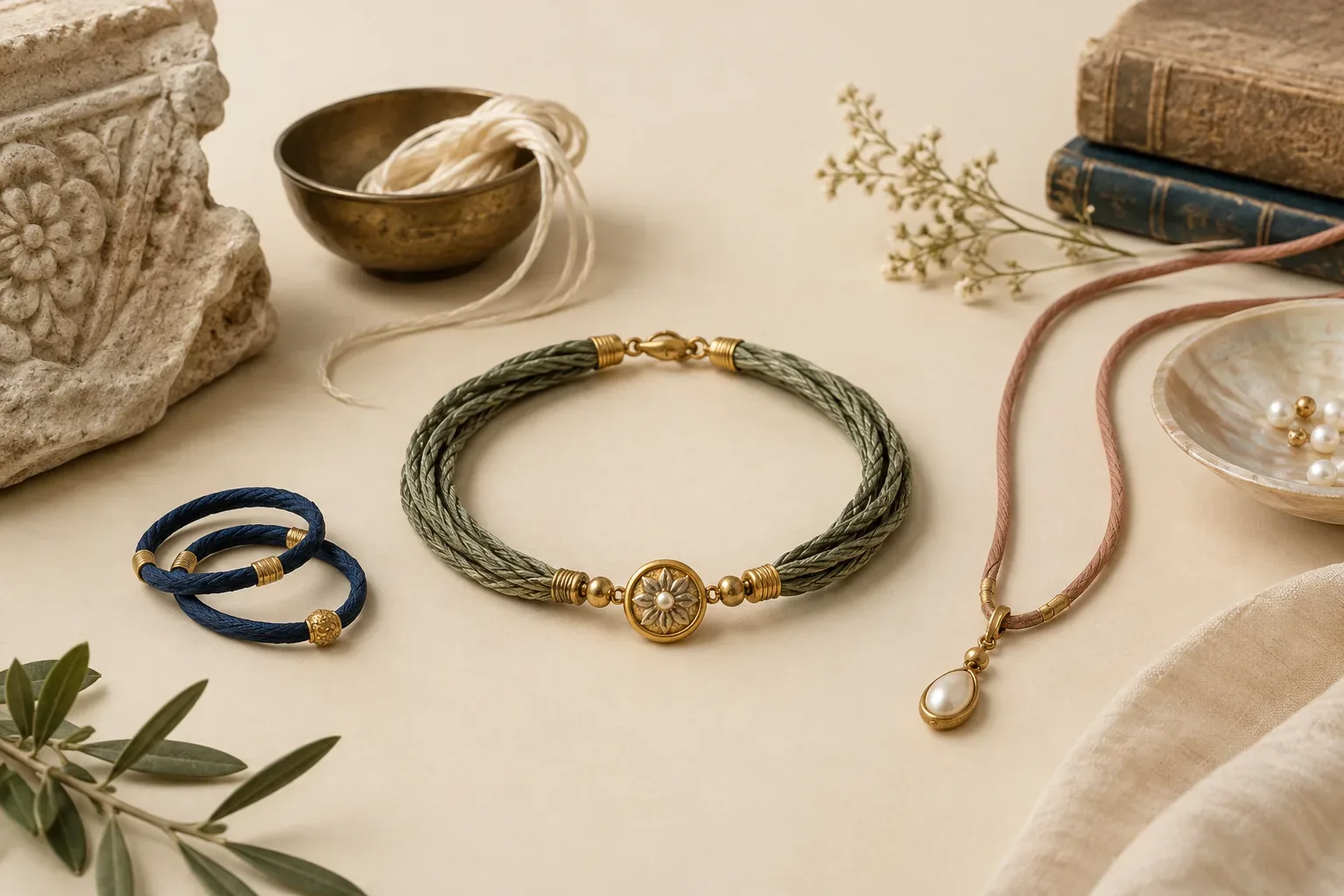
In practice, pieces described as silk cord jewellery combine one or more textile cords with metal findings, beads, gemstones, or metal-mounted pendants. The cord provides the primary non-metal visual element and structural support: it can be knotted, braided, wrapped, or finished with crimps, end caps, or adjustable sliders so that a pendant hangs from it or beads are strung on it.
Contemporary makers may use natural silk, other natural fibres, or synthetic cords. The visible options are often chosen for aesthetic contrast with metal and stone, for a softer feel at the throat, or for traditional reasons in particular styles. Because the cord itself is not a precious metal, regulatory hallmarks apply to metal components rather than to the textile cord.
Documented historical evidence and precise cultural periods
Museums and curators document that corded and textile elements appear repeatedly across jewellery history and that meanings and uses change with time and place. The Victoria and Albert Museum’s overview of jewellery history notes that jewellery practices evolve with social context and material availability, and that museum collections show corded and textile attachments alongside metalwork from different centuries and regions.
Those museum records encompass a wide range of cultures and periods rather than a single, uniform tradition: examples in museum narratives include ancient, medieval, early modern, and modern European jewellery as well as pieces that reflect connections beyond Europe. The important point in the V&A’s framing is that jewellery materials and forms are shaped by social function—such as display, mourning, or identity—so corded elements can signal different practices depending on date and place.
Separating documented historical meanings from modern personal interpretations
When looking for historical meanings, rely on documented provenance and curatorial interpretation. The V&A and similar collections record why an object was made or how it was used where such evidence survives, and they emphasise that social meanings shift over time. For example, a cord used to suspend a mourning pendant in one century may have been chosen for practicality in another.
Modern sellers and wearers frequently attach personal or contemporary symbolic meanings to silk cords—associations such as simplicity, earthiness, or intimacy, or linking cord colours to causes or identities. Those modern attributions are valid as personal interpretations, but they are not the same as documented historical belief systems unless a source explicitly links that colour or cord form to a given cultural meaning.
Where motifs, gemstones, and traditions show up on cord jewellery
Silk cord jewellery appears in several familiar formats. Pendants and lockets traditionally hung from ribbons or cords; corded chokers and adjustable bracelets use sliding knots or metal sliders; and beads or gemstone rondelles are occasionally strung directly on textile threads, often with metal bead caps or spacers. Museums’ gemstone guides highlight that gemstones can be mounted or drilled and then combined with textile elements depending on the object’s technique and date.
Motifs that appear with corded supports vary by tradition. A pendant motif that is religious, sentimental, or decorative may be identical in metal to one on a chain, but the choice of a cord can alter the object's look and cultural resonance. The V&A’s materials on gemstones and jewellery history make clear that how a gem or motif is presented—on a silk cord, a gold chain, or a ribbon—contributes to how contemporaries read that piece.
Hallmarks, disclosure, and buyer protections
Because the textile cord itself is not a precious metal, traditional hallmarking laws do not apply to the cord; hallmarking and legal marks relate to the metal components such as clasps, caps, and pendant mounts. That said, sellers should still disclose the composition of all materials used, and buyers should ask explicitly about those elements.
U.S. government guidance from the Federal Trade Commission sets out clear expectations for disclosure about gemstones, treatments, and imitations. The FTC advises that sellers must not misrepresent whether a stone is natural, synthetic, treated, or an imitation, and that consumers should be told about any enhancements or substitutes. Use that guidance when evaluating silk cord jewellery that incorporates gem beads, mounted stones, or treated materials: ask for written description of the stone’s nature and any treatments, and ask which parts of the item are metal and whether those metal parts are hallmarked or stamped.
Practical, respectful guidance for choosing or gifting
Consider the recipient’s lifestyle and how durable you need the piece to be. A silk cord will be softer and more casual than a metal chain and will age differently; it may require more frequent replacement or reinforcement if worn daily. If longevity is important, ask whether the cord is replaceable or whether a matching metal chain option exists.
Be explicit about provenance and symbolism. If you choose a corded piece because of a traditional meaning, confirm that that meaning is documented for the specific culture or period rather than assuming it is universal. If you prefer to give a personal meaning, state that intention when you gift the piece so the recipient understands whether the symbolism is historical or a contemporary gesture.
Check materials and disclosure. Ask the seller to identify cord fibre, metal content, and any gemstone treatments in writing. For pieces purchased in jurisdictions covered by FTC guidance, expect clear statements on whether stones are natural, lab-grown, or treated. When metals are present, look for standard stamps or ask for assay documentation when applicable.
Care, repair, and ethical notes
Silk and other textile cords are sensitive to moisture, oils, and abrasion, and many will darken or weaken with continuous wear. Keep corded jewellery away from swimming and heavy perspiration, and consider storing pieces flat in a dry place to reduce strain on knots and crimps.
Because cords are replacement-friendly, you can update a cord to change colour or to extend a piece’s life without altering the pendant or gem. If ethical sourcing or animal-derived materials matter to you, ask whether the cord is natural silk or a plant- or synthetic-based substitute and whether any gemstones were mined or lab-grown; disclosure requirements noted by the FTC apply to how sellers represent these aspects of a piece.
Conclusion
Silk cord jewellery explained at its simplest is a design choice that places a textile element alongside metal and stone. Museum documentation, including the Victoria and Albert Museum’s surveys, shows that corded elements have appeared in diverse jewellery practices and that meanings change with cultural and chronological context. Modern symbolic readings are common and personally meaningful, but they should be distinguished from what curators and provenance records document. When buying or gifting, ask clear questions about materials, hallmarks on metal parts, and any gemstone treatments so you understand both the physical make-up of the piece and the basis for any claimed meaning.
Frequently asked questions
Is a silk cord considered a precious metal and therefore hallmarked?
No. Textile cords like silk are not precious metals and so are not subject to traditional hallmark laws. Any metal parts such as clasps, end caps, or pendant mounts may be hallmarked or stamped; ask the seller to identify which elements are metal and whether they carry any assay marks or warranties.
How can I tell if a gemstone on a cord is natural or treated?
Request written disclosure from the seller. The Federal Trade Commission advises that sellers must not misrepresent whether stones are natural, lab-grown, treated, or imitations. Ask for a description of any treatments, origin information if available, and whether a gem report or certificate accompanies the piece.
Are silk cords durable for everyday wear?
Silk and other textile cords are generally softer and more sensitive to moisture and abrasion than metal chains, so they may require more frequent replacement if worn daily. If durability is a priority, ask whether the cord is replaceable or whether a metal chain alternative is available.
Does colour of a silk cord have a historical meaning?
Colour meanings are context-specific. Museum documentation shows that colours can carry different associations in different times and cultures, but a modern colour choice on a new piece often reflects contemporary aesthetics or personal symbolism rather than a fixed historical meaning. Verify any historical claim against provenance or curator notes.
Can I replace a silk cord with a metal chain?
Often yes, if the pendant’s bail or mounting accommodates a chain. Before removing the cord, check that the pendant will sit and balance correctly on a metal chain and that the metal chain complements the piece’s construction. A jeweller can advise on safe replacement and secure finishes.
What should I ask the seller before buying silk cord jewellery online?
Ask for a full materials list that names the cord fibre, the metal content of findings, and the nature of any stones. Request disclosure of gemstone treatments or lab-grown status, photos of hallmarks or stamps on metal parts, and the seller’s return and repair policy. When in doubt, ask whether the piece has provenance documentation if historical significance is claimed.
Is corded jewellery appropriate for formal occasions?
Appropriateness depends on design, materials, and cultural expectations. A fine silk cord with a high-quality pendant can be suitable for formal wear in many contexts, while a thick, casual cord will read as more informal. Consider the setting and the recipient’s style when choosing corded jewellery for formal gifting.
Sources and further reading
- Bedazzled: A History of Jewellery — Victoria and Albert Museum
- An A-Z of Gemstones — Victoria and Albert Museum
- Buying Gemstones, Diamonds, and Pearls — Federal Trade Commission