Meaning at a glance
This guide explains documented historical context for jewelry materials, separates museum-backed historical evidence from modern personal interpretations, describes how leather and associated motifs and gemstones appear in jewelry, and gives practical, respectful advice for choosing, caring for, and gifting leather jewelry.
Why a focused guide matters
Leather is a flexible material that appears in bracelets, chokers, cords, pendants, and mixed-media pieces. It behaves differently from metal or stone, so choosing leather jewelry requires attention to hide quality, tanning and finishing methods, joinery and hardware, and how any stones or motifs are set or attached.
This guide draws on museum documentation about how jewelry materials and meanings have changed over time, and on consumer-protection guidance about material disclosure, so you can buy leather pieces that meet your practical needs and respect historical and cultural contexts.
Historical evidence and changing contexts
Museum scholarship stresses that jewelry has never been a single, unchanging category: materials, motifs, and social uses have shifted across cultures and periods as tastes, technology, and social structures evolved. The Victoria and Albert Museum presents this changing social context as central to understanding jewellery rather than assuming fixed meanings.
The V&A’s resources on gemstones and on the history of jewelry underline that societies have used a wide range of materials—precious and non-precious—according to availability, status, and fashion. Treat information about leather in jewelry the same way: some periods and cultures emphasized metal and precious stones, while others incorporated organic materials and cords. Use the museum material as a reminder to separate documented historical practice from later popular stories about symbolism.
Documented historical meanings versus modern personal interpretations
When a museum catalogue or exhibit identifies a historical meaning, it is usually tied to specific artifacts, makers, or recorded practices. The Victoria and Albert Museum’s work emphasizes showing those documented connections and the social contexts that gave objects meaning. Where you cannot find that documentation, avoid asserting a historic meaning as fact.
Modern wearers commonly ascribe personal or contemporary cultural meanings to leather—ruggedness, bohemian style, or environmental concerns, for example. These are valid personal or fashion interpretations, but they are not the same as documented historical meanings. State clearly when a meaning is modern or personal rather than historically verified.
How leather, motifs, and gemstones appear in jewelry
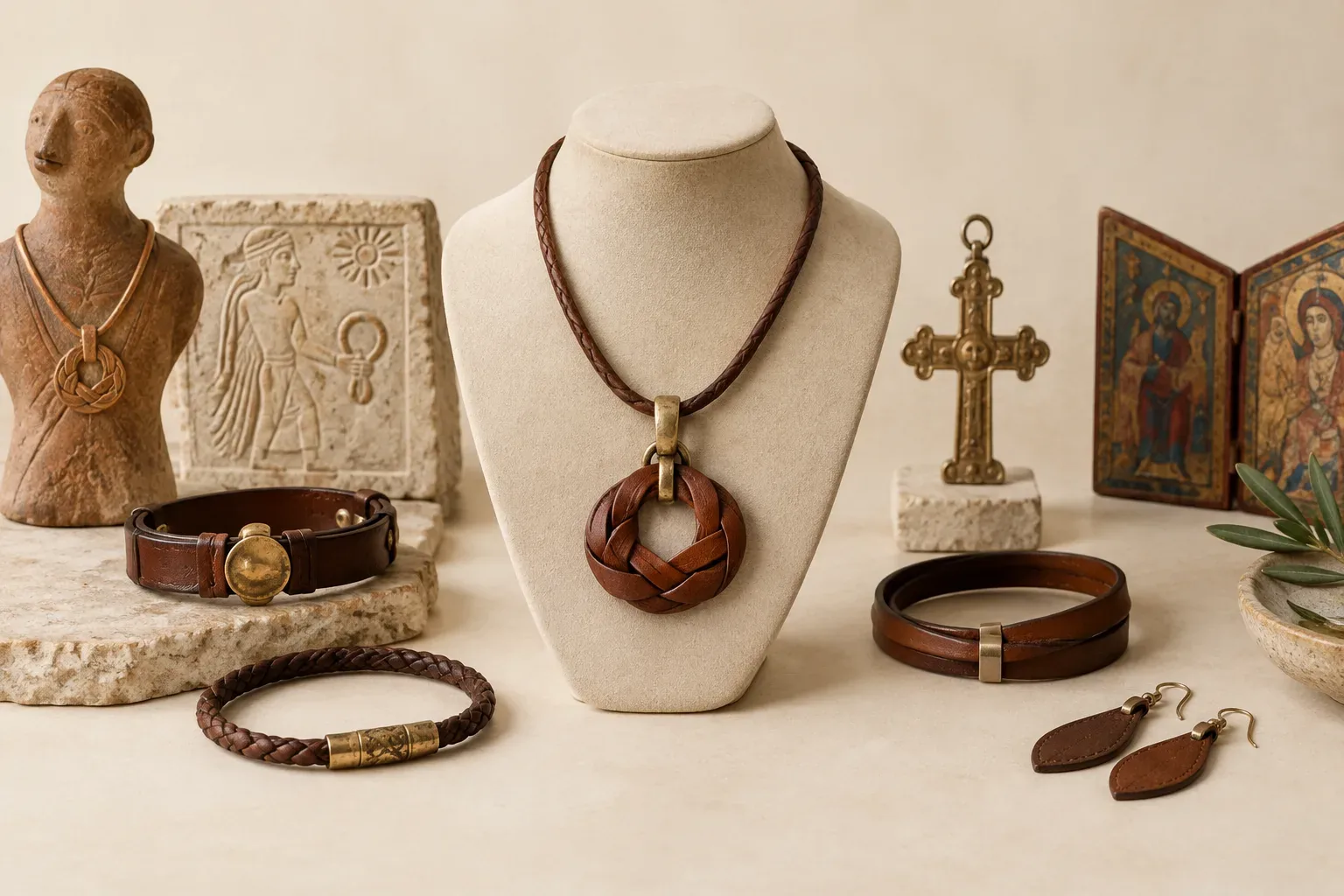
Leather appears in jewelry in multiple ways: as simple cords and straps, as braided or woven bands, as inlaid panels in metal settings, and as backing or mount for stones and metalwork. Artisans also use leather as a frame for pendants, with stone or glass insets attached by bezels, rivets, or adhesives.
Gemstones and beads may be set into metal mounts that are fastened to leather, threaded onto leather cords, or used as pendants hung from leather straps. For identification and historical context of particular gemstones when they appear with leather, museum resources such as the V&A’s A–Z of Gemstones explain traditional uses and appearances of many stones, while modern pieces may feature treated, synthetic, or imitation stones—details a seller should disclose.
Assessing quality: hide, tanning, and construction
Start with the hide. Full-grain leather retains the natural surface and is most durable; top-grain is sanded and finished for a smoother look but still stronger than lower-grade leathers. 'Genuine leather' is a marketing term for lower layers and is less durable, while bonded leather is made from scraps and an adhesive layer and will wear faster. Choose the grade according to intended wear: daily-wear bracelets and straps benefit from higher grades, while occasional decorative pieces can use lower-cost materials.
Examine the tanning and finish. Vegetable-tanned leather ages and develops a patina; chrome-tanned leather resists water and stays uniform. Finishes affect flexibility, colorfastness, and care needs. Check edge finishing and stitching: clean edges, secure stitching, and reinforced holes or crimps show attention to construction. Hardware—clasps, rivets, and metal fittings—should be solid, corrosion-resistant, and properly fastened to leather rather than glued alone.
Price and value: what drives cost
Several factors affect price: hide quality and tanning method, the workmanship of construction, the quality of hardware, whether the piece is handmade or mass-produced, designer or branded provenance, and whether any genuine gemstones or precious metals are used. Handcrafted pieces with high-quality hides and solid metal fittings command higher prices.
Added gemstones increase cost depending on type and whether the stone is natural, treated, synthetic, or an imitation. Because treatment and imitation status affect value, rely on seller disclosure; the Federal Trade Commission’s consumer guidance stresses that sellers should disclose treatments, synthetics, or imitations for gemstones and pearls.
Care and treatment disclosures
Leather care is different from metal or stone care. Keep leather dry, avoid prolonged sun exposure to preserve dyes and finishes, and use leather-appropriate cleaners and conditioners as recommended by the maker. Watch for finishes or dyes that may rub off on clothing or skin, especially on lighter garments.
If a leather piece includes gemstones or metal, ask about any treatments and ask for disclosure. The Federal Trade Commission advises consumers to get clear information about treatments, whether stones are natural or synthetic, and any imitations. That same principle applies to leather: ask whether the hide has been coated, embossed, or otherwise altered from its raw state.
Choosing and gifting leather jewelry respectfully
For everyday wear choose durable construction and higher-grade leather; for fashion statements opt for distinct colors or braiding. Consider the wearer’s lifestyle: someone with frequent water exposure or whose work requires frequent handwashing will need pieces designed for moisture resistance or with replaceable parts.
If a piece incorporates cultural motifs—religious symbols, tribal patterns, or traditional techniques—research documented meaning first and, when in doubt, choose neutral designs or ask the maker about provenance. The museum approach is useful here: documented links between a motif and a culture should be respected and not treated as a generic fashion statement. If you are gifting across cultural boundaries, prefer pieces that the recipient would identify with or that carry clear, respectful provenance.
Where to buy and what to ask
Buy from reputable makers, artisan markets with clear maker identity, or retailers who provide material and care information. Ask about hide grade, tanning method, and any dyes or coatings used. If gemstones appear, ask whether they are natural, treated, synthetic, or imitations and request any available certification or written disclosure.
For online purchases, request detailed photos of construction, seams, and hardware. Ask about return policies and warranties, and check whether the piece can be repaired or restrung if a cord or attachment fails. When in doubt, look for makers who describe materials and techniques openly and offer guidance on care.
A final word on meaning and style
Museum perspectives remind us that materials and meanings shift. Leather jewelry can carry practical uses, fashion statements, and personal meanings without claiming universal historic symbolism. Use the documented history as a baseline: seek provenance and disclosure when a cultural or historical meaning is claimed, and allow modern wearers to make their own interpretations when no documentary link exists.
Frequently asked questions
What leather grade should I choose for a bracelet I’ll wear daily?
For daily-wear bracelets choose full-grain or top-grain leather for durability; avoid bonded leather and lower-grade 'genuine leather' if you want long-term wear.
How can I tell if a stone in a leather piece is real or treated?
Ask the seller for disclosure about whether a stone is natural, treated, synthetic, or an imitation. The Federal Trade Commission recommends clear seller disclosure for treatments and imitation status; request photos and any paperwork if available.
Is leather jewelry appropriate as a gift when the design includes cultural symbols?
Gifting jewelry with cultural or religious symbols requires sensitivity. Research documented meanings and provenance first; prefer pieces with clear maker attribution or choose neutral designs if you are unsure how the recipient will interpret the symbol.
How should I care for leather jewelry to make it last?
Keep leather dry, avoid prolonged sun exposure, clean with leather-appropriate products, and condition if recommended by the maker. Avoid submerging leather in water and prevent contact with perfumes and cosmetics that can affect dyes and finishes.
Why does some leather jewelry cost as much as metal pieces?
Price reflects hide quality, tanning method, craftsmanship, quality of hardware, and any added gemstones or designer provenance. Handcrafted pieces with high-grade hides and solid fittings can be labor-intensive and priced accordingly.
Can leather jewelry be repaired if the strap or cord breaks?
Many leather pieces can be repaired or restrung, especially those using replaceable cords or modular hardware. Choose makers who offer repair services or use hardware that can be detached and replaced.
Sources and further reading
- Bedazzled: A History of Jewellery — Victoria and Albert Museum
- An A-Z of Gemstones — Victoria and Albert Museum
- Buying Gemstones, Diamonds, and Pearls — Federal Trade Commission