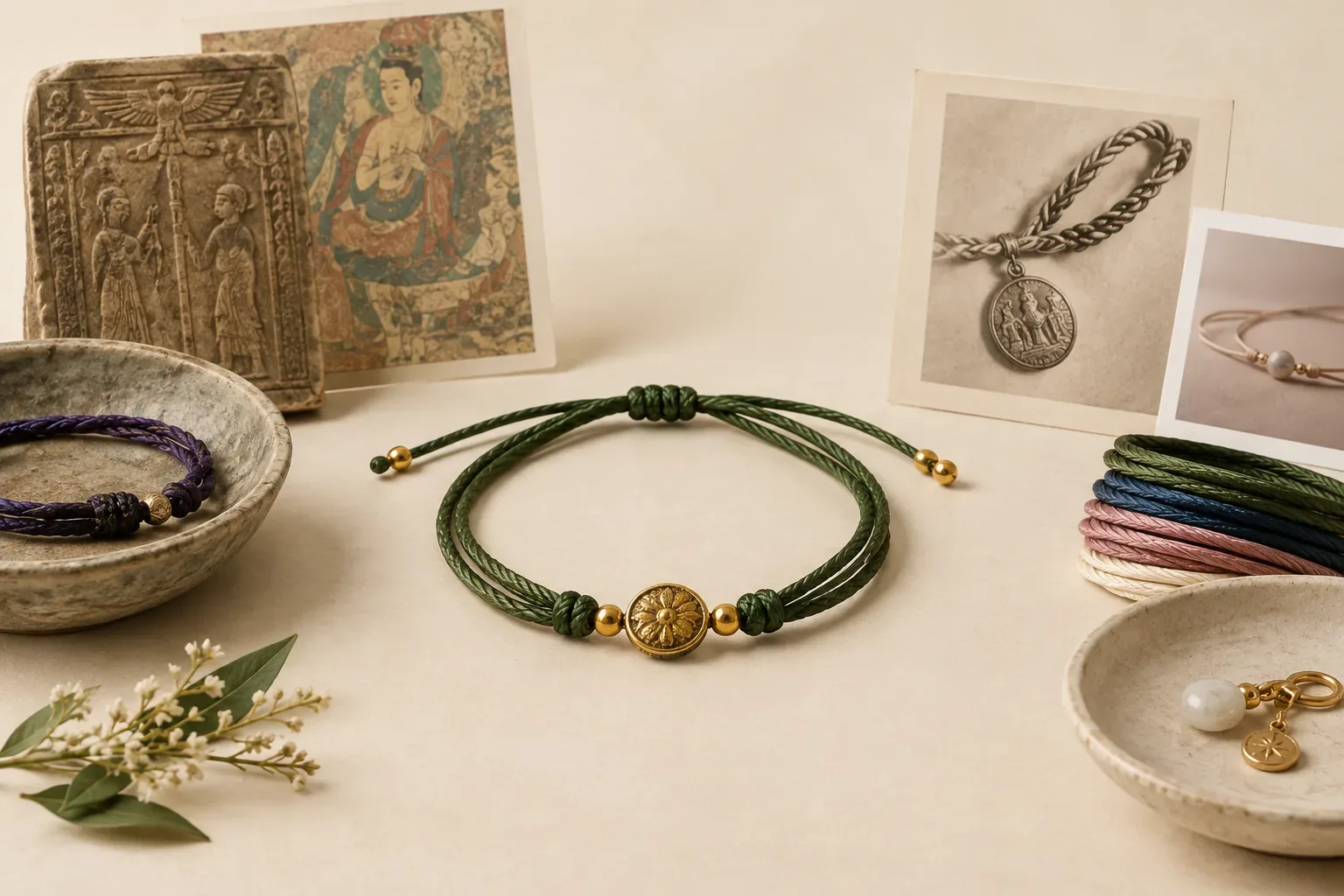
Meaning at a glance
Silk cord can be a long-lasting and beautiful choice for jewelry when matched to the piece, maintained correctly, and periodically restrung; museum collections show textile-supported jewelry across historical periods, and consumers should ask sellers about materials, treatments, and recommended service intervals.
Short answer
Silk cord jewelry durability depends mainly on the cord's construction, how it meets metal or gemstone components, and wearer habits: undamaged natural silk resists tarnish (silk does not oxidize like metal) but is vulnerable to abrasion, moisture, oils, sunlight and chemical exposure. With proper selection and routine care, silk-corded pieces can remain attractive and serviceable for years, but they usually require periodic inspection and professional restringing more often than metal chains.
What museum collections tell us about textile-supported jewelry
Public collections and exhibitions that survey the history of jewellery document long, shifting use of non-metal materials as integral parts of jewelry rather than mere temporary replacements. The Victoria and Albert Museum's summary of jewellery history and exhibitions such as Bedazzled describe how makers have chosen different threads, ribbons and cords for structural, decorative and cultural reasons across historical periods and regions.
The Victoria and Albert Museum also frames gemstones and their settings within shifting technologies and tastes. For example, historical stringing methods for pearls and beaded stones are part of how curators explain jewelry construction and display in different eras. Those museum records show that textile supports are historically established techniques rather than a purely modern innovation, and they stress that meaning and construction vary by place and time.
Identifying periods and cultural contexts precisely
Museum surveys at the Victoria and Albert Museum cover a broad chronological range that is useful for contextualizing silk-corded jewellery: they include medieval and Renaissance European collections, Georgian and Victorian era pieces, and objects from later nineteenth- and twentieth-century design movements. When textiles appear in V&A displays, they are examined in relation to the maker’s techniques, the object's use, and the social context of the moment.
That means if you are researching an apparent 'silk cord' in a specific piece, the precise cultural or temporal meaning must be checked against documentary cataloguing for that object or culture. The V&A collection entries and exhibition notes are a good starting point for identifying whether a cord was primarily structural, decorative, symbolic, or a later repair.
Documented historical uses versus modern interpretations
Documented historical evidence—such as the object records and curatorial essays at the Victoria and Albert Museum—tends to emphasize function and material context: cords and ribbons were used to hang lockets, to string pearls, to attach religious or military insignia, or to reinforce fragile mounts. These are curatorial observations based on object study and provenance.
Modern interpretations, by contrast, often layer new meanings on older techniques. Contemporary marketers or wearers may present silk-corded pieces as symbols of simplicity, spirituality, or artisanal authenticity. Those modern personal or commercial readings are legitimate as personal expression, but they are not the same as the documented, contextual meanings recorded by museum catalogues. Separate what curators and object records attest to from what present-day sellers or wearers feel or claim.
How silk cord appears in jewelry construction and design
Silk cord appears in jewelry in several consistent technical roles. It is used as a primary stringing material for pearls and small beads, as a suspension element for pendants where the cord is meant to be seen, and as an internal support tucked into the eye of a framed gem or cameo. It is also used decoratively as tassels, wrapped knots, and braided collars.
The Victoria and Albert Museum’s A–Z of gemstones and jewelry entries note historical stringing and setting techniques; those notes help explain why silk was often chosen for pearls and fine beads—silk knots protect individual pearls from rubbing one another and provide an elegant drape. In all cases, the cord acts as both a mechanical component and a visible design choice, and how it is finished where it meets metal findings will significantly influence durability.
Why silk wears differently from metal
Silk itself does not tarnish in the way metals do—there is no oxidation layer to form the green or dark films familiar with copper and base metals. Instead, silk’s vulnerabilities are physical and chemical: abrasion from friction, weakening from repeated bending, loss of tensile strength from UV exposure, and damage or discoloration from water, sweat, perfumes, and household chemicals.
Any metal or plated finding attached to a silk cord can still tarnish or corrode independently. A common practical failure mode is that the metal clasp corrodes or the cord frays where it rubs against a hard edge. Inspect both fiber and hardware when assessing the longevity of a silk-corded piece.
Practical care to extend silk cord jewelry durability
Keep silk-corded jewelry away from chlorinated or salt water and remove it before swimming and showering. Avoid heavy perfumes and hair products on or near the cord. After wearing, let the piece air dry if it has become damp rather than storing it in a sealed box with residual moisture.
Store silk-corded pieces flat or hung so the cord does not form tight bends at the clasp. Clean gently with a soft, dry cloth; do not submerge in water unless the maker’s instructions explicitly allow it. If a cord appears abraded, frayed, discolored, or softened, arrange for professional restringing rather than attempting aggressive household repairs.
Buying and material-disclosure guidance
When buying silk-corded jewelry, ask the seller to disclose the cord material precisely (natural mulberry silk, synthetic silk-like filament, cotton, nylon, or a blended core). The Federal Trade Commission’s consumer guidance about gemstones, diamonds and pearls emphasizes the importance of accurate disclosure about materials and treatments; the same consumer principle applies to cord materials and any coatings or stabilizing treatments applied to them.
Ask whether the cord has been coated, waxed, or bonded, and whether the cord is intended to be a replaceable component. If a piece includes valuable metal or gemstone components, request information about recommended service intervals for restringing and what the maker charges to replace the cord. A responsible seller will supply care instructions and be explicit about what is original and what might be a later repair or replacement.
Selection and gifting: practical and respectful advice
Match cord type to use. A delicate silk cord suits small pearls and lightweight pendants where drape and tactility matter; a thicker braided cord or a silk core with a durable sheath is better for heavier pendants. If the recipient prefers low-maintenance wear, consider a durable synthetic fiber that mimics silk’s sheen but resists moisture and abrasion more strongly.
Be culturally and personally respectful when gifting. Textile cords can have specific cultural or religious uses in some communities, and those meanings are not universal. If you are choosing a corded piece that resembles a traditional thread bracelet or ritual object, research or ask about that association first. When in doubt, choose a design and explanation that reflect the recipient’s tastes and background and, where relevant, consult resources such as museum catalogues or specialists to verify tradition-based claims.
Routine checks and when to seek professional help
Inspect junctions frequently—the point where cord meets clasp, the area around a pendant bail, and knots. Surface fuzz, thinning, discoloration, or unexpected stretching indicates the need for restringing. If a metal clasp shows corrosion, have it replaced to avoid cutting the cord.
For valuable gemstones, pearls, or heirloom items, seek a jeweller experienced with textile-stringed pieces. Museums and experienced conservators often recommend minimal, reversible interventions for historic items; for wearable modern pieces, prioritize secure, well-executed restringing by professionals who use appropriate mills or knotting techniques to preserve both aesthetics and safety.
Final perspective
Silk cord jewelry durability is a practical balance between material choice, construction quality, and wearer habits. Museum scholarship at institutions such as the Victoria and Albert Museum reminds us that textile supports are part of a long history of jewelry making and should be understood in their historical and social contexts rather than reduced to marketing shorthand.
If you choose silk or silk-like cords, prioritize transparent material disclosure, routine inspection and conservative care. Treated thoughtfully, a silk-corded necklace or bracelet can be both beautiful and long-lived; neglect or mismatched hardware will shorten its useful life.
Frequently asked questions
Does silk cord tarnish like metal chains?
No. Natural silk does not tarnish the way metals oxidize. Silk’s main failure modes are physical and chemical: abrasion, loss of tensile strength from UV exposure, and damage or staining from water, oils, sweat and chemicals.
How often should silk-corded jewelry be restrung?
There is no universal interval; frequency depends on wear, the weight of attached components, and exposure to damaging conditions. Check the cord regularly for fraying or thinning and arrange professional restringing as soon as you see wear. For frequently worn, valuable pieces, an annual check is a common precaution.
Can I wash a silk cord if it gets dirty?
Avoid submerging without maker guidance. For light surface dirt, gently wipe with a soft, dry cloth and air-dry if damp. If deeper cleaning is needed, consult the maker or a professional jeweler to avoid shrinking or weakening the fiber.
Are there durable alternatives to silk that look similar?
Yes. Synthetic filaments and coated textile cords can mimic silk’s sheen while offering greater water and abrasion resistance. When choosing an alternative, ask sellers for exact material disclosure and care recommendations.
What should I ask a seller before buying silk-corded jewelry?
Request precise disclosure of the cord material; ask whether the cord has coatings or treatments; learn the recommended service interval for restringing; and ask about policies for repair or replacement. The FTC encourages clear disclosure for materials and treatments for gemstones and similar consumer protections apply to cord materials as well.
Sources and further reading
- Bedazzled: A History of Jewellery — Victoria and Albert Museum
- An A-Z of Gemstones — Victoria and Albert Museum
- Buying Gemstones, Diamonds, and Pearls — Federal Trade Commission