Meaning at a glance
Scales of justice jewelry historically draws on Western legal iconography to signify balance and impartiality; today it also serves as a professional emblem and a personal symbol of fairness, and should be chosen with attention to material quality, cultural context, and clear disclosure of gemstone treatments.
Historical evidence and cultural contexts
When we want to trace what a motif meant in the past, museum collections and curatorial research are primary evidence because they preserve objects and contextual documentation. The Victoria and Albert Museum’s work on jewellery history makes clear that motifs travel between public iconography, civic regalia, and personal adornment as societies change, and that jewelers adapt symbolic images to new functions and fashions. Use of the scales in visual culture is part of that broader pattern of motifs moving from public emblems into wearable forms, and the V&A treats such shifts as part of jewellery’s changing social context.
In Western contexts, the scales appear in legal and civic imagery alongside personifications of justice; these themes were reproduced in prints, medals, and official regalia before jewelers adapted them into brooches, pendants, and other small objects. Museum catalogues and exhibitions document the presence of justice imagery in European decorative arts and jewellery collections, showing how the symbol was associated with the ideals of impartiality and lawful order in civic life. The V&A emphasises that jewelry styles and motifs reflect their social and political moments rather than carrying a single fixed meaning.
Outside of this Western documentary thread, different cultures have used balance imagery for a variety of purposes, but meanings and usages vary by place and time. The evidence accepted for this article is drawn from museum studies that focus on jewellery’s shifting contexts; when making claims about a particular culture’s historical use of the scale motif, consult specialists and primary sources specific to that culture rather than assuming continuity across regions.
Documented historical meanings versus modern interpretations
Documented historical meanings are those that appear in surviving objects, inscriptions, official uses, and the curatorial records that accompany them. For the scales motif in Western collections, the primary documented association is with weighing—literally and metaphorically—and with civic concepts of impartial judgement, as recorded in medals, official seals, and regalia that museums collect and interpret. The Victoria and Albert Museum’s research into jewellery history highlights how such public meanings were sometimes reproduced in personal pieces, especially for legal professionals or civic officials.
Modern interpretations are more varied and often personal. Today wearers may choose scales of justice jewelry to mark a law degree, celebrate admission to the bar, signal a career in advocacy, or express a private commitment to fairness, moral balance, or reconciliation. Others treat the motif as a fashionable emblem, detached from a legal profession. Modern meanings are layered and subjective; they can coexist alongside historical associations but should not be presented as identical to them.
How the motif, gemstones, and tradition appear in jewelry
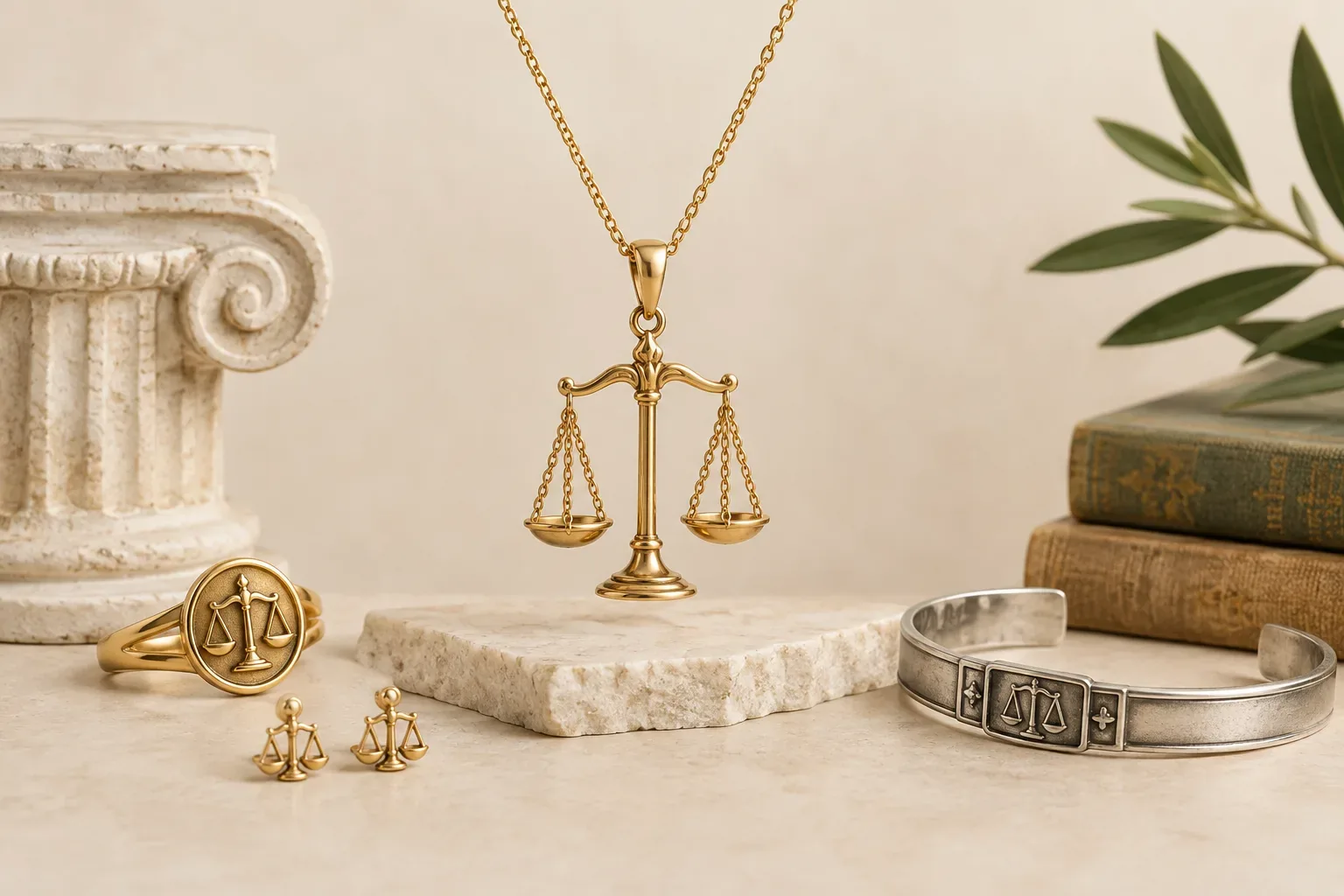
As a motif, the scales are rendered in many jewellerly forms: small-scale metal silhouettes suspended as pendants, stylised charms on bracelets, lapel pins and cufflinks used as professional insignia, and even as engraved details on signet rings. Museum studies show that jewellers have long used common techniques—metalwork, engraving, and enamel—to translate larger public symbols into wearable formats that fit contemporary tastes and functions, a process the Victoria and Albert Museum documents in its surveys of jewellery history.
Gemstones and materials affect how the motif is read. The Victoria and Albert Museum’s A–Z of Gemstones explains the historical uses and cultural associations of different stones and provides context for why makers select particular gems. In modern scales jewellery, makers may choose durable stones such as sapphires or garnets for longevity, or they may use monochrome materials like onyx or black enamel to emphasise sobriety and form. Plain metal versions in silver, gold, or plated finishes are common when the emphasis is professional insignia rather than ornament.
Techniques range from cast and stamped metal forms to openwork filigree that suggests balance visually, and contemporary designers may add stones as focal points on one or both pans of a tiny balance or as bezel-set accents in the pendant’s body. Where gemstones are used, consumer protection and disclosure considerations apply: the United States Federal Trade Commission advises buyers and sellers to disclose treatments, synthetics, and imitations, so that a purchaser understands whether a stone is natural, heat-treated, lab-grown, or simulant.
Practical and respectful guidance for selecting or gifting scales of justice jewelry
Begin by clarifying purpose and context. If you are gifting to a legal professional for a graduation or bar admission, choose a restrained, high-quality piece that will be appropriate with professional dress and that honours the milestone. If the piece is intended as a personal talisman—expressing balance, reconciliation, or an ethical stance—prioritise style and symbolism that align with the recipient’s tastes and values rather than ostentation.
Select materials with care. For durability and longevity, prefer solid precious metals or well-made vermeil rather than cheap plating that will wear quickly. If the piece contains gemstones, consult reputable information about those stones; the Victoria and Albert Museum’s A–Z of Gemstones is a useful reference for historical context, and the Federal Trade Commission’s guidance on buying gemstones, diamonds, and pearls explains why sellers should disclose treatments, lab-grown origins, and imitations. Ask the seller for written details about metal karatage, plating, and any gemstone treatments before purchase.
Respect cultural and situational sensitivity. The scales can have civic and legal connotations that carry different emotional weight depending on personal histories and local politics. Avoid gifting a scales-of-justice piece in a context where the recipient might see it as a comment on fairness in a charged dispute, and when in doubt ask whether a law-themed gift would be welcome.
Personalise thoughtfully. Engraving a date, name, or brief phrase can make an emblematic piece feel private rather than declarative. Keep inscriptions concise and avoid presumptive language about someone’s role or values. Consider a subtle version—a small pendant, discreet lapel pin, or understated cufflinks—if the recipient prefers low-key jewellery.
Care and provenance. Choose a seller who provides care instructions and transparent provenance. Follow standard maintenance advice for the metal and any stones, and keep documentation that describes materials and any treatments in case the recipient wishes to resell or insure the piece.
Frequently asked questions
What does scales of justice jewelry mean?
Historically in Western iconography the scales have signified weighing and impartial judgement; in contemporary use the motif may indicate a legal profession, a public ideal of fairness, or a private commitment to balance—meanings vary by wearer and context.
Is the scales symbol appropriate to gift to a judge or lawyer?
Yes, it is commonly accepted as a professional emblem for those in law, but choose a tasteful, well-made piece suitable for formal wear and consider personal preference; avoid implying a comment about a specific case or dispute.
Should I worry about gemstone treatments when buying scales jewelry?
Yes; the Federal Trade Commission recommends that sellers disclose gemstone treatments, lab-grown origins, or imitations so buyers understand what they are purchasing, and buyers should ask for written information when gemstones are involved.
Are there cultural sensitivities to consider?
Yes; the scales carry different resonances in different places and communities. Avoid assuming the symbol will be read the same way by all recipients, and ask about preferences if you are unsure.
How should I care for a scales pendant?
Care depends on the metal and stones used; solid precious metals require basic polishing and protection from harsh chemicals, while plated items need gentler handling. Keep any seller-provided care instructions and have valuable pieces serviced by a jeweller.
Can scales of justice jewelry be personalized?
Yes; inscriptions, discreet engraving, or choosing a subtle finish can personalise a piece. Personalisation is a respectful way to mark professional milestones or private meanings without overstating intent.
Sources and further reading
- Bedazzled: A History of Jewellery — Victoria and Albert Museum
- An A-Z of Gemstones — Victoria and Albert Museum
- Buying Gemstones, Diamonds, and Pearls — Federal Trade Commission