Meaning at a glance
Resin jewelry blends ancient material traditions—most notably amber, a fossilized tree resin—with modern synthetic and epoxy resins; the Victoria and Albert Museum documents continuity and change in jewellery materials and meanings, while the U.S. Federal Trade Commission sets standards for disclosure about treatments and imitations. This guide separates documented historical uses from modern personal interpretations and gives practical buying, care, and gifting advice for contemporary resin jewelry.
Historical evidence and cultural contexts
The Victoria and Albert Museum frames jewellery as a long-changing set of practices that reuse materials and meanings over many periods and cultures. V&A collections and exhibition material show that organic materials—including fossilized resins like amber—appear throughout European and Mediterranean archaeological and historic jewellery, and that jewellery styles and materials shift with trade routes, technology, and social customs.
Specifically, museum overviews link the presence of resins to defined periods and regions: prehistoric and early historic contexts where amber entered long-distance exchange networks, Classical Mediterranean jewellery where amber and other organic materials were adapted into rings and beads, and later periods such as the Victorian era when sentimental and organic materials reappeared in fashionable jewellery. The V&A exhibition and articles position these as distinct historical moments with different social meanings rather than a single continuous symbolism.
Documented historical meanings versus modern interpretations
Museum documentation concentrates on how materials and forms functioned in context—material value, trade significance, and fashionable display—rather than asserting a single spiritual or symbolic meaning across cultures. For example, the V&A emphasizes social and aesthetic contexts: certain materials signaled access to trade networks or were chosen for texture and colour in a particular period's style.
By contrast, modern personal or popular interpretations frequently ascribe new symbolic meanings to resin and amber—healing properties, energy, or general vintage charm. Those contemporary associations are valid as personal meanings if chosen intentionally, but they are not equivalent to the documented social uses recorded by museum collections. Treat historical claims and modern claims as different kinds of statements: one rooted in archival and material evidence, the other rooted in individual or contemporary cultural preference.
How resin and related motifs appear in jewelry
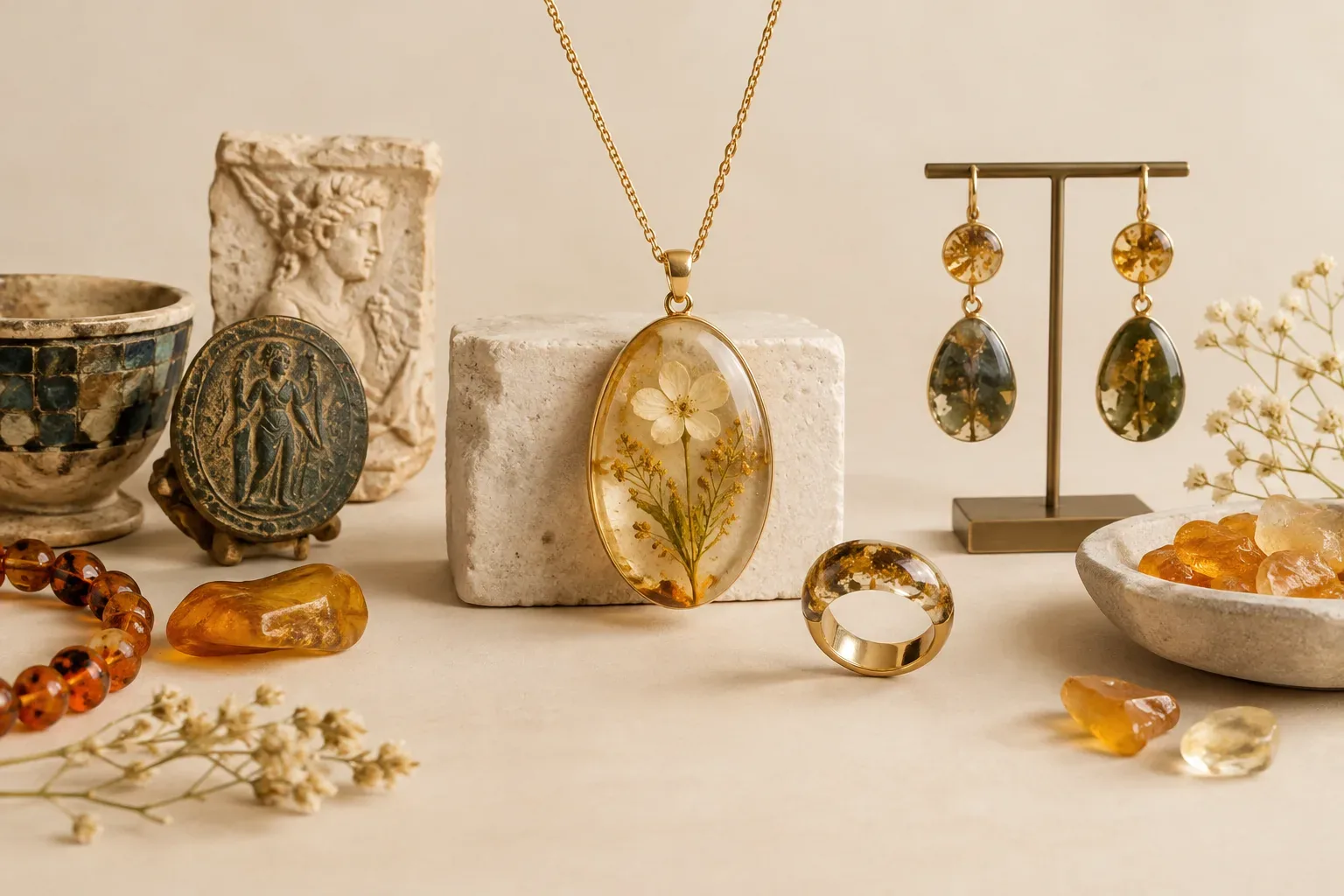
Historically and today, resins enter jewellery in two main ways: as natural, fossilized materials (commonly called amber) fashioned into beads, cabochons, and intaglios; and as modern synthetics and epoxies cast into shapes, often encapsulating colours, pigments, botanical inclusions, or small objects. Museum profiles show examples of beads, inlays, and mounted stones as standard ways gemstones and organic materials were incorporated; contemporary makers use those same forms but with synthetic media and new finishing techniques.
Motifs associated with resin pieces vary by period. In historical collections documented by museums such as the V&A, resin elements appear in classically inspired designs, beads for necklaces and rosaries, and later in sentimental lockets and cameos. In modern craft and fashion contexts resin is frequently used for bold color blocks, embedded motifs, and lightweight sculptural shapes that would be impractical in heavier stones or metals.
Quality indicators when buying resin jewelry
First identify the material. Sellers should state whether a piece is natural amber, an imitation, or a modern polymer/epoxy resin. The Federal Trade Commission's guidance on buying gemstones, diamonds, and pearls emphasizes that sellers should disclose treatments and imitations; apply the same standard to resin and amber. If a seller declines to clarify material origin, treat that as a red flag.
Examine craftsmanship. Look for uniform curing and a smooth finish without tackiness, sharp and consistent polish, and clean joins where resin meets metal. Bubbles and inclusions can be intentional design features, especially in handcrafted resin art pieces, but inconsistent curing, sticky surfaces, or poorly bonded metal findings indicate low-quality production.
Assess settings and findings. High-quality resin jewellery pairs durable suspensions and fastenings with appropriate metal grades for the price point. Check soldering, clasps, and bezel work. Lightweight resin allows for larger forms but the hardware must be proportionate to secure the piece in daily wear.
Consider long-term behavior. Synthetic resins vary in UV stability and scratch resistance. Ask the maker about UV resistance and whether the piece has a protective topcoat. Natural amber is softer than many gemstones and can scratch; both natural and synthetic resins benefit from careful storage away from abrasive materials and prolonged sunlight.
Price: what you are paying for
Price reflects material authenticity, labour, and metalwork more than novelty alone. A piece made from confirmed Baltic amber set in sterling silver will command a different price than a large cast epoxy pendant with a plated brass chain, even if they appear visually similar. V&A research into jewellery history highlights how material rarity and craftsmanship historically shape value across periods; apply that same logic to contemporary resin pieces.
Handmade processes and time-consuming techniques—such as multi-layered casting, careful inclusion placement, and hand-polished finishes—justify higher prices in modern resin jewellery. Conversely, mass-produced resin pieces can be very affordable but will often show compromise in finish, long-term durability, and disclosure about materials.
Best uses for resin jewelry
Everyday wearable art: Resin is ideal for lightweight statement necklaces, colourful earrings, and bold rings that won't weigh the wearer down. For routine fashion wear choose well-finished pieces with secure fittings and reliable plating or precious metal where skin contact is frequent.
Design and seasonal pieces: Because resin is easy to colour and cast, it is perfect for trend-driven collections and seasonal motifs. If you like rotating your accessories to match fashions, resin offers economical variety.
Sentimental or memory pieces: Resin can encase objects such as pressed flowers, small mementos, or pigments. When used this way, the maker's archival practice matters—ask about UV protection and the stability of any inclusions if you want the enclosed items to remain visually intact for years.
Collectible or authentic historical pieces: If historical authenticity matters—if you are collecting amber or period jewellery—be prepared to buy from reputable dealers and request provenance. Museum documentation reminds us that authentic materials and historical contexts are different from modern reinterpretations, and authentic pieces require appropriate care and certification.
Selection and gifting guidance (practical and respectful)
Match the material to the recipient's needs. If the recipient prefers hypoallergenic metals and plans to wear a piece daily, pair resin with sterling silver or gold-filled findings. If the recipient values historical authenticity, prioritize certified natural amber and request documentation of provenance.
Respect cultural and personal meanings. Do not assume that a material carries a single meaning. Offer resin pieces as aesthetic or sentimental gifts rather than claiming universal symbolic properties. If giving a piece with embedded motifs (botanical inclusions, charms, symbols), check that the imagery is culturally appropriate and meaningful to the recipient.
Ask practical questions before purchase. Confirm the seller's disclosure about material type and treatments, ask about return policies and care instructions, and consider the expected lifespan of the finish. A transparent maker will welcome these questions and provide clear guidance on cleaning and storage.
Presentation matters. A simple, well-made box and a short note explaining materials and care add perceived value. If the piece encases a personal item, explain the preservation choices (UV coating, sealed inclusion) so the recipient understands how to maintain it.
Care and maintenance
Treat resin and amber gently. Avoid rough contact with abrasive surfaces and store pieces separately to prevent scratching. Keep resin jewellery away from prolonged direct sunlight if the maker warns about UV sensitivity, and avoid exposure to harsh chemicals which can dull or damage finishes.
Clean with mild, non-abrasive methods. Use a soft cloth and gentle soap if needed; avoid ultrasonic cleaners and strong solvents unless the maker explicitly states the piece is resistant. For pieces mounted with precious metals, use the appropriate metal care routines while protecting the resin element.
When to consult experts
If a piece is presented as an antique amber collectible, ask for documentation and, if necessary, an independent appraisal. If you are unsure about a seller's claims or the piece's material, seek a reputable jewellery conservator or gemmological lab assessment. The FTC guidance underscores the importance of clear disclosure; when disclosure is absent, ask for verification.
Frequently asked questions
How can I tell natural amber from modern resin?
Ask the seller for an explicit statement about material origin and any testing or certification. The Federal Trade Commission advises that sellers disclose treatments and imitations; when provenance or labelling is absent, request further proof or an independent assessment. Visual cues alone can be misleading because modern resins can mimic amber's colour and inclusions.
Is resin jewelry hypoallergenic?
Resin itself is often inert for many wearers, but allergy risk depends on the metal findings, coatings, or added pigments. If the recipient has metal sensitivities, choose pieces with hypoallergenic metals like sterling silver or gold-filled findings and confirm all surface finishes with the maker.
How should I clean and store resin jewelry?
Clean gently using a soft cloth and mild soap if needed, avoiding solvents and ultrasonic cleaners unless the maker approves them. Store resin pieces separately in soft pouches to prevent scratches and keep them away from prolonged direct sunlight if the maker warns of UV sensitivity.
Are resin pieces considered fine jewellery?
Fine jewellery traditionally denotes certain precious materials and craftsmanship. Resin can be used in high-quality, well-crafted pieces and can carry artisan value, but material authenticity and the use of precious metals influence whether a piece falls into the conventional fine jewellery category.
What should I ask a seller before buying resin jewellery online?
Ask about the exact material (natural amber, imitation, or synthetic resin), any treatments or coatings, the type of metal used for findings, care instructions, return policy, and whether the piece is handmade or produced in a batch. Transparent sellers will provide clear answers and documentation when relevant.
Sources and further reading
- Bedazzled: A History of Jewellery — Victoria and Albert Museum
- An A-Z of Gemstones — Victoria and Albert Museum
- Buying Gemstones, Diamonds, and Pearls — Federal Trade Commission