Meaning at a glance
Explain the documented history and changing contexts of the renaissance european jewelry techniques motif, separate cultural or religious evidence from later popular interpretations, and give practical guidance for choosing and wearing the motif in modern jewelry.
Quick answer
Renaissance European jewelry techniques combined advanced metalwork, gem-setting and decorative finishing—documented in museum collections and exhibitions—to produce objects whose social meanings shifted across courts, cities, and centuries; separate the historical evidence from later romanticized readings, and when choosing or gifting Renaissance-style pieces today, confirm materials, provenance, and any modern alterations before purchase. (This summary reflects the thesis established for this article.)
What the historical evidence shows (and which cultures or periods it describes)
Modern understanding of Renaissance jewelry techniques rests largely on surviving pieces, workshop records and museum research. The Victoria and Albert Museum’s materials on jewellery history emphasize that European jewelry from roughly the late medieval period through the Renaissance developed in the courts and city-states of Italy, France, the Low Countries, England and the German-speaking lands, with distinctive local tastes and workshop practices documented in collections and exhibitions hosted by the V&A. The museum collection and its interpretive materials are a primary reference for how forms, materials and techniques were used and adapted over time.
Those sources show that 'Renaissance' jewelry is not a single uniform style. Italian city-states such as Florence and Venice were centres for luxury goldsmithing and gem trade, where courtly patrons and merchants commissioned elaborate pieces. French and Burgundian courts developed their own fashions and patronage networks that influenced material choices and ornament. English and German workshops also produced regionally characteristic objects. The V&A places pieces in social and material context to trace how technique, patronage and trade routes combined to produce the jewelry we now identify as Renaissance.
Documented techniques and materials
Museum documentation highlights the combination of artisan metalworking and gemstone work that defines much Renaissance European jewelry. Metalworkers used techniques such as casting, hammering and finely chased decoration, together with setting methods to secure cut and cabochon stones. Enamelling and applied ornament appear frequently in museum pieces, and pearls and natural gemstones are widely present in surviving examples. The Victoria and Albert Museum’s overview of gemstones and its jewellery history materials are the basis for these observations about technique and material use.
Gemstone work changed during the Renaissance as gem-cutting and trade introduced new cuts and materials into Europe. The V&A’s A–Z of Gemstones explains identification and historical contexts for particular stones, and the museum’s collections show how gem choices related to fashion, status and trade networks. Documentary and object-based evidence also record the use of organic materials such as pearls, coral and shell alongside hard stones.
How these techniques and motifs appear on actual objects
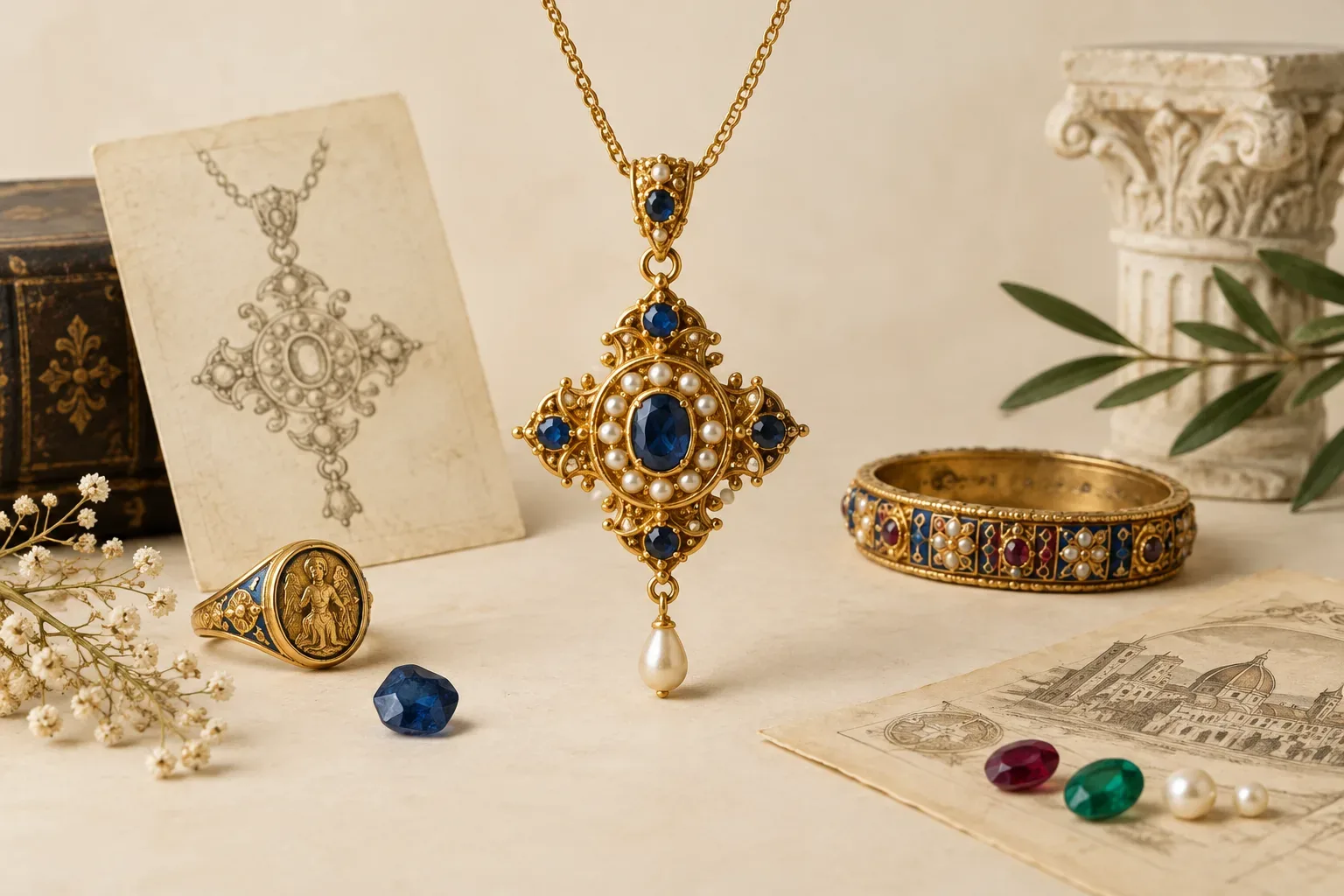
On surviving pieces, the documented techniques manifest as integrated craft: gold or silver frameworks carrying cabochons or faceted stones set into bezels or prongs, surfaces enriched by chased or engraved ornament, and areas filled with coloured enamel to create pictorial or patterned effect. Pearls are often sewn or mounted as pendants or fringe elements. The V&A exhibitions show that motifs ranged from classical subjects borrowed from antiquity to religious emblems, heraldry and vegetal ornament, and that many pieces combined these motifs in single objects.
Because Renaissance jewellery was both wearable art and a display of wealth, the technical choices—how a stone was cut, whether a border was enamelled, how an element was soldered—reflect both aesthetic preference and the skills available in particular workshops. The result is a body of surviving work that lets curators and historians identify regional workshop traits and changing fashions across generations.
Meanings in historical context versus modern interpretation
Museum interpretation distinguishes documented historical meanings from later or modern readings, and the V&A materials make this methodological point explicit. Historically, many motifs and materials carried meanings connected to social status, marital alliances, dynastic identity or devotional practice within a specific cultural setting. For example, courtly portrait miniatures or heraldic devices were closely tied to a patron’s identity and rank in a particular court or city.
Modern popular interpretations often layer additional symbolic readings onto Renaissance motifs—such as assigning broad spiritual or personality traits to particular stones or designs—that are not consistently supported by contemporary documentary evidence. The V&A’s historic approach helps separate what is demonstrably documented (materials, workshop origin, patronage links) from later sentimental or commercial meanings. When a modern seller or buyer applies universal symbolic claims to a Renaissance motif, treat that as an interpretive overlay rather than a documented historical fact.
How the craft and trade supported design and distribution
The objects in museum collections attest to a complex relationship among craft, patronage and trade. Workshops of skilled goldsmiths and gem-setters produced bespoke commissions for patrons in courts and merchant households, while international trade in gem materials—through ports such as Venice—brought new stones and cuts into European workshops. The V&A’s exhibitions and catalogues explain how changing trade networks and workshop practices affected style, availability of materials and price.
Surviving marks and records also show an emerging market for luxury goods: some pieces were explicitly made for display in courtly ceremonies, others as portable wealth. The ability to work in multiple techniques—metal casting, detailed chasing, enamelling and precise stone-setting—allowed workshops to produce pieces that met the tastes and symbolic needs of diverse patrons across Europe.
Practical guidance for selecting, wearing, or gifting Renaissance-inspired pieces today
If you are choosing or gifting a piece described as 'Renaissance' or 'Renaissance-style', begin by asking for provenance and condition information and whether the piece is an original, a later antique, or a modern reproduction. The Victoria and Albert Museum’s collection research provides models for how museums document objects; reputable dealers will likewise provide clear information about origin, maker when known, and any restorations.
Ask specifically about materials and any treatments. The United States Federal Trade Commission’s guidance on buying gemstones, diamonds and pearls stresses the importance of disclosure for treatments, enhancements and imitations. Treatments such as heating, dyeing or surface coatings alter value and care needs, and imitation materials are common in the market. For pearls, for example, ask if they are natural, cultured, or assembled beads.
Consider the practicalities of wear: many genuine historic techniques and materials require special care. Antique enamel can be fragile, thin wires and solder joins may be weakened by repair, and older settings may not meet modern security standards for everyday wear. For gifting, consider the recipient’s lifestyle: an ornate, historically accurate piece can be a treasured statement for occasional wear while a well-made modern interpretation may be a better choice for everyday use.
If authenticity and investment are important, seek documentation such as hallmarks, condition reports or specialist appraisals. When purchasing from online sources, request clear photographs of details and hallmarks and ask the seller to confirm return policies. For ethical concerns, inquire about the sourcing of gemstones and whether any materials were acquired responsibly.
Where to research further and next steps
Start with museum resources to understand documented practice and context. The Victoria and Albert Museum’s materials and exhibitions provide an evidence-based foundation for recognizing techniques, identifying motifs, and placing objects within social and trade contexts. For practical buying guidance about treated gemstones and disclosure, consult the Federal Trade Commission’s consumer advice on gemstones, diamonds and pearls.
If you plan to buy an antique or high-value piece, consult a qualified jewellery conservator or independent specialist for a condition assessment and provenance research. For modern commissions that reference Renaissance techniques, ask makers about their methods and whether they use traditional tools and materials or contemporary substitutes. Finally, use the internal resources on this site for related topics such as cultural and historical jewelry, gift guidance, and how to research jewelry symbols.
Frequently asked questions
What defines a piece as 'Renaissance' jewelry?
A piece is described as 'Renaissance' when its style, materials and techniques correspond to the forms and workshop practices of late medieval to early modern European courts and cities as documented in museum collections and scholarship; many modern sellers also use the term for revival or reproduction pieces, so always confirm provenance and date.
How can I tell if a gemstone has been treated or is an imitation?
Ask the seller for full disclosure and any laboratory or appraisal reports. The Federal Trade Commission advises buyers to seek information about common treatments (such as heating or dyeing) and to request documentation for natural, cultured or assembled gemstones and pearls.
Are motifs on Renaissance jewelry purely decorative or symbolic?
Both. Museum research shows many motifs served social, dynastic or devotional purposes in their original contexts, while other designs were primarily decorative. Later popular readings sometimes attribute universal symbolic meanings that are not consistently supported by historical evidence.
Should I wear an antique Renaissance piece daily?
Not usually. Antique materials and historic construction can be fragile; many museum conservators and dealers recommend reserving historic pieces for occasional wear and using well-made modern interpretations for daily use.
What documents or marks should I look for when buying an antique piece?
Look for hallmarks, maker’s marks, provenance records, condition reports and specialist appraisals. Reputable sellers should supply clear photographs and documentation; museums’ cataloguing practices provide a useful standard for what information to expect.
Can modern jewelers reproduce Renaissance techniques?
Yes. Many contemporary makers specialise in historically informed techniques, using traditional tools and methods or combining them with modern technologies. When authenticity of method matters to you, ask the maker to describe their process and materials.
Sources and further reading
- Bedazzled: A History of Jewellery — Victoria and Albert Museum
- An A-Z of Gemstones — Victoria and Albert Museum
- Buying Gemstones, Diamonds, and Pearls — Federal Trade Commission