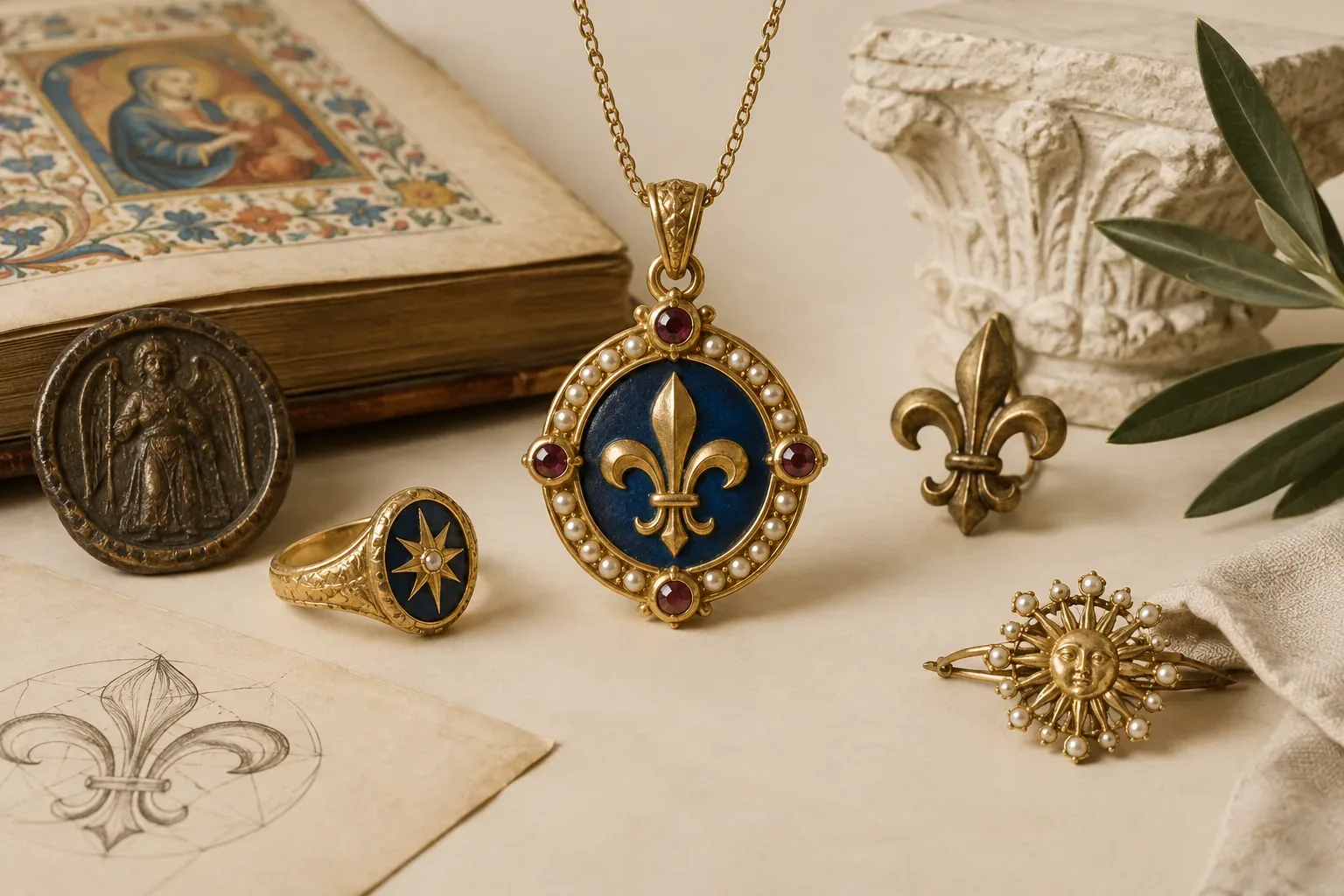
Meaning at a glance
Explain the documented history and changing contexts of the renaissance european jewelry symbols motif, separate cultural or religious evidence from later popular interpretations, and give practical guidance for choosing and wearing the motif in modern jewelry.
What the historical evidence shows (period and sources)
When we speak of Renaissance European jewelry symbols we mean motifs and gem choices used across fifteenth- to seventeenth-century Europe in court, civic and devotional contexts. Museums that collect and interpret period jewellery place those objects in social and material context rather than treating symbols as fixed, universal messages. The Victoria and Albert Museum, for example, frames jewellery within changing social roles and tastes in its overview of the history of jewellery and in its A–Z of gemstones. Those museum resources emphasize how design, material and use together carried meaning in a specific time and place.
Because the surviving record is object-based and interpretive, historical evidence for a symbol’s meaning usually comes from a combination of surviving jewellery, inventories, portraits that show jewellery in use, and contemporary writing about taste and virtue. Museum interpretation therefore attributes likely meanings while acknowledging variety across regions and social groups. Curatorial work at institutions such as the Victoria and Albert Museum demonstrates that a single motif could signal devotion in one context, rank or allegiance in another, and purely fashionable taste in a third.
Separate documented historical meanings from modern or popular interpretations
Documented historical meanings are those that museums and historians can tie to primary sources or consistent patterns in objects and texts. For example, many Renaissance jewels were explicitly devotional (crosses, reliquary pendants) or commemorative (lockets and portrait settings) and appear in inventories and portraits connected to those practices. The Victoria and Albert Museum’s writings on jewellery stress that such objects often served social or ritual functions and that their meanings are anchored in those documented uses.
Modern interpretations—including romanticized or broadly generalized meanings—are frequently layered on later. Modern wearers may interpret a heart, an emerald or a clasped-hand motif as a universal symbol of love, fidelity or protection. Museum interpretation cautions that while those meanings may be attractive and personally valuable, they are not always the historically documented reason a piece was made or worn during the Renaissance. Treat modern symbolic attributions as personal or contemporary meanings unless you find consistent primary evidence linking the symbol to that meaning in Renaissance sources.
How motifs, gemstones and traditions appeared in Renaissance jewellery
Motifs appeared in many forms: rings, necklaces, pendants, brooches and garments-mounted jewels. Portrait miniatures and painted enamel were used to show likenesses or heraldry; religious symbols were often worked into pendants and reliquary forms intended to be touched or carried. Museums that describe Renaissance collections emphasize technique as much as iconography, because the way a motif was made and worn—enamel, engraving, setting—contributed to its meaning and visibility.
Gemstones were selected for visual impact, rarity and culturally attributed properties, and they were integrated into designs as focal points or as patterned fields. The Victoria and Albert Museum’s A–Z of Gemstones explains how different stones had recognised associations and were valued for colour, lustre and rarity. That resource also places gemstones within broader craft traditions: gemstones could be cabochon-set, faceted (later in the period), or used as beads, and settings and mount types shaped how the stone read to contemporaries.
Certain traditions—like wearing portrait locks near the heart or carrying devotional objects—are documented in museum interpretation and offer clear links between object type and use. Equally important is recognising that the same visual element could be adapted: a leaf motif might mean natural abundance in one object, a badge of loyalty in another, and a purely decorative filler in a third. The context of the object, its materials and how it was worn determine which reading is most likely.
Practical guidance for selecting or gifting Renaissance-motif jewellery today
Decide whether you want historical authenticity, historical style, or a modern piece inspired by Renaissance motifs. If authenticity matters, prioritize reputable provenance and museum-quality studies; museum catalogues and specialist dealers can point to documented parallels in collections. If you prefer a modern interpretation, choose makers who acknowledge the source and avoid claiming a single, universal historical meaning.
Consider the recipient’s cultural and religious background before gifting overtly devotional symbols. A cross or a reliquary-style pendant carried devotional weight in many Renaissance contexts; in a contemporary gift, such symbols may be meaningful, neutral, or uncomfortable depending on the recipient. The safest route is to discuss preferences where appropriate or to select motifs with clear secular meanings if you are unsure.
Attend to material disclosures and gemstone treatments. The Federal Trade Commission advises consumers to expect transparency about treatments, imitations and enhancements. For gemstones, ask for written information about whether a stone is natural, treated, synthetic or assembled, and request documentation of metal content and any restorations when buying older pieces. Sellers who handle antique jewellery should be able to explain what has been conserved or altered.
When choosing design and scale, respect how Renaissance pieces were worn: many original jewels were boldly scaled to be visible in portraits and public ceremonies. Modern wearers often prefer smaller or more durable adaptations. Think about daily wear versus special-occasion use, and choose metals and settings that match the recipient’s lifestyle and sensitivity to alloys.
If symbolic meaning matters to you or the recipient, research before purchase. Use museum resources to understand historical context, and pair that research with a frank conversation about what the symbol will mean to the wearer. Internal resources on our site can help with this research and with communicating respect for the object’s origins.
Where to look next and how to research responsibly
Start with museum resources and catalogues that document objects in context; the Victoria and Albert Museum’s overview of jewellery history and its A–Z of Gemstones are good entry points for understanding how motifs and stones were used and valued historically. Those institutional resources emphasise changing social contexts rather than single meanings.
If you handle or purchase historic pieces, request treatment records and provenance information and follow guidance about authenticity and disclosure from consumer protection sources such as the Federal Trade Commission. When in doubt about a motif’s cultural weight, consult specialists or curators rather than relying on mass-market labels that may simplify history into marketable symbolism.
Use the site’s related articles to deepen practical skills: our guides on choosing meaningful jewellery and on researching symbols provide steps you can follow for both new and antique pieces. These resources can help you balance appreciation of historical meaning with sensitivity to the lived cultures behind those objects.
Frequently asked questions
Were Renaissance jewelry symbols the same across Europe?
No. Symbol meanings varied by region, social status and context. Museum interpretation shows motifs could signal devotion, allegiance, wealth or fashion depending on how and where the object was used. Avoid assuming any single, universal meaning.
How can I tell if a Renaissance-style piece is authentic?
Authenticity requires provenance, condition reports and expert assessment. Request written provenance and treatment history, compare the piece to museum-documented examples, and consult a qualified specialist when necessary.
Are gemstones in Renaissance jewellery treated differently from modern stones?
Stone working and treatments have changed over time. The Victoria and Albert Museum explains historical contexts for gemstone use, and the Federal Trade Commission advises consumers to ask sellers about modern treatments, enhancements, or synthetics before purchase.
Is it appropriate to gift religiously symbolic jewellery?
It can be appropriate, but consider the recipient’s beliefs and preferences. Because religious symbols had specific devotional meaning historically, be respectful and, when uncertain, ask or choose a secular motif that still honours the aesthetic you want to share.
Can I wear a Renaissance motif for purely personal reasons?
Yes. Modern personal interpretation is valid. Museums encourage understanding the historical context, but contemporary wearers often adopt symbols for personal or aesthetic reasons distinct from their original meanings.
Sources and further reading
- Bedazzled: A History of Jewellery — Victoria and Albert Museum
- An A-Z of Gemstones — Victoria and Albert Museum
- Buying Gemstones, Diamonds, and Pearls — Federal Trade Commission