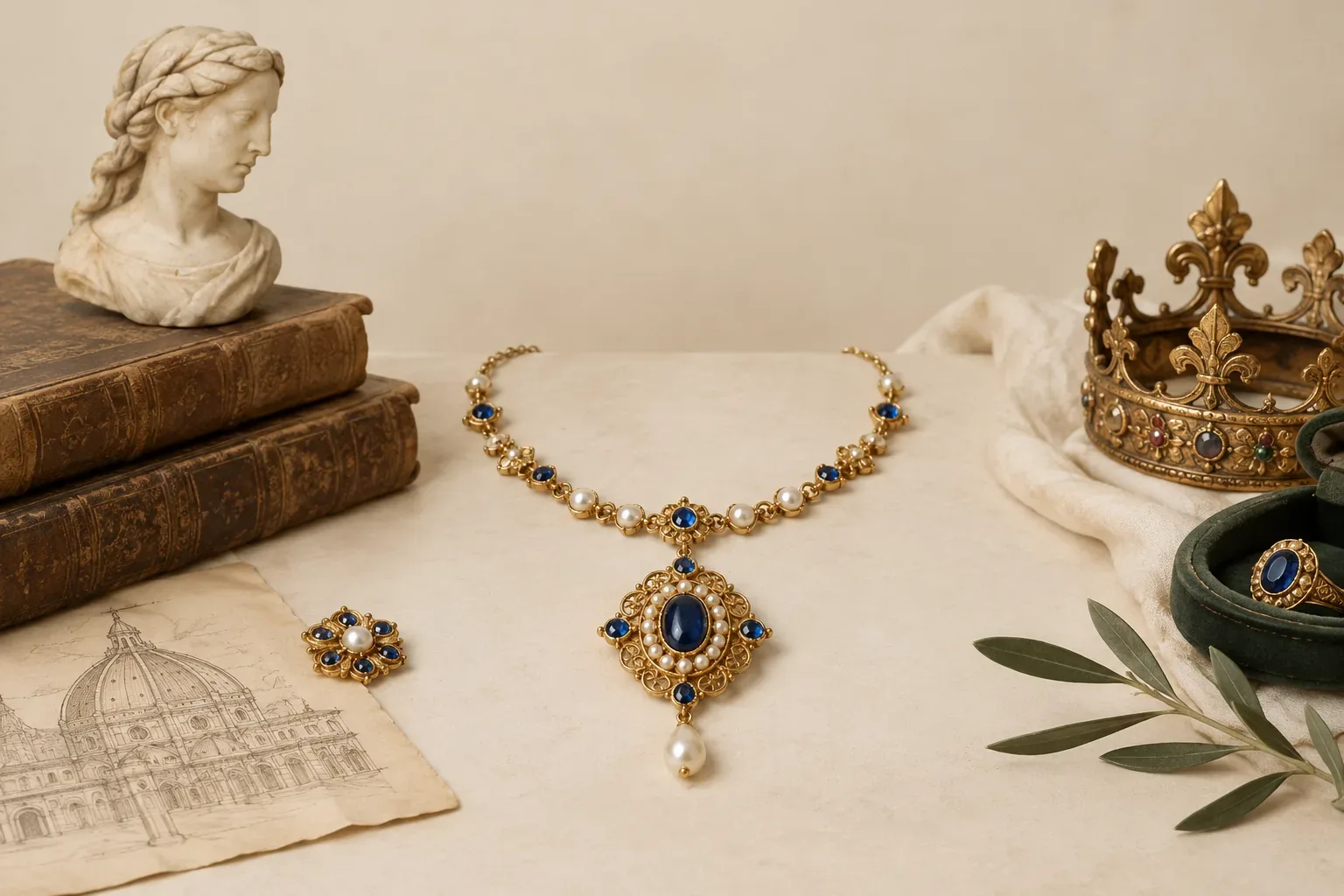
Meaning at a glance
This guide explains documented Renaissance-era jewelry practices and how modern revival pieces reinterpret them, distinguishes historical meanings from personal symbolism, and offers practical, respectful buying and gifting advice including how to verify materials and provenance.
What we mean by Renaissance European jewelry — evidence and cultural scope
When we use the term Renaissance European jewelry we mean European jewellery forms and techniques associated with the Renaissance period and its immediate cultural sphere rather than a single pan-European style. The Victoria and Albert Museum describes jewellery history in social and technical terms, noting how form, materials and ornament reflected city-state and court tastes across regions such as Italy, France, England and the lands of the Holy Roman Empire. Use of the V&A’s research helps separate documented crafts and materials from later storytelling about those objects.
Because the Renaissance was not a single monolithic culture, documented practices vary by place and patron. Italian courts sponsored elaborate goldsmithing and enamelling; Northern European workshops developed their own preferences for portraiture, pearls and religious badges. The V&A places these differences in social context rather than treating them as universal meaning.
Documented historical practices and meanings (what the record shows)
Museum and curatorial research documents the materials and techniques used by makers and the high-level social functions of jewels. The Victoria and Albert Museum records that gemstones, enamels, pearls and complex metalwork were prominent in Renaissance pieces and that jewellery communicated rank, wealth and allegiance as much as private sentiment. These sources emphasize craft, provenance and social context rather than prescribing a single symbolic meaning for any motif.
Historical records and surviving pieces show that religious imagery, portrait miniatures and heraldic devices were used in devotional, commemorative and political contexts. The presence of a saint’s image, a coat of arms, or a portrait miniature in a pendant generally had documented links to devotion, lineage or patronage in specific communities and courts rather than a single, universal meaning across Europe. The V&A’s work highlights the importance of reading each object against its documented social and regional background.
Separating documented historical meanings from modern personal interpretations
Documented historical meanings are those supported by provenance, inventories, correspondence, or consistent usage in period contexts as recorded by museum research. For example, when a Renaissance pendant appears repeatedly in inventories as a devotional badge, the documentary record supports interpreting it as having a religious or communal role. The Victoria and Albert Museum’s historical accounts and collections research are the kinds of documentation you should consult to ground any historical claim.
Modern personal interpretation is equally valid for contemporary wearers but should be described as such. Today a buyer may choose a Renaissance-style serpent ring for its association with rebirth, or a carved cameo for its antique look; these are modern meanings applied by wearers and designers. They are distinct from what an object signified in its original setting and should be presented as personal, stylistic, or emotional symbolism rather than historical fact.
How motifs, gemstones and traditions appear in jewelry — historically and in revival pieces
Historically, motifs such as religious scenes, heraldic animals, classical heads and vegetal ornament appeared in goldsmithing, enamel plaques and gem carving. The Victoria and Albert Museum documents the technical forms—enamel work, gem settings, and goldsmith techniques—that carried those motifs, and their research is a useful reference for identifying period methods versus later imitations.
Gemstones documented in historical collections—pearls, garnets, emeralds and early diamonds among them—were used for visual effect and as markers of status. For guidance on gemstone identification and historical usage, the V&A’s A–Z of Gemstones explains how particular stones were valued and handled in museum contexts. Contemporary revival pieces borrow motifs and stones but often use modern cutting, treatments and settings that differ materially from historic originals.
Responsible context: authenticity, disclosure and modern manufacture
If authenticity matters to you, look for provenance, documented restoration histories, or authoritative attributions. Museums like the Victoria and Albert Museum provide context for original works that dealers can reference; their collection research clarifies how an object should be read historically. When a dealer labels a piece as a ‘Renaissance original,’ ask what documentation supports that claim.
The Federal Trade Commission offers consumer guidance on material and treatment disclosure. The FTC recommends that sellers disclose gemstone treatments, imitations and whether a stone is natural, lab-grown or synthetic. Modern revival jewellery often combines historically inspired design with contemporary materials and treatments, so responsible sellers will state what is antique, what is newly made, and what treatments or substitutes have been used.
Practical selection and respectful gifting guidance
Match the object to the recipient’s context and values. If you choose a motif that had religious or cultural significance historically—such as a saint’s image or a heraldic emblem—consider how a contemporary recipient will perceive that symbol. For gifts intended as heirlooms, prioritize well-documented pieces or well-made reproductions with clear labeling so future owners understand provenance.
Ask for written details: materials, treatments, maker or attribution, and return policy. For gemstones and pearls, request disclosure of treatments and origin where available and consider an independent appraisal for high-value purchases. The FTC’s consumer guidance encourages buyers to seek clear information on treatments and imitations and to expect honest disclosure from retailers.
Respect cultural and religious meanings. Using historical religious imagery purely for fashion can be acceptable in many contexts, but some communities regard certain symbols as sacred. When in doubt, research the symbol using museum resources such as the Victoria and Albert Museum and discuss intentions with the recipient, particularly for gifts intended to honor belief or heritage.
Authentication, care and practical buying steps
Start with reputable sources: established dealers, auction houses with published provenance, or specialist jewellery conservators. Compare seller claims to museum documentation where possible; the Victoria and Albert Museum’s collections and articles can help you understand historical techniques and likely markers of age and manufacture.
Request lab reports for significant purchases and insist on disclosure of treatments in writing. The Federal Trade Commission advises consumers to ask about treatments, synthetics and imitation materials; insist that the retailer documents such disclosures on invoice or certificate. For everyday care, follow standard guidance for metals, enamels and pearls to avoid damage; museum conservation recommendations can differ from retail cleaning instructions, so when possible use specialist advice for valuable or antique pieces.
Last words
A thoughtful purchase of Renaissance-inspired or genuine Renaissance jewellery balances appreciation for historical record with respect for contemporary meaning. Rely on museum research to understand documented context, use consumer-protection guidance to verify materials and disclosure, and choose motifs and pieces with attention to the cultural and personal significance they may carry for the wearer.
Frequently asked questions
How can I tell if a piece is an actual Renaissance original or a revival?
Ask the seller for documented provenance, condition reports and any conservation history. Compare maker marks and techniques to museum references; the Victoria and Albert Museum’s collection research can help you identify likely period methods. For high-value items, obtain an independent specialist opinion or a lab report verifying materials and age-related markers.
What should sellers disclose about gemstones and treatments?
The Federal Trade Commission advises that sellers disclose gemstone treatments, whether a stone is natural, lab-grown, or synthetic, and any imitations used. Request written documentation of treatments and origin when buying gemstones, diamonds or pearls.
Is it culturally insensitive to wear religious or heraldic motifs from the Renaissance?
Context matters. Many motifs are used respectfully as historic or aesthetic designs, but some communities treat certain religious symbols as sacred. If a motif is tied to living religious practice or a specific lineage, consider the recipient’s beliefs and research the symbol’s meaning using museum sources before gifting.
Are revival pieces less valuable than originals?
Original Renaissance items may carry historical, artistic and monetary value beyond a modern revival. Well-made revival pieces can be valuable for craftsmanship and materials, but their value depends on maker, materials and provenance. Decide whether historical authenticity or contemporary craftsmanship is more important for your purchase.
Should I buy an appraisal or lab report for a significant purchase?
Yes. For high-value items, request an independent appraisal and lab reports that document gemstone treatments and authenticity. These documents provide objective information for insurance, resale and accurate historical attribution.
Where can I learn more about historical meanings of specific motifs?
Begin with museum resources. The Victoria and Albert Museum’s publications and collection entries are reliable starting points for understanding historical context, and specialist books or academic catalogues can provide deeper study of particular motifs or regional practices.
Sources and further reading
- Bedazzled: A History of Jewellery — Victoria and Albert Museum
- An A-Z of Gemstones — Victoria and Albert Museum
- Buying Gemstones, Diamonds, and Pearls — Federal Trade Commission