Meaning at a glance
Explain the documented history and changing contexts of the renaissance european jewelry history motif, separate cultural or religious evidence from later popular interpretations, and give practical guidance for choosing and wearing the motif in modern jewelry.
Quick answer
Renaissance European jewelry history shows that jewelers reused classical forms, expensive metals and gems, and new surface techniques to signal wealth, religious identity, and personal alliances; museum scholarship emphasizes shifting social contexts rather than single universal meanings, and modern wearers should separate documented historical uses from later sentimental or popular interpretations when choosing or gifting such pieces.
What the historical evidence shows (and how scholars divide cultures and periods)
Surviving objects, inventories, portraits, and contemporary written descriptions form the basis of what we know about jewelry in Renaissance Europe. The Victoria and Albert Museum presents this evidence as part of a broader narrative about jewellery's role across changing social contexts. Their work emphasizes that pieces must be read in context: urban courts, mercantile cities, and regional workshops produced different styles and functions.
When discussing the Renaissance it is important to keep regions and courts separate. Northern and Italian workshops, for example, worked from different local traditions and client tastes. Museums today typically distinguish Italian Renaissance court jewellery, which often looked to classical antiquity for motifs, from Northern European pieces that might combine local religious tastes with imported techniques. Attributing a single meaning to a motif across all of Renaissance Europe overlooks these regional differences and the changes across decades.
Materials and techniques documented by museums
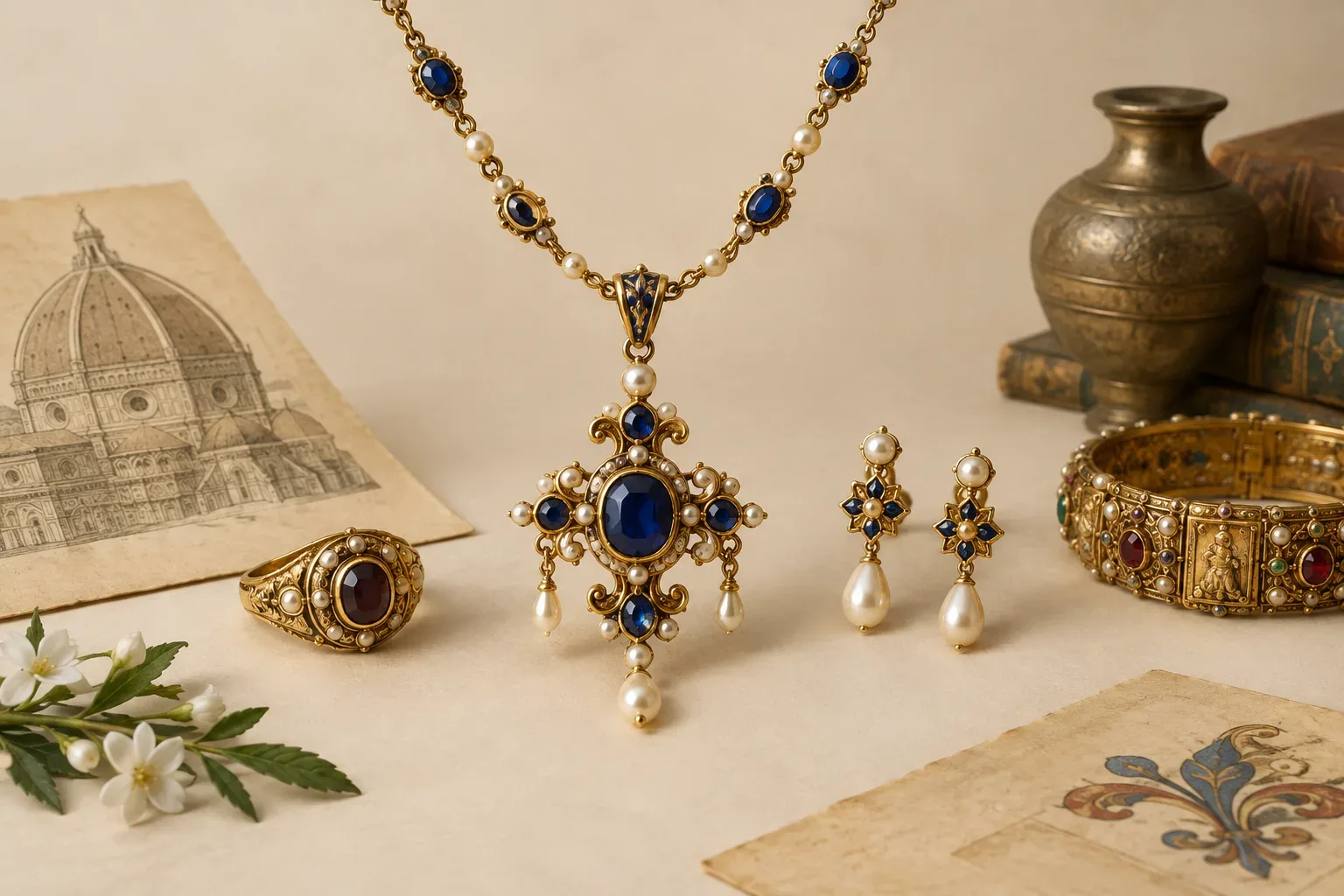
Museum collections and scholarly displays highlight a few consistent material choices in Renaissance jewellery: precious metals such as gold, surface treatments like enamel, and the use of pearls and cut gemstones. The Victoria and Albert Museum’s exhibition materials and articles describe how craftsmen combined these materials with complex settings and enamel work to create pieces that were visible signs of status and taste.
Gemstones played both aesthetic and status roles. The V&A’s resources on gemstones explain that the choice of stone, how it was cut, and how it was set influenced how a piece read in its original time. Modern reference guides, such as those assembled by museums, also remind us that contemporary gem names and cutting techniques do not map exactly onto Renaissance practice. Finally, consumers today need to be aware of modern treatments and imitations; the Federal Trade Commission provides guidance that dealers must disclose treatments, synthetics, or imitations when selling gems.
How motifs, gemstones, and traditions appear in Renaissance jewellery
Motifs frequently referenced classical antiquity, biblical subjects, and heraldry, and they appeared as carved cameos, engraved scenes, intaglios, and miniature portraits. Museums describe how cameos and classical motifs were often set in gold frames or attached to larger compositions that signalled education and classical learning in specific social circles.
Gemstones and pearls appear in many forms: as single focal stones in rings, as strings of pearls in necklaces and headdresses, and as small accent gems in intricate metalwork. Enamel panels and gem-inlaid surfaces provided color and pattern. The arrangement of gems, the use of pearls, and the incorporation of enamel or miniature painting influenced a piece’s public function—whether it was worn to court, for public display, or for more private devotional use.
Documented historical meanings versus later or modern interpretations
Museum scholarship stresses that many meanings we assign today are modern reinterpretations or sentimental readings that developed after the period. For example, an emblem or motif that a modern wearer finds romantic or protective may originally have been a mark of family identity, a display of classical learning, or a public statement tied to a particular court. The Victoria and Albert Museum cautions readers to read pieces against contemporary records and portraits rather than assuming present-day symbolic associations.
Documented meanings come mainly from inventories, wills, household records, and visual sources where context is clear. When a motif is described in a contemporaneous inventory as a 'locket with a saint’s image' or a 'gold ring with a heraldic device', those descriptions provide stronger evidence for historical intent than later folklore. Modern personal interpretations—such as assigning universal romantic significance to a motif—can be meaningful for the wearer but are not historical facts.
Practical guidance for choosing or gifting Renaissance-inspired pieces today
Decide whether you want an authentic period piece, a museum-quality reproduction, or contemporary work inspired by Renaissance forms. Authentic Renaissance objects are rare and typically held in museum collections; if you encounter such a piece on the market, seek documented provenance and independent scholarly or dealer verification. If your goal is historical style rather than antiquity, a skilled modern maker can reproduce motifs and techniques more affordably and safely for daily wear.
Respect cultural and religious significance. When a motif has a documented religious or heraldic origin, consider whether wearing it could be sensitive for the communities historically associated with it. If you are unsure, consult museum resources or a specialist dealer and choose designs that honor provenance rather than appropriate or trivialize it.
Ask sellers about gemstone treatments and disclosure. The Federal Trade Commission advises that sellers must disclose known treatments, synthetic stones, and imitations. For gems and pearls, request written details about whether stones are natural, treated, or lab-grown and whether pearls are natural or cultured. A clear report or certificate increases confidence for both buyers and gifters.
Match metalwork and stone choice to use. For everyday wear choose durable mountings and stones that tolerate day-to-day wear. For a gift intended as a keepsake, consider secure settings and classic motifs that can be appreciated in different contexts. If the piece references a known personal or family symbol, verify spelling and heraldic elements with the recipient when possible to avoid gifting errors.
Contextualize your gift. When presenting a Renaissance-inspired piece, include a concise note that explains whether the piece is an original, a reproduction, or a modern design inspired by historical forms and, if possible, a short line about the motif’s documented historical meanings or regional origins. This both educates and signals respect for the object’s past.
Final note on wearing historical motifs today
Wearing Renaissance-inspired jewelry can be an elegant way to connect with artistic traditions, but it is best done with attention to provenance and context. Museum research encourages contemporary users to separate historically documented roles of jewellery—from status and allegiance to devotional uses—from modern personal symbolism. Whether you select an antique or a modern piece in a Renaissance mode, transparency about origin and sensitivity to historical meaning will make the piece both more interesting and more respectful.
Frequently asked questions
What materials were most common in Renaissance European jewellery?
Museum resources show that precious metals such as gold, surface techniques like enamel, pearls, and a variety of cut gemstones were commonly used; the exact mix varied by region and client, so scholars rely on surviving objects and inventories to identify local patterns (Victoria and Albert Museum).
How can I tell if a piece is an authentic Renaissance object or a later reproduction?
Authentic Renaissance pieces are typically documented in museum collections or come with reliable provenance; physical age indicators require specialist assessment. If authenticity is important, seek independent verification from a qualified dealer or conservator and ask for provenance documentation rather than relying on a seller’s description.
Are the symbolic meanings of Renaissance motifs the same today?
No. Museums emphasize that many meanings commonly assigned now are later reinterpretations. Documented meanings should be drawn from contemporary inventories, portraits, and records; modern personal meanings are valid for the wearer but are not historical evidence (Victoria and Albert Museum).
What should I ask about gemstones when buying Renaissance-style jewellery?
Follow federal guidance: ask whether stones are natural, treated, synthetic, or imitations and request written disclosure. The Federal Trade Commission advises that sellers must disclose known treatments and the nature of the stones to buyers.
Is it appropriate to wear religious or heraldic motifs from the Renaissance?
It can be appropriate if you understand the motif’s provenance and respect its historical associations. When in doubt, research the symbol’s original context and consider choosing a design that honors rather than trivializes cultural or religious meaning.
Should I buy an original or a reproduction as a gift?
If your priority is affordability and everyday wear, a high-quality reproduction or contemporary piece inspired by Renaissance forms is generally a safer choice. If you prioritize historical authenticity, be prepared to request provenance and expert verification and to purchase from reputable dealers or auction houses.
Sources and further reading
- Bedazzled: A History of Jewellery — Victoria and Albert Museum
- An A-Z of Gemstones — Victoria and Albert Museum
- Buying Gemstones, Diamonds, and Pearls — Federal Trade Commission