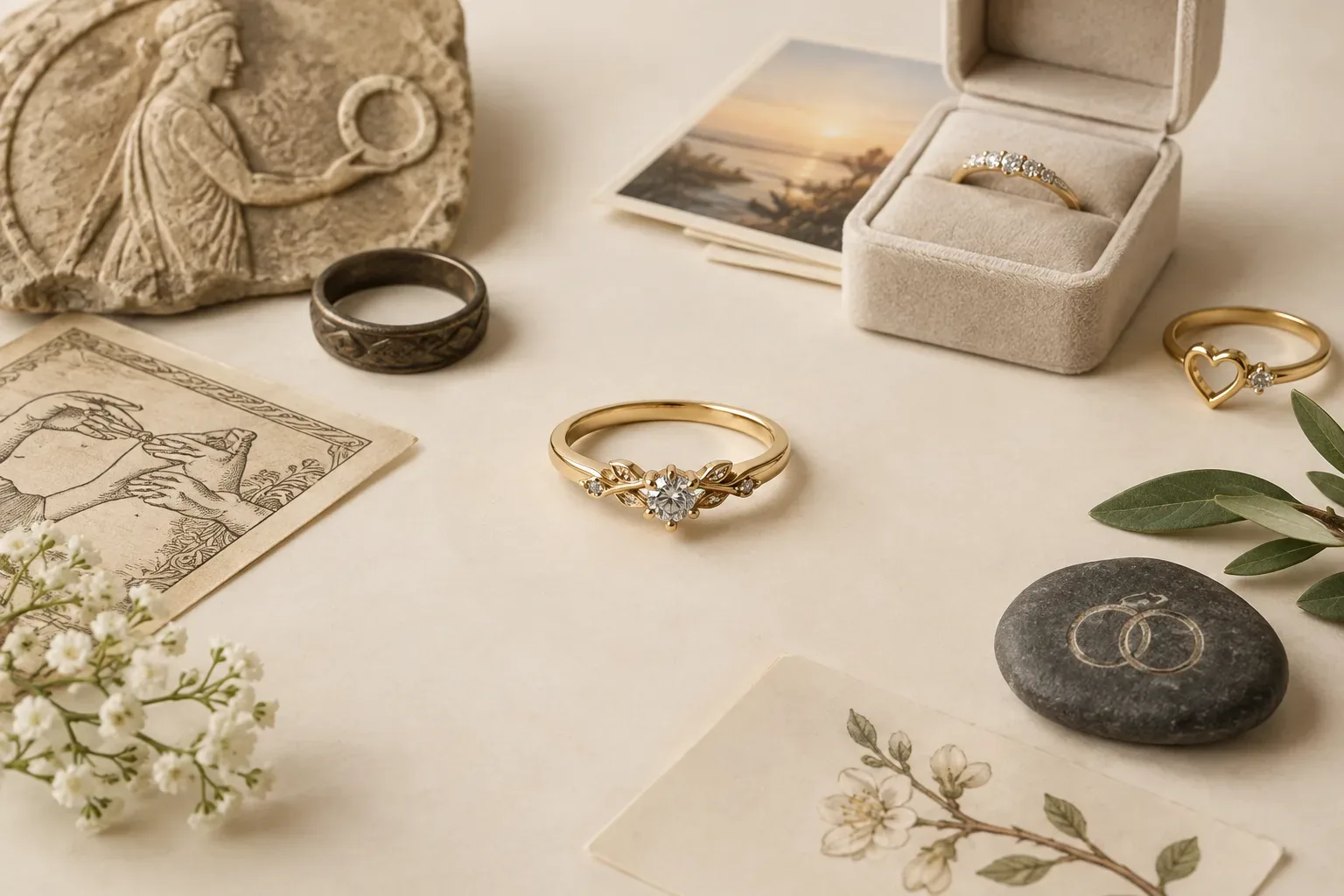
Meaning at a glance
This guide explains the documented history and changing contexts of promise-style rings, separates historical evidence from modern personal meanings, describes how motifs and gemstones appear in jewelry, and gives practical online-shopping and gifting advice including what photos and policies to require and which red flags to avoid.
What history tells us (and which sources say so)
Jewellery has carried social meanings across times and places, and museums such as the Victoria and Albert Museum emphasise that the function and symbolism of rings have evolved as social contexts changed. The V&A frames jewellery history as a record of changing fashions, materials and social signals rather than a single, fixed set of meanings. Use that museum context to understand rings: what looks like a 'promise' in one era may have had a very different role in another.
The V&A’s research and collections also show that certain forms and motifs recur—knots, hearts, and clasped hands appear in examples of sentimental jewellery documented by curators—while different gemstones have their own histories of fashion and association. For information about individual gems and their changing uses in jewelry, the V&A’s A–Z of Gemstones provides identification and historical context for stones you will commonly see in modern promise-style rings.
Documented historical meanings versus modern personal interpretations
Documented historical meanings come from period-specific uses, makers’ records, and museum interpretation. For example, curators at the Victoria and Albert Museum explain how sentimental motifs and personal tokens shifted in meaning as social habits changed; a ring worn as a token of friendship, a family heirloom, or a marker of social contract in one century may be read differently by people today. When assessing older rings or vintage styles, rely on documented provenance and museum scholarship rather than assuming contemporary uses.
Modern personal interpretations are individual and culturally varied. Today people buy ‘promise rings’ for many reasons: a symbol of commitment without marriage, a friendship token, a purity pledge in some religious communities, or simply a romantic gesture. These meanings are contemporary social uses, not universal definitions. Treat them as personal or subcultural practices rather than fixed historical facts.
How motifs, gemstones, and traditions appear in promise-style jewelry
Motifs: Visual symbols long associated with affection—such as knots, hearts, and clasped hands—appear repeatedly in history and in modern designs. Museum collections documented by the Victoria and Albert Museum show that these motifs are durable because they are visually compact and recognisable, making them useful for tiny objects like rings and signet-style pieces.
Gemstones and treatments: Promise-style rings commonly use small diamonds, sapphires, pearls, or more affordable gemstones depending on budget and taste. The V&A’s A–Z of Gemstones helps identify stones and provides historical context about when certain gems rose or fell in fashion. When buying online, be aware that gems may be natural, treated, synthetic, or simulant, and sellers should disclose such information. The U.S. Federal Trade Commission specifically advises consumers to ask about treatments, origin, and any imitations, and to expect clear disclosure for diamonds, colored stones, and pearls.
Traditions in manufacture and styling: Contemporary promise rings range from plain bands to gem-set designs and engraved or themed motifs. Historically, the production methods and available materials shaped design: fine metalwork and hand engraving dominated earlier centuries, while modern casting and new gem varieties expanded accessible styles. The V&A highlights how changing technology and social tastes have affected what makers produce and what wearers expect.
Photos, policies, and what to demand from an online seller
Photos: Insist on clear, current photographs that show the item from several angles at realistic scale. You should see close-ups of the setting, the hallmarks or stamps inside the band, the gemstone from multiple directions, and at least one photo that provides size context, such as the ring on a sizing cone or next to a ruler. Ask for unedited images if authenticity is a priority.
Written descriptions and disclosures: The seller should identify metal type and purity, gemstone identity, and any treatments or enhancements. The Federal Trade Commission calls attention to material-treatment and imitation disclosures; if a seller does not clearly state whether a stone is natural, treated, lab-grown, or a simulant, that is a legitimate cause for concern.
Certification and documentation: For higher-value stones, request independent certification or a gemstone report that matches the item you see. Certificates should reference the specific stone (weight, measurements, and distinguishing characteristics). For modestly priced promise rings, good seller provenance and consistent descriptions are often sufficient, but examine photos and policies carefully.
Sizing and measurements: Sellers should list ring size, inner diameter or circumference, band width, and gemstone measurements in millimetres. If the seller offers resizing, check whether that service is included, how long it takes, and whether it affects returns.
Return, repair, and shipping policies: Expect a clear return window, return shipping instructions, and a repair policy. Confirm who pays return shipping in case of size mismatch or misrepresentation, and ask about insured shipping for valuable items.
Red flags to watch for
Blurry or stock images that do not show identifying marks or that look like generic product shots. If the seller provides only a model photo of a ring and not pictures of the actual item, request additional proof.
Vague or missing material information. If the listing omits the metal purity, gemstone identity, or any mention of treatments, ask directly. The FTC highlights the importance of disclosure about treatments, imitations, and origins.
No return policy or an unusually short or conditional return window. Reliable sellers offer reasonable return terms for jewellery for fit or dissatisfaction reasons.
Price that is dramatically lower than comparable items with no reasonable explanation. Extraordinary bargains on recognisable high-value gems or designer marks often indicate imitation or misrepresentation.
Inconsistent details across photos, description, and certificate. If measurements, weights or descriptions don’t match the photos or accompanying paperwork, pause and request clarification.
Pressure tactics to send money via non-protected methods or to accept a ‘no-questions-asked’ sale. Reputable sellers use traceable payment and shipping channels and provide receipts.
Practical and respectful selection and gifting guidance
Clarify intention before buying. Consider the relationship and how the gift will be received. A promise ring can mean many things; if the meaning matters to both people, have a conversation about expectations. If the ring is meant as a surprise, choose a neutral, reversible meaning or include a note explaining your intention to reduce misinterpretation.
Match style and wearability. Choose a profile and band width that suits the recipient’s daily activities and taste. A low-profile setting works better for those who use their hands a lot; a plain band may be preferable for minimalist wearers. When in doubt, choose classic, durable designs that can be worn alone or stacked.
Budget and gem choice. Set a budget and be transparent about it if the recipient values knowledge of cost. Consider alternative stones or design choices: small diamonds, sapphires, or bezel-set stones offer durability and daily-wear practicality. For meaningful color choices, consult the recipient’s preferences instead of relying on supposed universal gemstone meanings.
Sizing and personalization. If you can’t get an exact size, shop for a ring with a return window or one that the seller will resize. Simple engravings can personalize the piece without changing its everyday wearability.
Documentation and a caring presentation. Provide any certificates, receipts, and a clear return policy when you gift the ring. A thoughtful note explaining your intent separates personal meaning from assumed obligations.
Final checklist before you click Buy
Confirm that photos show the actual item and its marks, ask for additional images if anything is unclear, and verify the ring size and measurements in millimetres. Ensure the seller discloses metal purity and gemstone identity and asks about any treatments or enhancements. Review the return policy, repair or resizing options, shipping insurance, and whether a certificate accompanies the piece. If answers are slow, incomplete, or inconsistent, treat that as a reason to pause.
Frequently asked questions
What exactly is a promise ring?
A promise ring is a small, often symbolic ring given to signify a personal commitment decided by the giver and recipient. Modern uses vary widely—examples include romantic commitment without immediate engagement, friendship tokens, or personal pledges. The specific meaning depends on the individuals involved rather than a single historical definition.
What photos should I demand from an online seller?
Ask for clear, recent photos from multiple angles including close-ups of any hallmarks or stamps, a scale photo to show size context, and detailed images of the gemstone and setting. Request unedited images or additional angles if any detail is unclear.
How do I know if a gemstone is treated or synthetic?
Reputable sellers will state whether a stone is natural, treated, lab-grown, or a simulant. For higher-value stones, ask for an independent lab report. The Federal Trade Commission recommends that buyers request disclosure of treatments and origin, and treat missing information as a reason to ask more questions.
What are the key return and repair policy items to check?
Confirm the length of the return window, who pays return shipping, whether the seller will resize and at what cost, how repairs are handled and how long they take, and whether insured shipping is provided for valuable items.
Is it disrespectful to ask about price or provenance when gifting?
No; many recipients appreciate transparency. If you prefer to keep price private, include the receipt and provenance with the gift but explain that the cost is personal. Open communication about meaning and expectations is usually more respectful than assuming a single interpretation.
What should I do if a listing seems too good to be true?
Treat unusually low prices or inconsistent listings as a red flag. Ask for more photos, proof of hallmarking, and documentation. If the seller resists verification or insists on rushed payment methods, walk away and buy from a more transparent seller.
Sources and further reading
- Bedazzled: A History of Jewellery — Victoria and Albert Museum
- An A-Z of Gemstones — Victoria and Albert Museum
- Buying Gemstones, Diamonds, and Pearls — Federal Trade Commission