Meaning at a glance
Prehnite is commonly pale green to yellow‑green and is most often cut as cabochons or beads; when buying and caring for prehnite jewelry, focus on correct identification, treatment disclosure, and protective settings rather than assuming universal symbolic meanings.
Quick answer
Prehnite jewelry meaning is twofold: as a mineral description it is most often pale green to yellow‑green and commonly fashioned into cabochons and beads; as a symbolic meaning it has become associated in modern contexts with calm and preparedness, but identity, inclusions, treatment disclosure, durability, and practical care are separate, objective concerns you should treat independently when buying or gifting.
What the record shows about prehnite’s history and cultural use
Museum and gemological records emphasize prehnite as a mineral specimen with particular physical and geological characteristics rather than as a widely documented cultural emblem. The Smithsonian National Museum of Natural History frames prehnite within mineral collections and geological context, where emphasis is on identification and formation rather than on a body of consistent historic symbolism (Smithsonian National Museum of Natural History).
Because standard museum and gemological literature focuses on geology and gem treatment, there is limited, well‑documented material in those sources tying prehnite to a single, long‑standing symbolic tradition across a named culture or historical period. That absence of clear, unified historical symbolism in authoritative museum and gemological records means modern symbolic meanings are best understood as recent, personal, or community creations rather than as universally attested historical beliefs.
Documented evidence versus modern interpretation
Documented evidence in the institutional sources used here concerns mineral identity, formation context, and responsible consumer disclosure. The Smithsonian provides the scientific framework for identifying and understanding prehnite as a mineral specimen (Smithsonian National Museum of Natural History). Professional gemology organizations like the Gemological Institute of America concentrate on treatments, disclosure practices, and how to evaluate a gem’s reported history (Gemological Institute of America).
Modern meanings—words like “calm,” “healing,” or “preparedness” that you may see attached to prehnite in marketing or personal storytelling—are contemporary interpretations made by individuals, jewelers, or spiritual communities. Those personal or contemporary associations are valid as subjective meaning for the giver and wearer, but they are not the same as documented historical evidence and should not be presented as a universal cultural fact.
Color, appearance, and common cuts
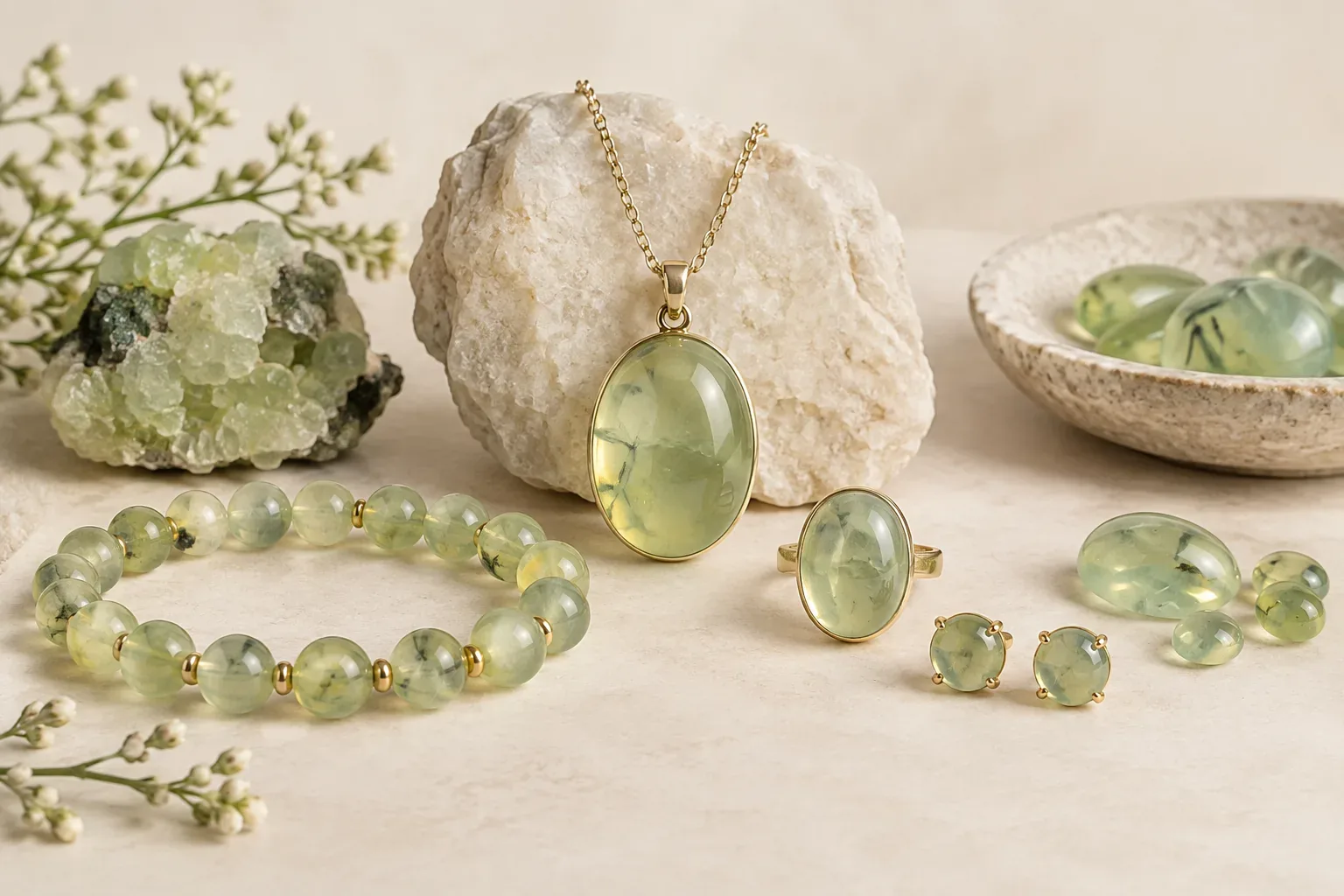
Prehnite is commonly pale green to yellow‑green in tone and is frequently cut as cabochons and beads for use in jewelry. Those forms show color and surface luster well, and cabochons in particular emphasize smooth color fields rather than faceted brilliance. In contemporary jewelry you will also find prehnite set in pendants, beaded necklaces, and artisanal wire‑wrapped or bezel settings that showcase the stone’s soft hue.
Because prehnite is used primarily as a polished gem rather than a faceted brilliant, it often appears in designs that favor organic, understated presentations: rounded cabochon rings and starched or draped beaded necklaces are common ways artisans and commercial makers highlight the stone’s gentle green tones.
How prehnite appears in jewelry and design contexts
Designers typically use prehnite in pieces that suit its visual character: pendants that let light pass through thin sections, cabochon rings or earrings whose smooth domes accentuate color, and bead strings where multiple beads create a field of green. The stone’s subdued color supports both minimalist and bohemian aesthetics; it is often paired with silver and other pale metals, or with mixed‑metal designs when artisans want a soft, natural palette.
Because contemporary uses are diverse, prehnite can be a statement cabochon in a handcrafted ring or a subtle bead in a layered necklace. Where protective settings are desired for rings or bracelets, look for bezels or raised edges that reduce the chance of knocks and abrasion during wear.
Buying and gifting: what to ask and what to expect
When buying prehnite, ask the seller for clear information about the stone’s identity and any treatments or enhancements. The Gemological Institute of America explains the importance of treatment disclosure and the kinds of questions consumers should expect about a gem’s alterations (Gemological Institute of America). The U.S. Federal Trade Commission (FTC) also advises consumers that terms such as “natural,” “treated,” “lab‑grown,” and “imitation” have specific meanings and must be disclosed in sales situations, and that buyers should verify those claims (Federal Trade Commission).
If the piece is expensive or if you want an independent opinion, request written confirmation of origin or a gemological report. For gifting, consider how the recipient wears jewelry: a bezel setting and a lower‑profile mounting will be safer for everyday wear, while an open pendant or loose bead strand might suit someone who prefers more delicate handling. Because symbolic meanings are personal and culturally variable, if you intend the piece as a symbolic gift, explain your intention in a note or conversation rather than assuming the recipient shares the same interpretation.
Durability and practical care
Objective concerns about durability and care should guide how you wear and store prehnite pieces. Before using mechanical cleaning methods or exposing a stone to heat, ask the seller whether the piece has been treated or assembled with adhesives or fractures. The Gemological Institute of America recommends confirming treatments prior to using steam or ultrasonic cleaners because some treatments and adhesives can be damaged by those methods (Gemological Institute of America).
For everyday safety, keep prehnite jewelry separate from harder gemstones and metals that could scratch it, and avoid subjecting pieces to strong blows or harsh chemicals such as household cleaners or cosmetics. Store softer or polished pieces in a fabric‑lined box or pouch to reduce abrasion and accidental chips. Routine cleaning with a soft cloth and a mild soap and water rinse is a conservative approach; if you need stronger cleaning, verify that the method is safe for that specific stone and setting before proceeding.
Practical selection tips and respectful gifting guidance
When selecting prehnite for yourself or as a gift, prioritize credible disclosure, appropriate protective settings, and color consistency that matches the recipient’s taste. Ask the seller for information about treatments and for clear return policies so you can exchange or return a piece if it doesn’t meet expectations. The FTC’s consumer guidance highlights the importance of clear labeling and the buyer’s right to accurate, non‑misleading information about gemstones (Federal Trade Commission).
If symbolic meaning is important, frame the stone’s modern associations as personal and contemporary rather than historic fact. Offer context for why you chose prehnite—its color, the look of a particular cabochon, or the personal meaning you attach to it—and allow the recipient to accept, adapt, or decline that symbolism on their own terms. Thoughtfully packaged information about care and any known treatments is also a respectful and useful addition to a gifted piece.
Final notes
Prehnite’s appeal in jewelry arises from its soft green shades and the quiet elegance of cabochons and beads. Until a seller provides otherwise, treat modern symbolic claims as personal interpretations rather than documented historical fact, and treat practical concerns—identity, treatment disclosure, appropriate setting, and careful maintenance—as the primary determinants of a good purchase.
If you want to learn more about related topics—how to choose meaningful jewelry, how to care for color and coatings, or how natural, lab‑grown, and imitation birthstones differ—see our related articles on the site for deeper practical guidance.
Frequently asked questions
What colors does prehnite come in?
Prehnite is commonly pale green to yellow‑green. Variations in tone and saturation occur, but the stone is most often seen in those soft green hues.
Are prehnite gems treated or enhanced?
Gem treatment practices vary by market; the Gemological Institute of America recommends asking sellers about any treatments. Sellers are expected to disclose treatments, and consumers should verify such claims before purchase.
How should I clean prehnite jewelry?
A conservative cleaning method is a gentle soap and lukewarm water rinse with a soft cloth. Before using steam or ultrasonic cleaners, confirm with the seller or a gemologist whether those methods are safe for the specific piece, since some treatments or settings can be damaged by aggressive cleaning.
Is prehnite a good choice for everyday wear?
Whether prehnite is suitable for daily wear depends on the piece’s setting and how the wearer uses it. Protective settings such as bezels reduce risk of damage. Confirm treatment status and select sturdy mountings if you expect heavy everyday use.
How can I be sure a prehnite stone is authentic?
Ask the seller for clear identification and treatment information. For higher‑value pieces, request a written report from a recognized gemological laboratory. The FTC advises consumers to seek accurate labeling so that 'natural,' 'treated,' 'lab‑grown,' or 'imitation' descriptions are not misleading.
Should I present symbolic meanings when gifting prehnite?
Yes, but frame symbolic meanings as personal or contemporary interpretations rather than as universally historical facts. Explain your intended symbolism in a note so the recipient understands your meaning and can accept or reinterpret it.
Sources and further reading
- Gems and Minerals: Beauties and Building Blocks — Smithsonian National Museum of Natural History
- An Introduction to Gem Treatments — Gemological Institute of America
- Buying Gemstones, Diamonds, and Pearls — Federal Trade Commission