Meaning at a glance
Follow a step-by-step planning method that fixes the names and dates, selects month-to-stone choices from an accepted list, defines engraving text and layout limits, pre-approves substitutions, confirms spelling, and secures a written order confirmation that includes gemstone disclosures and timelines.
What historical evidence shows about birthstones
The association of particular gems with times of life and months is not a single universal tradition but an evolving set of lists and practices. The Gemological Institute of America (GIA) documents that these associations were recorded in different places and eras and that the lists used in modern retail practice developed over time. GIA traces links between gem lists used in ancient and medieval cultures and the later commercial lists used by jewelers.
GIA and related professional materials show that modern standardized month-to-stone lists emerged in the 20th century as trade associations and gemological bodies sought to harmonize varying local lists for consumers and retailers. This standardization reflects commercial and cultural developments rather than a single ancient prescription for meaning.
Documented historical meanings versus modern personal interpretations
Documented meanings reported by professional bodies like the GIA relate to historical usage and to the practical role birthstone lists have played in commerce. Those documented facts include which stones have been associated with which months at various times and where jewelers standardized lists for retail practice.
Modern personal interpretations—what a stone or an engraved name means to an individual or family—are contemporary, subjective, and vary widely. They are not universal facts and should be treated as personal symbolism rather than as historical prescription.
How names, motifs, and birthstones appear in jewelry
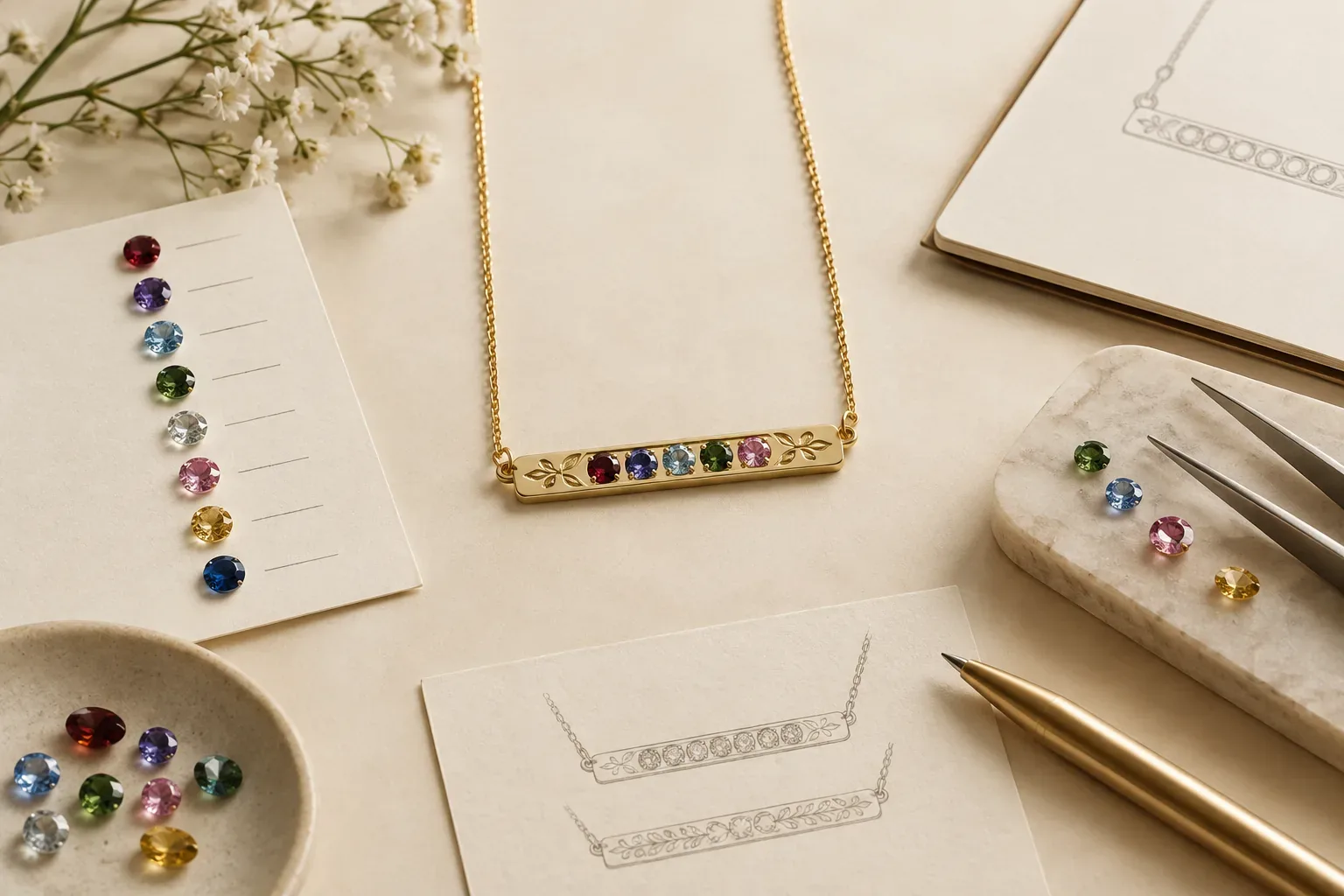
Personalized birthstone jewelry commonly combines engraved text with set gemstones in pendants, rings, bracelets, lockets, and bar-style necklaces. Typical motifs include simple nameplates, birthstone stations in chain bracelets, stacked rings with small set stones, and family-style pendants that place multiple stones in a single piece. Jewelers of America describes the common formats and considerations customers use when choosing metal and setting style for personalized pieces.
Design and setting decisions should reflect the chosen stone’s durability and the wearer’s lifestyle. The GIA’s guidance on gemstone durability explains how setting style, bezel protection, and metal choice affect how a stone will wear over time. For everyday wear such as rings and bracelets, choose better-protected stones or protective settings; for occasional wear, more delicate stones or open settings may be acceptable.
A precise planning method (names, stones, engraving, approvals, substitutions, spelling, and confirmation)
Step one: Fix the guest list and the exact text. Decide which names and dates will appear and whether you will use full names, initials, nicknames, or birth years. Draft the exact engraved text in plain text and include capitalization, accents, and punctuation exactly as you want them to appear. This prevents later disputes and is the basis for the layout proof.
Step two: Choose months and stones from a known reference. Use an accepted month-to-stone list as your starting point so everyone understands what each listed month implies. The Gemological Institute of America publishes a contemporary list of commonly accepted birthstones; use that list to avoid confusion when ordering from a jeweler who follows the same standard.
Step three: Match stone choice to use and durability. Consult the GIA’s gemstone durability guidance to decide which stones are appropriate for everyday wear versus occasional jewelry. If a chosen birthstone is relatively soft or brittle, select a protective setting such as a bezel or choose to locate that stone in a pendant rather than a ring.
Step four: Draft engraving and layout requirements. Give the jeweler a single approved engraving text and a maximum character count including spaces. Specify the desired font family or a close sample and whether you want upper-case, lower-case, or mixed case. Ask the jeweler to provide a digital layout proof showing the names, dates, and stone placement before production begins.
Step five: Define acceptable substitutions and alternatives in writing. Decide whether you will accept lab-grown stones, alternative stones for color match, or simulated gems if the natural option is unavailable. The Federal Trade Commission requires clear disclosure of treatments, lab-grown origin, and imitation materials, so include explicit acceptance or rejection of those options in your order instructions.
Step six: Spelling verification and approval. Double-check spellings, diacritics, and the order of names. Ask for a repeat-back from the vendor that copies your supplied text exactly. If you are ordering on someone else’s behalf, get written permission from the recipient when possible to avoid unexpected personal or cultural missteps.
Step seven: Written order confirmation. Before production begins, require a written order summary that lists the engraved text, the month-to-stone choices, the exact gem specifications including whether stones are natural, lab-grown, or treated, the agreed substitutions policy, the expected production and delivery dates, the return and resizing policy, and the cost breakdown. Keep that confirmation until the order is fulfilled.
Step eight: Final pre-production sign-off. Only after you receive and approve the layout proof and the written order confirmation should the jeweler begin work. Make any final minor corrections in writing and retain all correspondence as proof of the agreed instructions.
Practical and respectful selection and gifting guidance
Respect personal and cultural meanings by asking, when appropriate, whether the recipient prefers a particular stone or is comfortable with personalization. Do not assume a birth month or a stone conveys the same meaning across families or cultures. If you cannot ask, choose neutral personalization such as initials or a shared family date rather than symbols that might carry political or religious connotations.
Be transparent about materials and care. The Federal Trade Commission advises consumers to seek written disclosure about whether gemstones are natural, treated, or lab-grown. Tell recipients how to care for their piece, especially if it contains a less durable stone, and choose protective settings for active wearers. If you are ordering for a child or someone who works with their hands, prioritize durability and fastening security.
Allow time for custom work. Personalized engraving and setting require extra production time. Build a reasonable schedule so layout proofs, approvals, and any required remakes fit before gifting dates. Include a contingency plan in the written order confirmation for late delivery or unacceptable proof results.
Final checklist before you click order
Verify the exact engraved text in writing, including capitalization and accents. Confirm the month-to-stone list you used and that the jeweler follows that reference. Accept or decline specific substitutions and note whether lab-grown or treated stones are acceptable. Approve the digital layout proof and confirm the setting style chosen to protect softer stones. Get a written order confirmation that names the exact materials, any treatments or lab-grown status, production and delivery timelines, the seller’s return and remake policies, and the final price. Keep all confirmations, proofs, and messages until the order is complete and any warranties have been activated.
Frequently asked questions
Can I substitute a different stone for a birth month?
Yes, you can substitute if you and the recipient agree. Specify acceptable substitutions in writing and note whether you accept lab-grown or simulated stones. The FTC requires sellers to disclose treatment and origin, so document acceptance or rejection of substitutes before production.
How do I handle spelling or name changes before engraving?
Provide the exact engraved text with capitalization and accents in writing and require the jeweler to repeat it back. Approve a digital layout proof before production. If the recipient’s name may change, consider using initials or a neutral date instead.
What should I ask about a stone’s durability?
Ask the seller about the stone’s hardness and toughness and consult GIA guidance on durability. For pieces intended for daily wear, choose stones and settings that offer protection, such as bezels or recessed mounts.
Do I need a written order confirmation for a custom piece?
Yes. A written order confirmation should include the engraved text, stone choices and origin, any treatments, agreed substitutions, production and delivery timelines, return and remake policies, and total cost.
Are there common character limits for engraving?
Character limits vary by item size and font. Request the jeweler’s maximum character count and ask for a layout proof. If space is tight, use initials or a shortened form to avoid cramped engraving.
Should I tell the recipient I’m ordering personalized jewelry for them?
When possible, ask permission to avoid surprising someone with personal or culturally sensitive text. If the occasion requires secrecy, choose neutral personalization such as initials, a shared date, or a simple symbol.
Sources and further reading
- Birthstones for Each Month — Gemological Institute of America
- Buying Gemstones, Diamonds, and Pearls — Federal Trade Commission
- Jewelry Buying Guides — Jewelers of America
- Gemstone Durability: Design to Display — Gemological Institute of America