Meaning at a glance
This guide explains the documented history and changing contexts of pendant motifs, distinguishes historical meanings from later popular interpretations, and gives practical advice for choosing materials, assessing quality, and gifting pendant necklaces today.
What the historical evidence tells us (and where it comes from)
Museum scholarship and exhibition research present most of what we can reliably say about the long history of pendants. The Victoria and Albert Museum summarizes how jewelry has changed with social roles, technologies, and trade networks over millennia, documenting distinct uses of pendants in different times and places rather than a single continuous meaning (Victoria and Albert Museum).
For example, museum collections and catalogs show that in some ancient cultures pendants functioned as amulets or status markers, while in later periods pendants served as portrait lockets, religious badges, or fashion statements. The specific forms, materials, and social contexts differ: a carved gemstone worn in one culture may be an amulet, while an enamelled devotional pendant in another period signifies a different practice, and these identifications depend on archaeological and archival evidence rather than modern assumptions (Victoria and Albert Museum).
Gemstones themselves have long histories of trade, decorative use, and symbolic association. The Victoria and Albert Museum’s reference on gemstones outlines their historical sources, use in jewelry, and the changing fashions that influenced how particular stones were set and worn (Victoria and Albert Museum).
Separating documented historical meanings from modern interpretations
Documented historical meanings come from artifacts, inscriptions, inventories, and contemporary accounts studied by historians and curators. When museum records identify a pendant as a mourning locket, a devotional object, or a sign of social rank, they are basing that identification on contextual evidence such as inscriptions, portraits, or probate inventories (Victoria and Albert Museum).
Modern popular interpretations—such as assigning a single, universal spiritual meaning to a motif or assuming an ancient symbol has the same significance today—are different in kind. Contemporary wearers often repurpose historical forms as personal statements, fashion choices, or new symbols of identity, and those modern meanings are valid as personal interpretation but are not the same as the documented historical function. Treat museum evidence as context and modern meanings as individual or cultural reinvention.
How motifs, gemstones, and traditions appear in pendant jewelry
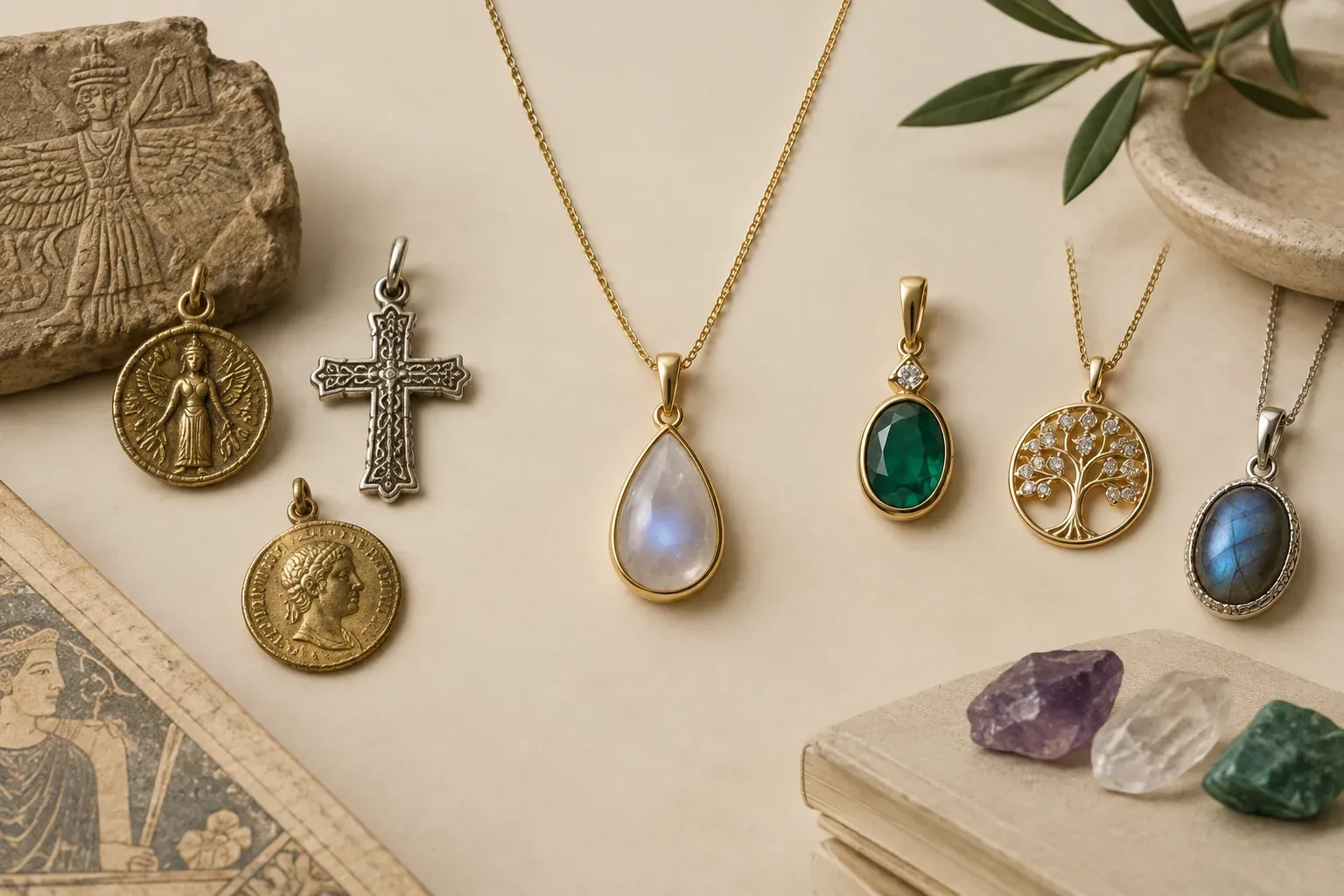
Motifs appear in pendants in many forms: engraved or carved gemstones, enamelled scenes, metalwork silhouettes, portrait lockets, and small sculptural forms. Museum collections show how artists and workshops used techniques like cameo carving, enamel, granulation, and filigree to realize motifs appropriate to their time and audience (Victoria and Albert Museum).
Gemstones are commonly used as focal points for pendants. Historical records and museum references explain which stones were valued in particular periods, how they were cut and mounted, and how trade routes affected availability; today's choices are influenced by that lineage but also by contemporary cutting, treatments, and lab-grown options (Victoria and Albert Museum).
Traditions such as wearing religious symbols, memorial lockets, or amuletic pendants have been continuous in the sense that pendants often fulfilled those roles, but the visual vocabulary and social meanings evolved. The physical forms—lockets for holding hair or miniatures, reliquary-style pendants for containing relics, or gem-set drops for display—recur in collections because the pendant format fits those purposes well (Victoria and Albert Museum).
Evaluating materials and quality: what to ask and what evidence matters
Start by confirming metal type and purity. Buyers should ask whether a pendant is solid gold, gold-filled, gold-plated, sterling silver, or a base metal alloy and request hallmarking or a written guarantee when available. Metal purity affects durability, color, and price and is a basic, documented measure of quality.
For gemstones, confirm the identity, whether the gem is natural, treated, or lab-grown, and whether any enhancements have been disclosed. The Federal Trade Commission advises sellers to disclose common treatments and imitations and to be transparent about whether a stone is natural, lab-created, or a simulant; buyers should ask for written confirmation of these points and for grading reports when applicable (Federal Trade Commission).
Inspect craftsmanship: check that prongs are secure, bezels are neat, solder joints are clean, and settings allow appropriate light when the design requires it. A pendant hangs from a chain, so examine the bail and the chain attachment method for durability and consider the chain’s weight and clasp type relative to the pendant’s size.
Ask about provenance and repairs for antique pieces. Museum and dealer scholarship shows that many historic pendants have been reworked, altered, or reset; a seller should disclose known restorations or changes, and any collector or buyer should assess how those changes affect value and meaning (Victoria and Albert Museum).
Price questions: what drives cost and how to compare offers
Price reflects materials, gemstone quality, craftsmanship, designer or maker reputation, age, rarity, and market demand. A simple gold pendant with a small semi-precious stone will cost much less than a pendant by a named maker, one containing an antique carved gem, or a pendant set with a high-quality diamond or a rare gem.
Compare like with like by focusing on metal weight and purity, gemstone carat, color, clarity, and any grading reports, and the complexity of workmanship. For treated gemstones or lab-grown stones, prices should reflect those distinctions; the FTC emphasizes accurate disclosure for treatments and imitations so buyers can make informed pricing comparisons (Federal Trade Commission).
For antiques, factor in documented provenance and condition. Museum evidence and dealer practice indicate that historical pieces with clear provenance or connections to important makers often command premiums, but condition issues such as significant repairs or weakened bails reduce value (Victoria and Albert Museum).
Practical selection and respectful gifting guidance
When choosing a pendant to wear yourself, balance personal meaning with everyday practicality. Consider metal allergies, the hardness of gemstones relative to intended wear, and chain length for comfort and styling. Softer stones such as opal or turquoise require more cautious wear than harder gems like sapphire or diamond.
When buying a pendant as a gift, respect the recipient’s cultural and religious background and avoid assuming symbols have the same meaning across cultures. If selecting a motif with cultural or religious associations, research those associations and, where appropriate, prefer pieces made by craftspeople from the culture or purchased through reputable channels that support respectful use.
For gifts meant to mark life events, consider creating meaning with the presentation: include a short note about why you chose the piece, accompany it with a care instruction card, and if the piece has significant monetary value, consider professional appraisal and insurance recommendations. Practical choices like secure chains and appropriate clasps can make the jewelry safer for daily wear and better suited to the recipient’s lifestyle.
Care, certification, and final checks before buying
Ask for written confirmation of metal content, gemstone identity, and any treatments or lab origins. The Federal Trade Commission advises sellers to disclose treatments and imitations; insist on transparent answers and documentation so you can compare pieces and prices fairly (Federal Trade Commission).
For valuable or antique pendants, obtain a professional appraisal if you plan to insure the piece. Check the bail and chain attachment for safety, and if buying online, confirm return and authentication policies. If a historical or cultural claim is part of the item’s appeal, request provenance documentation rather than accepting unverified assertions.
Finally, remember that documented history enriches understanding but does not dictate personal meaning. Whether you value a pendant for its documented past or for a new personal association, choose what fits your ethics, lifestyle, and budget while demanding clear information about materials and treatments.
Frequently asked questions
What should I ask the seller about a pendant’s gemstone?
Ask whether the gemstone is natural, treated, lab-grown, or a simulant, and request written disclosure or a grading report when available. The Federal Trade Commission advises sellers to disclose common treatments and imitations so buyers can make informed decisions (Federal Trade Commission).
How do I tell if a pendant’s metal is real gold or silver?
Request hallmarking, a written metal-content guarantee, or testing documentation. Sellers should disclose whether a piece is solid gold, gold-filled, or plated; metal content affects durability, color, and price.
Are antique pendants automatically more valuable?
Not automatically. Value depends on provenance, maker, condition, rarity, and historical significance. Museum research shows that many historic pieces have been altered or repaired, which can affect value and meaning (Victoria and Albert Museum).
What chain and clasp should I choose for a pendant?
Choose a chain with sufficient strength for the pendant’s weight and a secure clasp suited to daily use. Examine the bail and chain attachment for durability; a heavy pendant needs a sturdy chain and a reliable clasp.
Is it disrespectful to wear a pendant with a religious or cultural symbol if I’m not from that tradition?
Respectful use depends on context. Research the symbol’s cultural significance and, where relevant, prioritize items made by artisans from that community or bought through channels that support cultural respect. Avoid appropriative use if a symbol is sacred and not intended for general display.
Should I insure an expensive pendant?
Consider professional appraisal and insurance for pendants with significant monetary or sentimental value. Appraisals help with accurate replacement value for insurance and provide documentation of materials and condition.
Sources and further reading
- Bedazzled: A History of Jewellery — Victoria and Albert Museum
- An A-Z of Gemstones — Victoria and Albert Museum
- Buying Gemstones, Diamonds, and Pearls — Federal Trade Commission