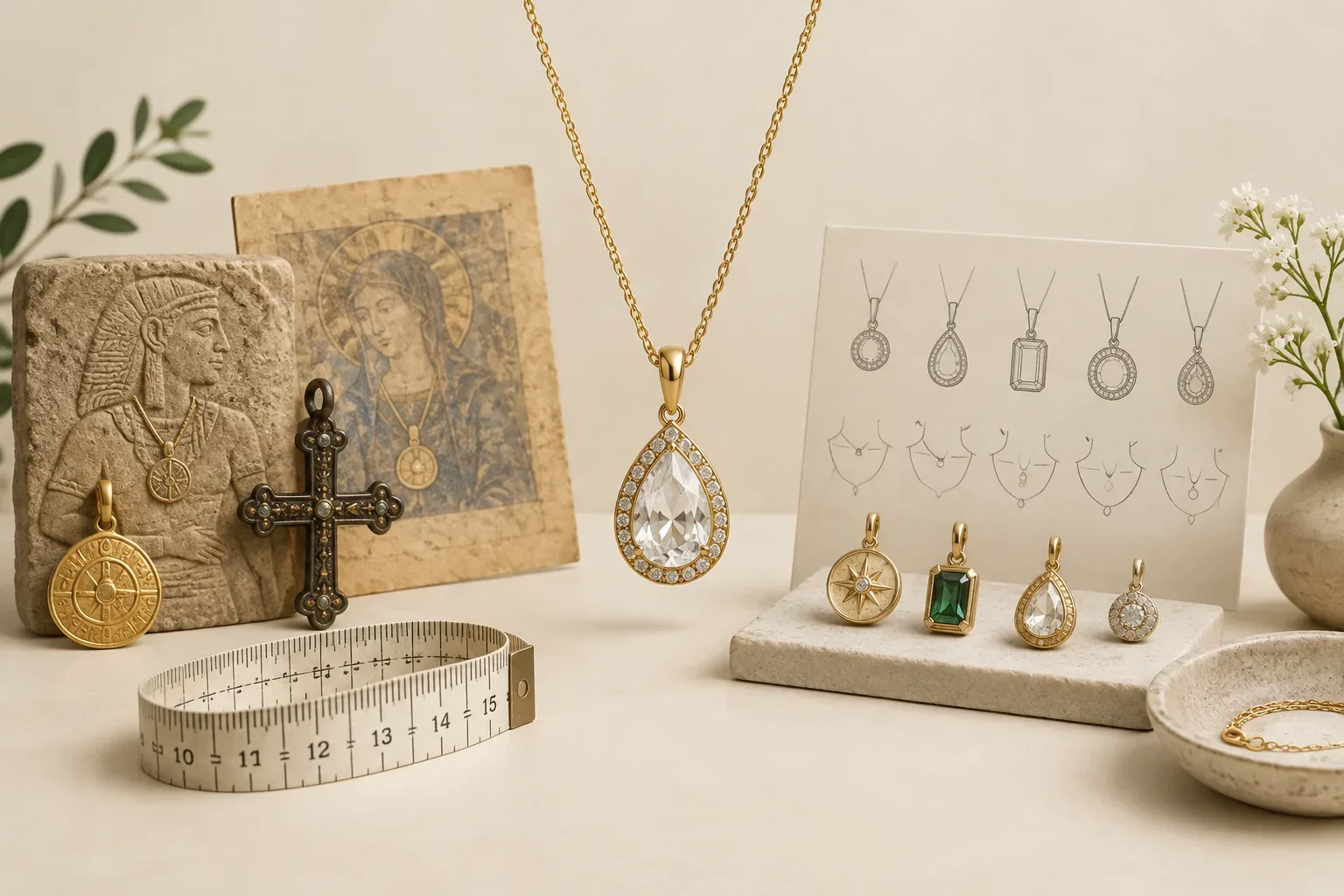
Meaning at a glance
This guide explains the documented history and changing contexts of pendant necklaces, distinguishes historical meanings from modern personal interpretations, describes how motifs and gemstones appear in pendant jewelry, and gives practical guidance for measuring, selecting, and gifting pendants today.
Documented historical evidence and changing contexts
The Victoria and Albert Museum (V&A) documents that jewellery — including pendants — has long served shifting social, religious and personal purposes. The V&A notes that across different periods and societies pendants could function as public status markers, private mementos and overt religious emblems rather than having a single consistent meaning. The museum’s historical surveys show how form and function evolved as materials, technologies and fashions changed, and how the same object type (for example a locket or religious pendant) could mean different things in different contexts.
V&A resources on gemstones further clarify that particular stones were chosen for a mix of aesthetic, technological and social reasons. Gemstone use in pendants reflected local availability, cutting and setting technologies, and fashion tastes as much as any fixed symbolic vocabulary. Where historical sources document a specific meaning — for example, a devotional pendant used in a particular faith community — those meanings are tied to that culture and period rather than being universal.
Separating documented meanings from modern interpretations
When interpreting pendant motifs, keep two categories separate: documented historical meanings and contemporary personal or commercial interpretations. Documented meanings are those that historical evidence links to a particular culture, place or time. For instance, the V&A describes lockets and mourning jewellery in Europe as objects with clearly recorded uses in certain centuries: some contained hair or miniature portraits and circulated within defined social practices. Those are historical facts about function and circulation.
Modern interpretations — including marketing claims, popular numerology, or a wearer’s personal symbolism — are contemporary layers added long after the object form was established. Today many people choose pendants because a motif ‘feels’ meaningful to them, or because a brand assigns a popularized meaning. Those contemporary meanings are valid for personal use but should not be presented as historical fact unless supported by documentary evidence. In short, historical records tell us what pendants were used for in specific times and places; modern meanings often reflect personal choice, trend cycles, or commercial narratives.
How motifs, gemstones and traditions appear in pendant jewellery
Motifs appear in pendants in many ways: as shaped metalwork silhouettes, engraved or enameled surfaces, portrait cameos, or as settings that showcase a central stone. Religious symbols, initials, protective talismans and commemorative lockets are recurring pendant forms found across cultures, each with different documented uses depending on period and place. The V&A describes how certain forms — such as portrait miniatures set into lockets — became popular in particular social contexts and served recognizable social functions.
Gemstones appear as focal points in many pendant designs. The V&A’s A–Z of Gemstones explains that choice of stone has historically depended on color preference, perceived rarity, local supply and the capabilities of cutters and setters. In pendants, gems may be bezel-set, prong-set, pavé-set, cabochon-cut, or left in their rough form, and these choices affect how large a stone can sit comfortably and how the pendant hangs. Contemporary designers often combine historical motifs with modern cuts and materials, which changes how a motif is read by modern audiences.
Measurements that matter: how to measure and what to consider
Begin by measuring the wearer’s neck circumference with a soft tape measure held where the necklace will sit. If you don’t have a tape measure, use a length of string and measure it against a ruler. Record that measurement and consider the wearer’s typical necklines: high collars, crew necks and turtlenecks need shorter chains or pendants that sit above the fabric, while low or V‑necklines allow longer drops.
Next decide how far below the collarbone you want the pendant to hang — this is the pendant drop. Measure from where the chain will sit at the back of the neck down to the desired pendant bottom. When shopping, compare that target drop to the total chain length given by the maker. Remember that pendant bail size and how the pendant moves on the chain can shift where the piece settles; a pendant with a large, fixed bail will sit slightly higher than the same item strung through the chain itself.
Consider pendant proportions relative to the wearer’s body and typical clothing. Small, lightweight pendants work well close to the throat and with delicate chains. Larger pendants need sturdier chains and more vertical drop so they rest flat against the chest. Think about scale: a pendant that feels balanced on one person may look oversized or insignificant on another, so prioritize the wearer’s build and style.
Practical fit details and design features
Chain thickness and strength matter as much as length. Lightweight pendants pair best with thin chains that allow the pendant to move freely; heavier or larger pendants require thicker chains and secure clasps so the chain bears the weight without stretching or breaking. Check how a pendant attaches to a chain: a fixed bail, integral loop, or removable jump ring changes how the pendant hangs and whether it can be repositioned.
Clasp type influences everyday comfort and security. A spring-ring clasp is common on light necklaces; lobster clasps and other locking designs are more secure for heavier pieces. If the pendant is valuable, consider a clasp with an additional safety mechanism or a professional jeweler’s recommendation for reinforcement. Also note that the finish of the chain and the pendant bail can affect movement: a smooth, rounded bail will let a pendant slide more readily than a textured, snug-fitting one.
Layering pendants requires attention to length differences and visual balance. When combining multiple necklaces, decide which piece will be the focal pendant and plan other lengths so each sits clearly above or below the others without tangling. If the focal piece is delicate, select simple, lighter strands for the additional layers so the overall look remains coherent.
Choosing and gifting respectfully
When selecting a pendant as a gift consider documented cultural meanings before assuming a symbol’s appropriateness. If the pendant motif has religious, cultural, or historical significance, research its origins and typical use rather than relying on trend-driven descriptions. The V&A’s treatment of historical jewellery helps illustrate that the same form may have been used very differently across cultures and time, so what seems decorative in one context may be sacred in another.
Ask about the recipient’s style and comfort. Do they prefer understated, everyday jewellery or statement pieces reserved for special occasions? If you’re unsure of neck measurements, choose adjustable chains or pendants with removable bails so the piece can be resized by a jeweller. For valuable gemstones, request transparent disclosure about treatments and origin; the Federal Trade Commission recommends that buyers ask sellers about any treatments, enhancements, or imitations so you can make an informed gift decision.
Material disclosure and care
The Federal Trade Commission advises buyers to seek full disclosure about gemstone treatments, synthetics, and imitations. Many gemstones receive heat treatment, diffusion, dyeing or other enhancements to improve color or clarity; sellers should disclose these alterations. Ask for written confirmation if a treatment is important to you, and for any warranty or return policy.
Care instructions affect long‑term fit and appearance. Some pendants contain soft or porous gemstones that can be damaged by chemicals and require careful cleaning, while others are robust. Chain metals can wear at clasps and bails if the components rub; periodic inspection by a jeweller can prevent loss. If a pendant is intended to be worn daily, choose durable settings and reputable care guidance from the maker or an independent professional.
Concluding guidance
A pendant necklace size and fit guide combines measurement precision, an eye for proportion, and cultural respect. Use simple measuring steps to determine chain length and pendant drop, match pendant scale to the wearer’s body and neckline, confirm material and treatment disclosures, and research any culturally significant motifs before gifting. Historical records such as those summarized by the Victoria and Albert Museum show that pendants have served many social functions over time; modern wearers add new personal meanings, which are valid but distinct from documented historical uses.
Frequently asked questions
How do I measure my neck for a pendant necklace?
Use a soft tape measure around the base of your neck where the necklace will sit, or wrap a piece of string and measure it against a ruler. Decide where you want the pendant to fall and measure the drop from the back of the neck to that point to determine total chain length plus pendant allowance.
What chain length should I choose if I don’t know the recipient’s preference?
If you’re unsure, choose an adjustable chain or a length that sits near the collarbone, as it tends to be versatile with many necklines. Alternatively, select a design with a removable bail so a jeweller can reposition or shorten the pendant later.
Are gemstone treatments important when buying a pendant?
Yes. The Federal Trade Commission recommends asking sellers about any treatments, enhancements or imitations so you understand a gemstone’s true condition and value. Request written disclosure if the treatment affects care or resale value.
How do I match pendant size to body type and neckline?
Smaller pendants generally suit higher necklines and petite frames, while larger pendants can complement deeper necklines and broader chests. Prioritize proportion and how a piece will sit against the clothing the recipient commonly wears.
Is it respectful to gift a pendant with a cultural or religious motif?
Research the motif’s cultural and historical context before gifting. Some symbols are sacred or have specific ritual uses; consult reliable sources or the recipient’s community if you’re unsure. Historical references such as those in the V&A can help identify contextual meanings.
How can I ensure a pendant won’t tangle when layered?
Plan layers by length so each necklace falls at a distinct level and avoid pairing heavy focal pendants with delicate strands. Use smooth bails and consider anti-tangle findings or separate clasps to minimize movement between pieces.
Sources and further reading
- Bedazzled: A History of Jewellery — Victoria and Albert Museum
- An A-Z of Gemstones — Victoria and Albert Museum
- Buying Gemstones, Diamonds, and Pearls — Federal Trade Commission