Meaning at a glance
Peacock jewelry meaning has changed across time and place: museum evidence shows the motif appears in South Asian, Byzantine/Ottoman, and European decorative traditions; historical meanings are specific to those contexts, while modern wearers also attach personal meanings like beauty or renewal. This article separates documented cultural uses from later popular interpretations and gives practical guidance for choosing and gifting peacock-themed jewelry.
Quick answer
In brief: peacock jewelry meaning cannot be reduced to a single, universal symbol. Museum surveys and curatorial research show the peacock motif appears in multiple times and places with context-specific meanings. Modern wearers often layer personal symbolism—such as beauty, confidence, or renewal—on top of those histories. This article explains the documented evidence, notes where modern interpretations diverge, describes how the motif is used in jewelry, and offers practical guidance for selecting or gifting peacock pieces.
What the historical evidence shows (and where it comes from)
The Victoria and Albert Museum’s long view of jewellery history emphasizes that animal and bird motifs recur across continents and centuries and that the meanings of such motifs are shaped by their social and religious contexts. Curatorial records and exhibition surveys at the V&A document peacock imagery appearing in objects from the Indian subcontinent, Byzantine and Ottoman metalwork, and in European decorative arts, especially during periods that revived naturalistic or exotic motifs.
Because the peacock figure appears in diverse collections, the documented historical meanings are also diverse. In museum labels and catalogues the motif is treated as part of a local visual language: sometimes decorative and status-related, sometimes tied to courtly or religious display. The V&A’s materials stress that jewelry functions as social language—signals of rank, wealth, piety, or fashion—so the peacock’s role in any one object depends on its place and period.
Archaeological finds, courtly pieces, and later decorative-jewellery movements are the main documentary sources that museums like the V&A use to trace the motif. Where museums can identify an object's provenance or patronage, they record historically specific reasons for choosing peacock imagery rather than assuming a single symbolic message.
Separating documented historical meanings from modern interpretations
Documented historical meanings are those recorded by curators, collectors, or contemporaneous sources and tied to a particular culture, religion, or social practice. For example, museum descriptions will note when a peacock motif decorates an object intended for courtly display, religious ritual, or funerary use, and will treat its symbolism in that attendant cultural context. Those documented meanings are the foundation for any historically grounded statement about what peacock imagery signified in a given time and place.
Modern personal interpretations are distinct and often layered on top of or apart from those historical meanings. Today, many people choose peacock jewelry to express ideas like individual beauty, confidence, watchfulness, or spiritual renewal, regardless of the motif’s original context. These contemporary meanings are valid as personal or cultural statements, but they are not the same thing as the historically documented functions recorded by museums.
When discussing peacock jewelry meaning, it is important not to conflate a modern fashion association with documented historical belief. The V&A’s approach—placing objects inside their original social and material contexts—helps keep those distinctions clear. Use a piece’s provenance and museum documentation to learn its original context; treat contemporary associations as a separate layer of meaning.
How the peacock motif appears in jewelry: motifs, materials, and techniques
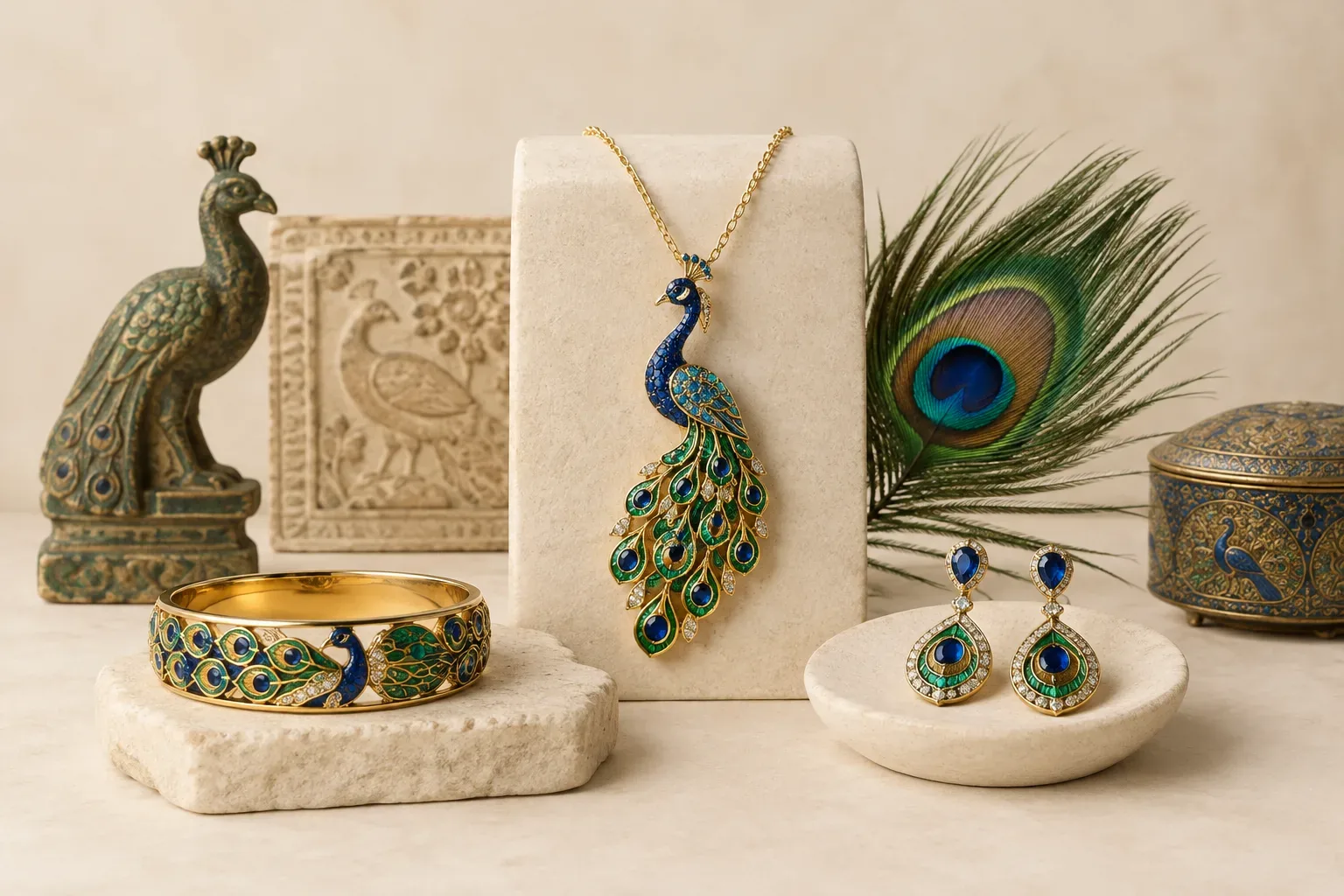
The peacock motif appears in jewelry in many forms: as full bird figures, stylized feathers, eye motifs, or abstracted plumage patterns. Jewelers have rendered these forms with metals, enamel, stones, and setwork. Museum surveys emphasize that jewelers choose materials and techniques to emphasize colour, surface, and texture—qualities that suit the peacock’s visual appeal.
Techniques commonly used to depict peacocks include metalwork and chasing for three-dimensional forms, colorful enamels to simulate iridescence, and the strategic setting of gemstones and pearls to create 'eyes' or bright highlights. The Victoria and Albert Museum’s resources on gemstones and jewellery history describe how gem choices and enamelling were used historically to mimic plumage and catch the light, and how naturalistic detail was achieved through skillful setting and surface work.
Gemstones often associated with peacock-themed pieces include sapphires, emeralds, tourmalines, topaz, and pearls where color and luster matter. Contemporary makers may use opal or treated stones to capture shifting colours. The V&A’s A–Z of Gemstones provides context about how different gems were valued and used historically to achieve particular visual effects in decorative jewellery.
Practical guidance for choosing, wearing, and gifting peacock jewelry
Start with the person and the context: consider the wearer’s style, cultural background, and whether they appreciate overt symbolism. If the recipient has a specific cultural or religious identity connected to peacock imagery, ask discreetly or choose a design that respects that heritage and avoids appropriation by favoring contemporary artisan interpretations or pieces made by artists from that culture.
If you care about historical authenticity, look for documentation about provenance or maker; museum-backed references and reputable dealers often provide context about an object’s origins. For contemporary pieces, artisans’ statements can explain whether a design references historical models or is purely decorative. For more on choosing meaningful jewelry generally, see our related gift guide article linked below.
Check materials and disclosures. The Federal Trade Commission advises buyers to ask about gemstone treatments, imitations, and the metal content of jewelry. Sellers should disclose whether a stone is natural, treated, or synthetic and whether the metal is plated or solid. If durability matters—for daily wear pick well-set gems and robust metalwork; for occasional wear, more delicate enamels or fragile inlays may be appropriate.
Think about scale and placement. Peacock motifs can be bold statement pieces—large brooches, pendants, or rings—or more subtle as small feather charms or stud earrings. Match the scale to the wearer’s comfort and wardrobe. Consider matching metals and stones to pieces the recipient already owns if you want the gift to be worn often.
Care and conservation: enamel, inlay, and certain treated stones need gentle care. Store such pieces separately and avoid exposure to harsh chemicals. For antique or museum-quality items, consult a conservator for cleaning advice. If buying online, request clear images and condition reports, and retain seller return policies in case the piece does not meet expectations.
A short note on ethical and cultural respect
When a motif carries identifiable cultural or religious significance, choose makers and sources that acknowledge or belong to that tradition, and avoid commodifying sacred symbols. Respect can mean buying from craftspeople within the culture, learning about the motif’s traditional meanings from reliable museum or scholarly sources, and using the jewelry in ways that honor, rather than trivialize, its origins.
Finally, remember that personal meaning matters: many wearers intentionally combine historical awareness with their own stories. Whether worn as a statement of heritage, fashion, or private symbolism, peacock jewelry can carry layered meanings—so consider both documented history and the recipient’s personal narrative when choosing or gifting a piece.
Frequently asked questions
Does a peacock motif have the same meaning everywhere?
No. Museum documentation shows the peacock motif appears in multiple cultures and periods with meanings tied to local social, religious, or courtly contexts. Modern personal meanings—such as beauty or renewal—are contemporary and separate from historical, documented uses.
What materials are commonly used to make peacock-themed jewelry look iridescent?
Historically and today, jewelers use colorful enamels, iridescent gemstones, opals, and careful stone-setting to mimic peacock coloration. The Victoria and Albert Museum’s resources note that gem choice and enamelling are central to achieving bright, layered color effects.
How do I avoid cultural insensitivity when gifting peacock jewelry?
Consider the recipient’s cultural background and whether the motif has specific religious or cultural meaning for them. Choose pieces made by artisans from that tradition when possible, or select contemporary, respectful designs and ask about the maker’s background if cultural authenticity matters.
How should I check gemstone claims when buying peacock jewelry online?
Follow the Federal Trade Commission’s guidance: ask the seller to disclose whether stones are natural, treated, or synthetic; request clear photos and condition reports for vintage pieces; and keep return and authenticity documentation.
Are antique peacock pieces harder to care for?
They can be. Antique enamels, inlays, and fragile stone settings require careful storage and gentle cleaning; for valuable or museum-quality pieces consult a conservator. For everyday wear choose robust settings and durable stones.
Sources and further reading
- Bedazzled: A History of Jewellery — Victoria and Albert Museum
- An A-Z of Gemstones — Victoria and Albert Museum
- Buying Gemstones, Diamonds, and Pearls — Federal Trade Commission