Meaning at a glance
Pavé settings give strong sparkle and a refined look but have trade-offs: they are more exposed to snagging and stone loss than solid bezel or low-profile prong settings, require regular inspection and careful daily wear, and some durability or treatment questions can only be answered by a qualified jeweler or a gemological laboratory.
What "pavé" means in practice and why it matters for durability
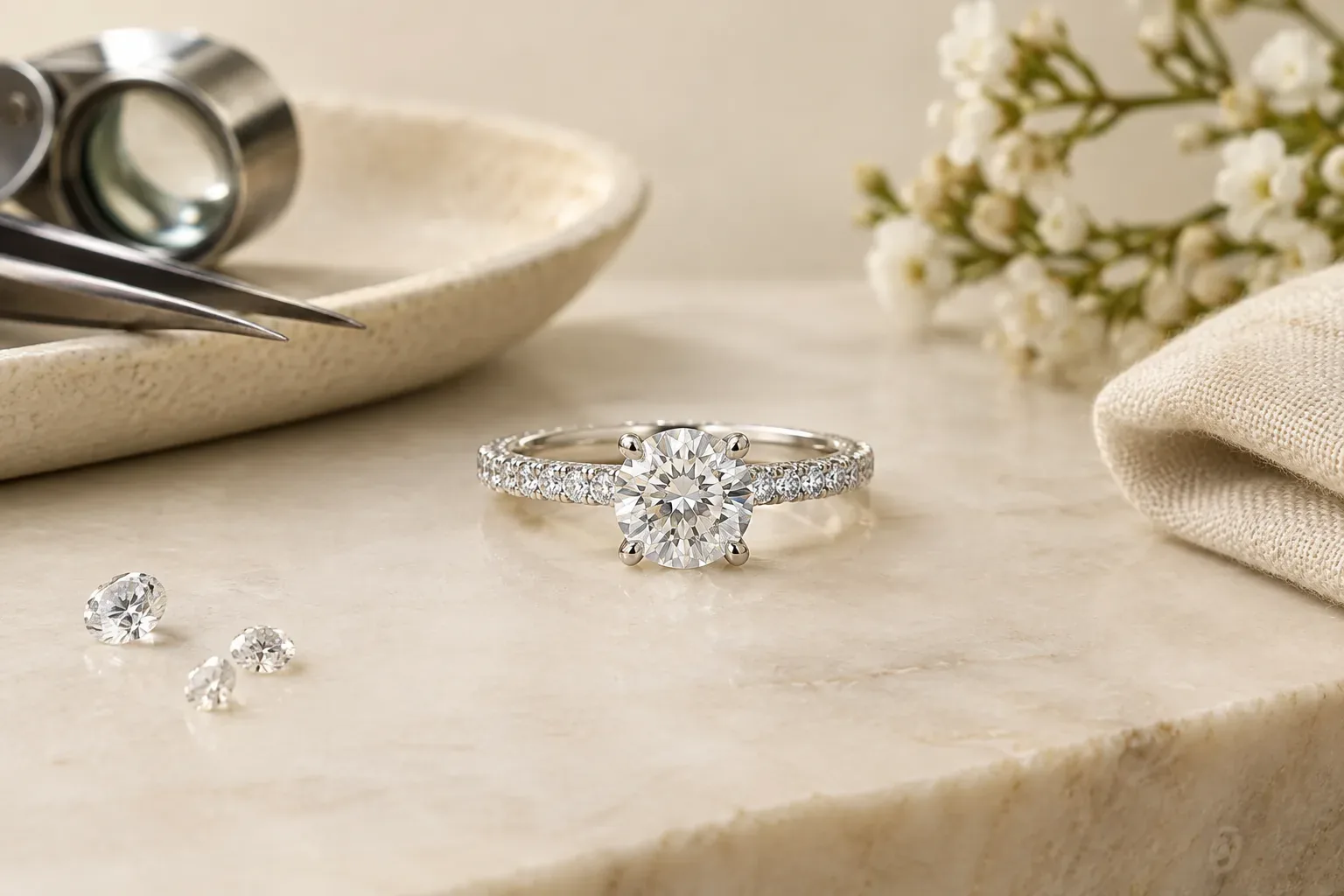
Pavé refers to techniques that set many small stones closely together so the metal is largely hidden, which increases overall surface sparkle. In practice that means more small stones, delicate metal beads or tiny prongs, and more individual settings on a single shank or head. That increase in components is the key durability consideration: more stones and more tiny metal work create more potential points of failure compared with a single large center stone held by robust prongs or a bezel.
Because a pavé ring distributes visual emphasis across many small stones, losing a single stone often affects appearance disproportionately. Repairs can be straightforward—resetting or replacing stones and re-beading metal—but those repairs are more frequent and potentially more visible than repairs to a simple solitaire band.
Historical evidence and cultural claims
Among the approved sources for this article there is no authoritative period-by-period or culture-specific history of the pavé technique. The four approved references address contemporary trends, consumer protections, gemstone treatments, and industry demand, but none provide a primary historical account tying pavé to a specific culture or era.
Given that limitation in the approved evidence set, this article does not assert a precise historical lineage for pavé. Readers seeking a documented cultural history should consult specialized jewelry history texts or museum catalogues rather than these consumer- and industry-focused sources.
Documented historical meanings versus modern personal interpretation
The approved references do not record historical symbolic meanings for pavé as a motif. That absence should be read as a documented gap rather than proof that pavé never had cultural meanings in specific contexts. In modern practice, pavé is primarily an aesthetic choice emphasizing brilliance and refinement; its meanings today tend to be personal—luxury, detail, or a preference for sparkle—rather than a single, documented symbolic message.
Separate clearly what is documented and what is personal interpretation when you gift or buy. If you assign a symbolic meaning—for example, 'many small stones represent many shared memories'—label that as your own contemporary interpretation rather than a historical fact.
How pavé appears in engagement rings and other jewelry
Designers use pavé in several common ways: as a full pavé band, as pavé shoulders flanking a center stone, in a halo around a center stone, or as accent lines on the shank. Because pavé relies on many small stones, it’s commonly paired with diamonds or durable colored gemstones; those choices influence both sparkle and long-term behavior.
Market researchers and industry bodies note that consumer interest in modern ring styles remains strong. Imaginaire Digital’s 2026 UK search estimates show pronounced demand for engagement rings and related categories, and Jewelers Mutual’s 2026 trend reporting emphasizes craftsmanship and modern styling—factors that help explain why pavé remains a popular finish in contemporary settings.
Durability trade-offs: daily wear, snagging, and repair risk
Daily wear exposes any engagement ring to bumps, abrasive contact, and chemicals. For pavé settings, two types of wear are most relevant: accidental impact to small beads or prongs and abrasion that can thin tiny metal partitions. Because pavé relies on many small metal points, repeated knocks or friction can loosen beads and allow stones to fall out over time.
Snagging risk is higher when pavé is set on the outer edges of a ring or on garments that catch easily. Rings worn while cooking, gardening, or doing manual work are more likely to suffer snags and consequent bead damage. Repair risk is tied to how many stones are set and how accessible they are: a tightly set pavé that sits low on the finger will often resist snagging better and require fewer repairs than raised or exposed pavé.
Decision criteria: how to choose a pavé engagement ring that fits your life
Decide first whether the visual effect outweighs higher maintenance for your lifestyle. If you want maximum brilliance and the wearer prefers a refined, glittering look and does light-to-moderate hand work, pavé can be an excellent choice. If the wearer uses their hands intensively for work or hobbies that risk abrasion and knocks, consider reinforced alternatives such as partial pavé, a low-profile pavé, a bezel-accented center, or a solitaire with pavé only in protected areas.
Consider stone size and metal hardness: slightly larger pavé stones and harder metals (for example, platinum instead of softer alloys) can reduce the frequency of repairs. Also weigh insurance and repair policies: Jewelers Mutual highlights that consumer interest in craftsmanship and versatility makes protection options and routine maintenance meaningful decisions when choosing modern engagement rings.
Practical care guidance to reduce snagging and repair needs
Keep the ring for everyday, low-impact wear if possible. Remove a pavé engagement ring before heavy lifting, gardening, sports, housework involving harsh chemicals, or tasks likely to catch fabric. Store pavé rings separately to avoid abrasion from other jewelry.
Establish a maintenance routine: have a qualified jeweler inspect a pavé engagement ring every six to twelve months to check for loosened beads or missing stones. Immediate attention to a loose stone often prevents further damage to surrounding metal. For questions about how particular gems were treated and how that affects care, refer to gemological guidance; the Gemological Institute of America stresses that treatments and disclosures affect detectability, durability, and care requirements.
Repair realities and what only a qualified jeweler or lab can verify
Minor repairs—tightening beads, replacing tiny stones, and re-rhodium plating white gold—are common and generally straightforward for a trusted bench jeweler. More complex repairs, such as reworking severely worn pavé sections or replacing many stones after an impact, can be costly and may alter the ring’s original look.
Certain verifications are beyond a buyer’s unaided ability. A consumer cannot reliably confirm gemstone treatments, origin, or subtle synthetic indications without specialized equipment. The Federal Trade Commission advises obtaining clear written disclosures from sellers about whether gems are natural, lab-created, treated, or imitation. The Gemological Institute of America similarly notes that treatment detection and durability implications are matters for gemological testing. If provenance, treatments, or precise carat weight credentials matter to you, request lab reports or independent evaluation before purchase.
Selection and gifting guidance: respectful, practical advice
When gifting a pavé engagement ring, be candid about trade-offs. Explain that the pavé finish is chosen for its sparkle and refinement but that it carries higher maintenance needs than some simpler settings. If you’re buying jointly, agree on inspection frequency and whether you will budget for periodic maintenance or insurance.
If buying as a surprise, consider documentation: include a written note about care expectations and an initial inspection voucher from the jeweler. Ask the seller for clear written disclosures about the metal, whether any stones are treated or lab-created, and available warranties or maintenance plans. The FTC underscores the importance of written disclosures for gemstones and treatments.
When to choose an alternative
Choose an alternative if the wearer has an exceptionally active lifestyle, works with their hands, or cannot commit to regular inspections. Consider alternatives that preserve some pavé visual cues—such as a protected halo, pavé set inside a channel, or smaller pavé accents—while using more robust elements where contact is most likely.
Also favor durable metals and slightly larger accent stones when you want the pavé look but less frequent maintenance. Discuss trade-offs with a jeweler so you can balance appearance, wear habits, and long-term cost of ownership.
Final takeaways
Pavé setting engagement ring durability depends on choices you make about design, metal, gemstone, and daily habits. Pavé delivers strong aesthetic rewards but increases the number of components that can fail. Expect a combination of careful wear, routine inspections, and occasional repairs, and insist on written disclosure about gemstone treatments and metal composition when you buy. For treatment verification and formal grading or origin claims, only a qualified jeweler or a gemological laboratory can provide reliable answers.
Frequently asked questions
Are pavé engagement rings durable enough for everyday wear?
Yes, they can be durable for everyday wear if you accept higher maintenance and careful use; pavé increases the number of small settings that can loosen, so regular inspections and removal for high-risk activities are recommended.
How often should a pavé ring be inspected?
Have a qualified jeweler inspect pavé work approximately every six to twelve months; the exact interval depends on wear patterns and the ring’s exposure to knocks or abrasion.
Can a jeweler replace missing pavé stones?
Yes. Missing pavé stones are commonly replaced and metal beads re-beaded or re-cut, but frequency and visibility of repairs vary and complex damage may be more costly to restore.
How can I verify whether pavé stones are treated or lab-created?
Ask the seller for written disclosures and any available lab reports; for definitive answers about treatments or origin, a gemological laboratory or qualified gemologist is required, as noted by the GIA and the FTC.
Is insurance recommended for pavé engagement rings?
Insurance or a protection plan is prudent for pavé settings because repairs and stone replacement are more likely over time; Jewelers Mutual’s trend coverage highlights the value of protection plans for modern, detail-oriented designs.
Sources and further reading
- Imaginaire Digital — Imaginaire Digital
- Jewelers Mutual — Jewelers Mutual
- Gemological Institute of America — Gemological Institute of America
- Federal Trade Commission — Federal Trade Commission