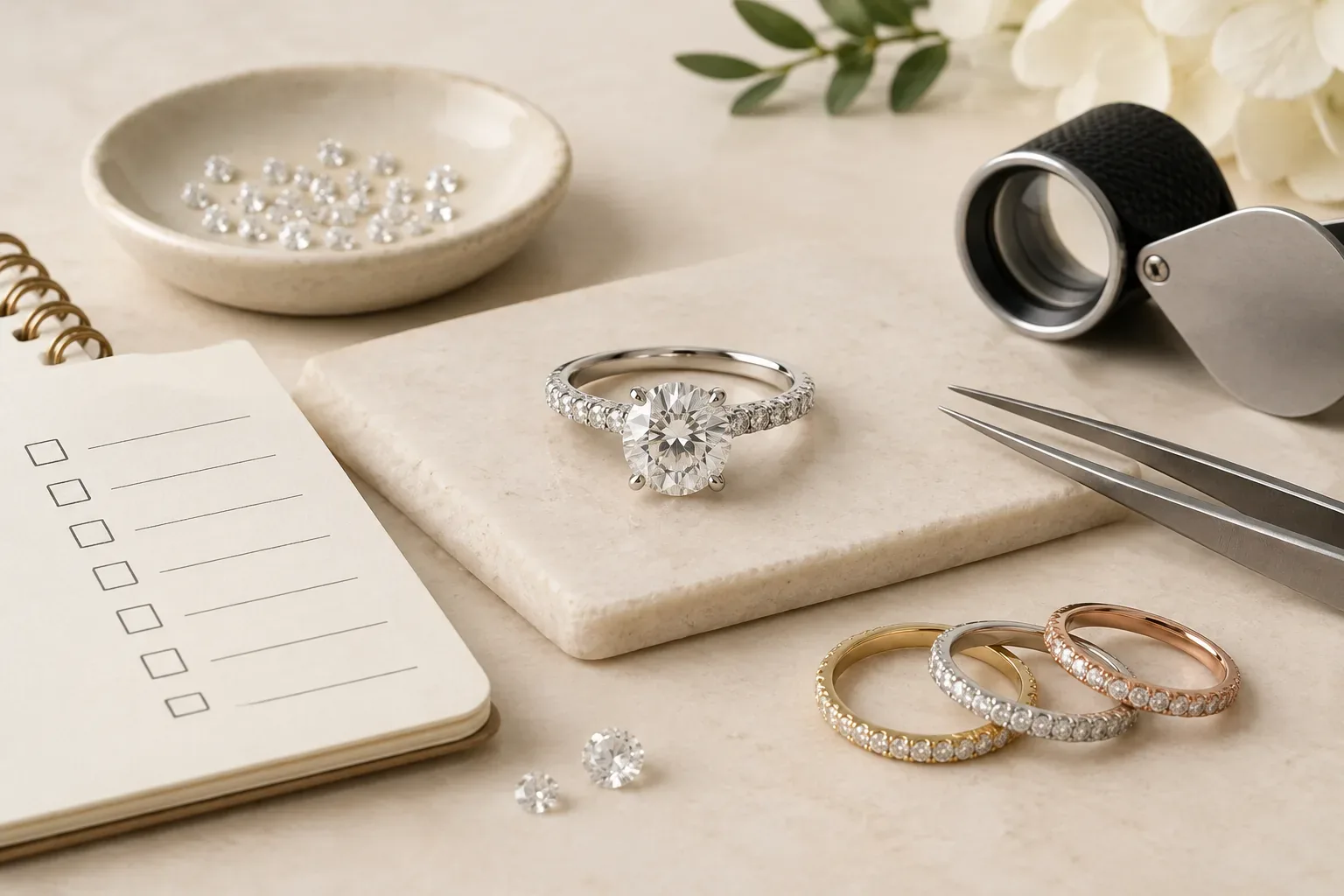
Meaning at a glance
Use a short checklist to confirm construction, disclosures, durability, documentation, care needs and return/resizing terms; ask for written disclosures, a lab report for the center stone when appropriate, and clear warranty and repair policies.
What a pavé setting is and why it matters
Pavé refers to a setting style in which many small stones are set close together so their metal mounts are minimally visible, producing a continuous surface of sparkle around a band or accenting a center stone. In practice, pavé varieties range from larger bead‑set pavé to very fine micro‑pavé that uses tiny settings and fine metal work.
That close setting increases visible brilliance but also creates practical trade‑offs: more exposed pavé stones mean more potential points of impact, potential for loosening during wear, and more complexity when resizing or repairing the ring. Understanding the exact pavé technique is the first practical step when deciding on an engagement ring.
Historical evidence and documented meanings
The approved sources for this article do not provide a documentation trail for pavé’s origin or a single historical symbolic meaning for the style. The industry and consumer sources used here focus on modern demand, craftsmanship, and consumer protection rather than historical symbolism.
Because these sources do not attribute a specific cultural or period meaning to pavé, any historical claims beyond modern trade use would require specialist historical jewelry research. Separate documented history from later personal meaning: contemporary buyers and makers assign romantic or aesthetic meanings to pavé today, but those are modern interpretations rather than documented historical facts in the sources cited.
Where pavé appears and how gemstones and motifs are used
Pavé appears as accents on shanks, halos, bridge work, and sometimes covering whole bands (eternity styles). Jewelers commonly use diamonds for pavé because small, well‑cut diamonds maximize sparkle, but pavé can also employ colored gemstones when the design or budget calls for it.
Design motifs vary: pavé can outline a central halo to magnify a center stone, form tapered shoulders, create pavé‑covered crowns or split shanks, or be combined with milgrain or engraving. The result is primarily aesthetic—an emphasis on surface brilliance and perceived size of the center stone—but each use has different implications for durability and maintenance.
Checklist: Questions to ask before you buy
What exact pavé method is used? Ask whether the ring is micro‑pavé, bead‑set pavé, shared‑prong pavé, or another technique and request close photographs or a magnified inspection. The method affects how delicate the ring is and how the ring will respond to everyday wear.
How are the pavé stones secured? Ask about the number and size of prongs or beads per stone and whether there is a protective edge (for example, a raised profile or channel on the inner shank). Inspect under magnification to check for consistent, evenly spaced bezels or beads.
What metal and karat is the ring? Confirm the metal type and hallmark. Softer metals (higher karat gold) allow easier setting work but scratch and deform more readily; platinum is harder wearing but can still show wear on fine pavé.
Can the ring be resized or repaired, and at what cost? Discuss resizing limits up or down and how resizing will affect the pavé pattern. Ask if the shop will replace lost pavé stones and whether they stock matching melee stones.
What are the written terms for warranty, returns, and repair? Get repair and return policies in writing, especially for delicate pavé. Check how long the warranty lasts and what it covers (missing stones, loose settings, accidental damage).
Is the center stone accompanied by a gemological report? For diamonds or valuable colored gems ask for a lab report that identifies natural versus lab grown, and any treatments. The Federal Trade Commission stresses clear distinctions and written disclosure for natural, lab‑created, treated, cultured and imitation materials.
Have any stones been treated? Ask which treatments (if any) have been applied to pavé stones or the center gem and whether the treatments are stable under everyday cleaning or exposure. The Gemological Institute of America discusses detectability and care implications for treatments.
Are the pavé stones matched for color and clarity? For consistency of appearance, confirm that the tiny stones are graded or matched to a shop standard—variations in color or clarity are more visible in large pavé fields.
Can I see the ring under magnification and in different lighting? Examine the ring under a loupe and in daylight and indoor light to judge sparkle, finishing, and visible flaws. If buying online, request high‑resolution images and a video that show the profile and inside of the setting.
What insurance and appraisal options are available? Ask whether the vendor provides or recommends an independent appraisal for insurance and whether their in‑house appraisals will identify treatments or origin.
Trade-offs and practical selection guidance
If you value maximum sparkle, choose tighter pavé and more small stones; accept that this increases potential repair work over decades. If you prioritize durability, choose larger bead‑set stones, a thicker shank, or partial pavé (accents rather than full eternity) to reduce exposure.
Choose your metal with care: platinum and lower‑karat gold alloys resist wear better for finely set pavé, but alloy and finish choices also affect color and contrast with the small stones. Jewelers Mutual notes current consumer demand for craftsmanship and versatility, which supports investing in robust construction and clear service terms.
Consider alternative designs when daily manual work or active lifestyles make a fragile pavé impractical. Channel settings, bezel accents, or a single halo with pavé shoulders can give sparkle while offering more protection for small stones.
Care guidance and limits on verification
Routine care: clean gently with a soft brush and mild detergent, rinse, and dry. Avoid ultrasonic or steam cleaners unless you have confirmation from the seller or a gem specialist that every stone and treatment is safe for those methods. The Gemological Institute of America highlights that treatments and certain materials require special care and that some treatments can be damaged by aggressive cleaning.
Verification limits: you can visually inspect craftsmanship, confirm metal stamps, ask for written disclosures, and review a lab report if provided. However, you cannot reliably verify diamond origin, identify most treatments, or certify a stone’s durability without a recognized gemological laboratory or a qualified, independent appraiser. The FTC emphasizes the need for written seller disclosures but does not replace laboratory testing.
When to consult an expert: if the center stone is expensive, treated, or claimed to be natural versus lab‑grown, request a report from a reputable laboratory. For questions about setting integrity, loose stones, or resizing risk, ask a qualified jeweler for a pre‑purchase inspection or a written statement of risk.
Practical and respectful selection or gifting guidance
Respect preferences: engagement rings combine personal style and practical use. Ask about daily activities that may influence durability needs and whether the recipient prefers visible flash or low‑maintenance wear. Jewelers Mutual’s trend reporting suggests many buyers now seek versatility and gender‑neutral options; prioritize construction that fits the wearer’s life.
Sizing and surprises: if the proposal is a surprise, choose a temporary sizing option (e.g., an adjustable insert) or learn typical sizing from close contacts. Be explicit with the seller about resizing policies and potential costs related to pavé work before purchase.
Budgeting beyond purchase: include potential repair, maintenance, insurance, and periodic re‑tipping or bead tightening in your budget. Pavé rings can require more maintenance than solitaire styles, and responsible gifting includes planning for that long‑term care.
Final notes
A pavé setting engagement ring checklist should balance aesthetic goals with clear verification steps: check technique and craftsmanship, insist on written disclosure of treatments and origin, request lab reports for high‑value center stones, confirm repair and resizing policies, and plan for appropriate cleaning and insurance.
Modern consumer demand for craftsmanship and versatility makes a well‑constructed pavé ring both popular and achievable, but some verification requires labs or qualified appraisers. Use the checklist above as a starting point for a practical, evidence‑led purchase conversation.
Frequently asked questions
Can a pavé engagement ring be resized?
Often yes, but resizing can disrupt a pavé pattern and may require resetting stones. Ask the seller about resizing limits, the likely cost, and whether they will guarantee matching replacement stones. For very fine micro‑pavé or full pavé eternity bands, resizing may be limited or impossible without major reworking.
How can I tell if pavé stones are loose before buying?
Visually inspect under magnification and gently test with a trained jeweler’s probe—do not force or repeat tests that might dislodge a stone. Ask the seller for a documented inspection and for any recent repair history. Only a qualified jeweler can reliably assess the long‑term security of tiny pavé stones.
Are there special cleaning rules for pavé rings?
Yes—clean gently with mild soap and a soft brush. Avoid ultrasonic or steam cleaning unless you have confirmation from the seller or a gem lab that all stones and any treatments are safe for those methods. Some treatments and fragile settings can be damaged by aggressive cleaning.
Do I need a lab report for the center stone?
For valuable center stones, a reputable gemological laboratory report is advisable to confirm natural versus lab‑created origin and to disclose treatments. The Federal Trade Commission requires clear seller disclosure, but laboratory testing provides independent verification when value warrants it.
What can I verify myself versus what needs a lab?
You can verify craftsmanship, metal hallmarks, visual uniformity of pavé stones, written seller disclosures, warranty and return terms, and request photos or videos. You cannot reliably determine a diamond’s origin, most treatments, or precise grading without a recognized gemological laboratory or an independent appraiser.
Sources and further reading
- Imaginaire Digital — Imaginaire Digital
- Jewelers Mutual — Jewelers Mutual
- Gemological Institute of America — Gemological Institute of America
- Federal Trade Commission — Federal Trade Commission