Meaning at a glance
Successful oval cut wedding band pairing hinges on three decisions: how the band’s shape complements the oval profile, whether to close or accept a finger-gap and how, and which metal balances visual match and daily wear. Use shaped or contoured bands, low-profile guards, or straight bands depending on setting height and personal style; prioritize disclosed gem information and professional verification for treatments and origin.
What the historical evidence shows (and what it does not)
There is limited, specific historical documentation about how oval-cut engagement stones were traditionally paired with wedding bands across distinct cultures or historical periods in the sources used for this guide. Contemporary market evidence, rather than long-standing ceremonial rules, shapes most current pairing conventions. Industry reporting shows growing interest in oval engagement styles and modern stacking approaches rather than a single historical standard (Imaginaire Digital; Jewelers Mutual).
Where hard evidence exists among the approved sources, it concerns modern market behaviour, design trends, gemstone treatment disclosure, and care rather than ancient cultural prescriptions. For example, trade and consumer guidance sources document demand trends toward fluid forms and stacking versatility in the 2020s (Jewelers Mutual) and search-interest data that highlights popularity of oval engagement rings (Imaginaire Digital). Regulatory and gemological sources document consumer needs for clear disclosure about treatments, lab-grown materials and durability rather than pairing traditions (Federal Trade Commission; Gemological Institute of America).
Documented historical meanings versus modern personal interpretation
Documented meanings in the approved evidence focus on contemporary consumer questions: the importance of disclosure about gem treatments, differences between natural and lab-grown stones, and the practical demands of daily wear (Gemological Institute of America; Federal Trade Commission). These are documentary and regulatory concerns, not symbolic meanings of shape.
Modern personal interpretations — for example, treating an oval as 'elongating the finger,' 'symbolizing continuity,' or 'appearing vintage' — are valid for the wearer but are not universal or historically documented by the sources in this guide. Personal symbolism varies by individual and culture and should be treated as a contemporary personal layer on top of the practical pairing choices driven by shape, setting and lifestyle.
How the oval cut and related motifs appear in jewelry
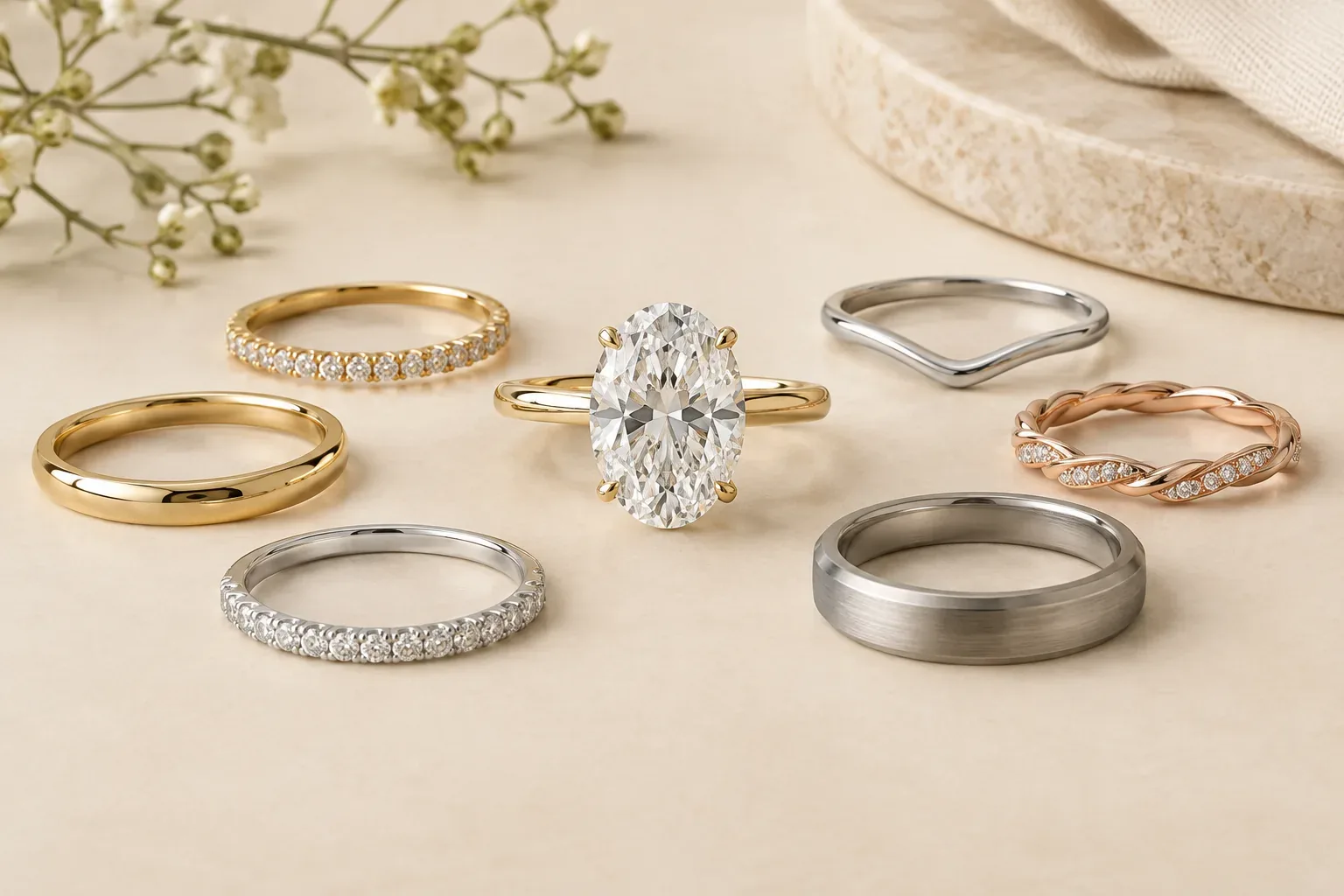
An oval cut stone presents an elongated, rounded silhouette that can be set in single-solitaire, halo, three-stone or cluster settings. Designers may orient the oval’s long axis either parallel to the finger (classic orientation) or east–west (horizontal), and they will adjust the mounting height and shoulder design accordingly. Those variations change how a wedding band sits next to the engagement ring: a low-set solitaire with slim shoulders often allows a straight band to sit flush, while a high-set halo or cathedral prong requires either a contoured band or a small gap to avoid interference.
Motifs such as halos, milgrain edging, pavé shoulders, and bezel surrounds frequently appear with oval stones; each motif affects the silhouette at the ring’s profile. A halo adds diameter and a softer round edge that may visually 'fill' small gaps, while pavé shoulders create a stepped profile that benefits from a matching or gently contoured band. These are design realities that influence pairing choices as much as any symbolic interpretation.
Shape decisions: contoured, straight, or custom
If you want no visible gap, choose a contoured or shaped wedding band designed to nestle against the oval’s profile. Contoured bands are machine- or hand-shaped to follow the engagement ring’s shoulders and are most effective when the engagement setting’s shoulders are symmetrical and the stone sits relatively low.
A straight band can work if the engagement ring has low shoulders and a low setting height; many shoppers prefer this classic look because it simplifies resizing and future maintenance. Where the engagement setting sits higher or has a halo, a straight band will usually create a visible gap unless you add a ring guard or choose a very thin band that reduces the apparent space.
Custom shaping is the reliable solution when off-the-shelf options fail: a jeweler can make a band that mirrors the engagement ring’s exact profile and accounts for slight rotations that occur with wear. Custom work can be more expensive and may require accurate measurements or temporarily mounting the engagement ring to guarantee fit.
Managing the gap: guards, spacing, and stacking
Decide whether the gap is desirable as part of the style or something you want to eliminate. Some wearers like a small gap because it highlights the engagement stone; others prefer the seamless look of nesting bands. A removable ring guard is a compromise: it fills the gap without permanently altering either ring, and it can be swapped for a different guard if tastes change.
Stacking multiple rings provides another solution to a visible gap. Slim stacking bands, either plain or pavé, can sit between the engagement ring and the wedding band to create a graduated look. Industry reporting indicates a strong modern preference for fluid stacking and versatility, which supports this as a contemporary approach (Jewelers Mutual).
Metal choices: color, hardness, and everyday wear
Match metal color to achieve a cohesive set or mix metals deliberately for contrast. Matching metals (for example, yellow gold with yellow gold or platinum with platinum) gives a unified appearance and simplifies later polishing because metals with similar hardness and finishing properties behave similarly under wear.
If you choose mixed metals, be mindful of practical trade-offs: harder metals like platinum resist scratches differently than 18K gold, and contrasting metals can age differently over time. Trade-offs include cost, ease of resizing, and long-term maintenance. Many shoppers now favor gender-neutral and versatile metal selections as part of contemporary styling trends (Jewelers Mutual).
Care, verification limits, and what only a pro or lab can confirm
Ask for clear written disclosures from the seller about whether the oval stone is natural, lab-grown, treated, or an imitation; the Federal Trade Commission advises consumers to demand accurate, written seller disclosures for gemstones and diamonds (Federal Trade Commission). The Gemological Institute of America documents common treatments and explains that some treatments affect durability and require special care (Gemological Institute of America).
Understand the limits of what you can verify at retail. Only a qualified jeweler or gemological laboratory can reliably confirm origin (natural vs lab-grown), detect some treatments, or provide a formal grading report for color and clarity. If origin or treatment matters to you, request a current lab report from a recognized laboratory and retain seller documentation. Insure high-value pieces and follow manufacturer or jeweler care guidance for cleaning and service; Jewelers Mutual emphasizes the importance of craftsmanship, routine maintenance, and insurance for frequently worn jewelry (Jewelers Mutual).
Practical selection and respectful gifting guidance
When buying a wedding band to pair with an oval engagement ring, measure the engagement ring’s profile: note the oval orientation, setting height, shoulder shape and whether the engagement ring rotates on the finger. If you can, bring the engagement ring to the jeweler so a band can be tried on in person. When gifting, consider the wearer’s existing jewelry habits: do they favor low-profile, minimal pieces for daily work, or do they prefer bolder, decorative stacks? Choose accordingly.
Respect preferences and practicalities. If you are unsure about size or shape, a simple thin band in a matching or neutral metal is a safe gift that can be exchanged or resized. When gifting an important piece based on symbolism, discuss explicit preferences when possible and keep receipts and documentation; the FTC and GIA guidance underscores the importance of clear disclosure and informed purchase choices for quality and care (Federal Trade Commission; Gemological Institute of America).
Trade-offs and final decision checklist
Decide whether you prioritize seamless appearance, ease of maintenance, or interchangeability. Seamless appearance favors contoured or custom bands; ease of maintenance favors simpler straight bands in hard metals; interchangeability favors guards or thin stacking bands that can be removed or changed.
Before purchase, check these items: does the seller provide written disclosure about the stone’s origin and treatment? Can the band be resized without altering the engagement ring’s fit? Is there a lab report available for a high-value stone? Answering these questions will reduce surprises and ensure your chosen pairing meets both aesthetic and practical needs.
Frequently asked questions
Will a straight band look awkward next to an oval engagement ring?
Not always. A straight band sits flush when the engagement ring has low shoulders and a low setting height. High-set halos, cathedral mounts, or wide decorated shoulders usually create a visible gap with a straight band; a contoured band, guard, or custom solution eliminates that gap.
Is matching the metal necessary?
Matching metal color produces a unified appearance and simplifies maintenance, but mixing metals is a deliberate modern choice. Consider wear resistance and cost: platinum is harder-wearing than many gold alloys, and different metals may age and scratch differently over time.
Can I verify if the oval stone is natural or lab-grown at the store?
You should request written disclosure and, for high-value stones, a current lab report. Only a qualified gemological laboratory or experienced gemologist can reliably confirm origin and detect some treatments, so insist on documentation rather than verbal claims (Federal Trade Commission; Gemological Institute of America).
Should I get a custom band?
Custom bands are the best solution when off-the-shelf contoured bands don’t match the engagement ring’s profile or when the engagement ring has an unusual shoulder shape. Custom work costs more but provides the most precise fit and long-term comfort.
What care considerations should I take for an oval-cut setting?
Follow jeweler and manufacturer care instructions; be aware that certain gem treatments affect durability and cleaning methods, and some stones require gentler care (Gemological Institute of America). Insure daily-worn pieces and schedule periodic professional inspections (Jewelers Mutual).
Sources and further reading
- Imaginaire Digital — Imaginaire Digital
- Jewelers Mutual — Jewelers Mutual
- Gemological Institute of America — Gemological Institute of America
- Federal Trade Commission — Federal Trade Commission