Meaning at a glance
Treat the orthoceras motif as a modern jewellery preference with shifting meanings; use museum and consumer-protection approaches to verify authenticity, ask sellers about treatments per FTC guidance, and choose and care for pieces with practical, respectful intent.
What the historical record shows (and what it doesn’t)
Museum scholarship and public programming remind us that jewellery materials and motifs change meaning over time. The Victoria and Albert Museum’s work on jewellery history emphasizes that context—social, technological and aesthetic—shapes how a material or motif is used and understood. Use that principle when you encounter orthoceras motif jewellery: ask where and when a particular style began to circulate, how it was marketed, and who wore it, rather than assuming one continuous meaning.
The V&A’s resources on gemstones and jewellery history tend to treat materials and motifs as elements whose significance changes across periods and cultures rather than as fixed religious or cultural tokens. For orthoceras specifically, museum literature frames the motif as part of modern decorative practice and collecting rather than as a single documented symbol with an ancient, universal cultural meaning. That means claims that a particular fossil motif carried one distinct meaning across ancient cultures should be treated cautiously unless supported by specific archaeological or museum publication evidence.
Documented historical meanings versus modern personal interpretations
Documented historical meanings in jewellery studies are those grounded in dated objects, written records, museum catalogues, or archaeological contexts. The V&A’s overviews show that established meanings are drawn from surviving examples plus contemporary commentary, and that museums separate material culture evidence from later reinterpretation.
Modern personal or spiritual interpretations are often applied informally by makers, sellers, or wearers and can be meaningful to individuals or communities today. These contemporary meanings are valid as personal expression but should not be conflated with documented historical symbolism unless a reliable source links the motif to that past use. When you see claims about ancient religious or cultural symbolism attached to orthoceras motif pieces, look for citations to museum collections, archaeological reports, or reputable academic work before accepting those claims as historical fact.
How the orthoceras motif and fossil materials appear in jewellery
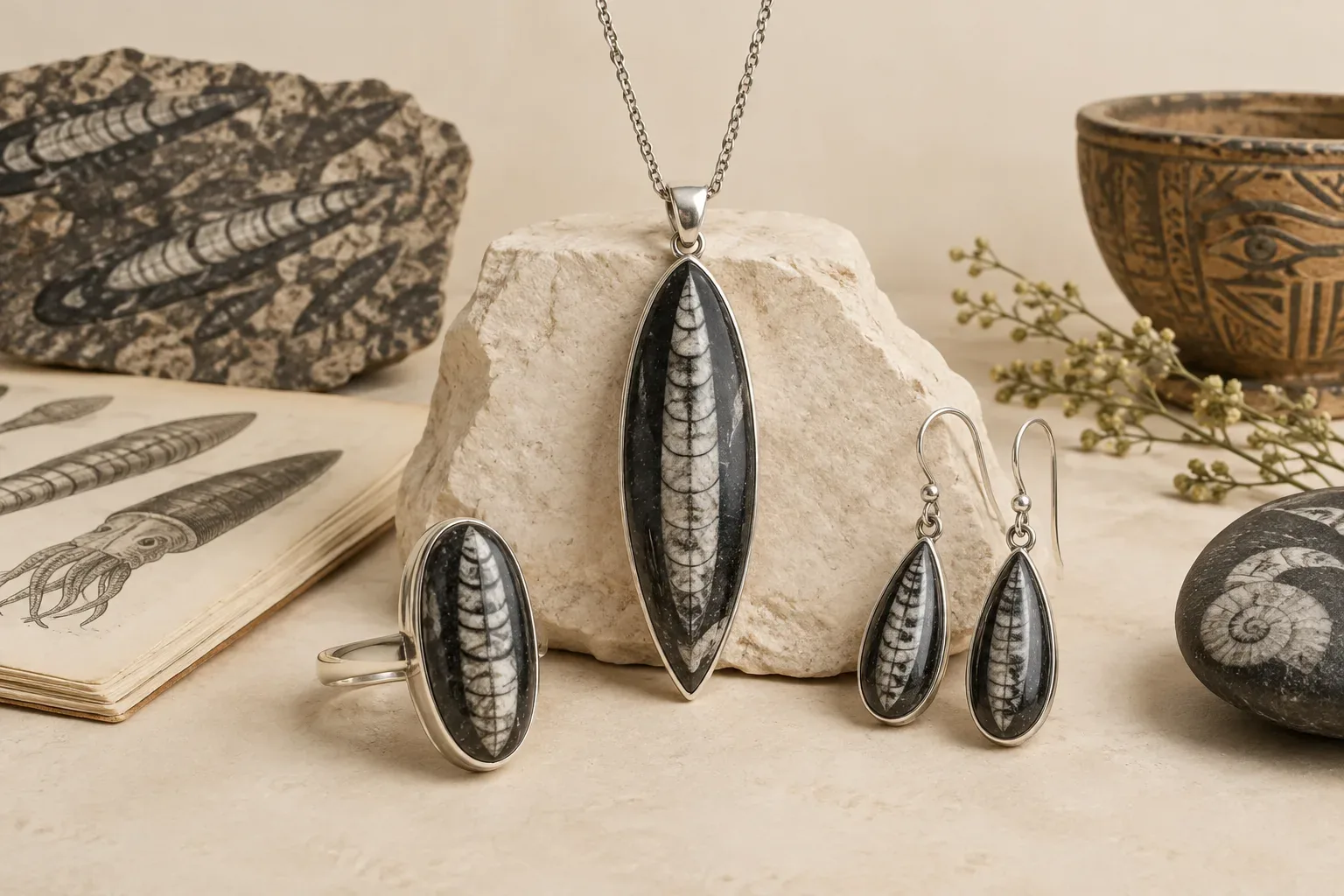
In modern jewellery markets the orthoceras motif most often appears as polished slices, cabochons, or inlay panels set into silver, gold-plated mounts, or contemporary mixed-media designs. Makers may mount whole polished specimens, cut sections, or reproductions and present them as pendants, rings, cufflinks, or decorative beads.
Retail descriptions vary in precision. Some sellers describe pieces as carved or polished fossil sections; others sell items labelled as ‘fossil motif’ jewellery or as natural stone jewellery. Because terminology differs across sellers and markets, clear provenance and material labelling are essential for a confident purchase.
Authenticity, treatments, and disclosure — what to ask and expect
Federal Trade Commission guidance on buying gemstones, diamonds, and pearls stresses that sellers should disclose treatments, imitations, enhancements, and the material’s origin. Apply that same consumer standard to orthoceras and other fossil-derived jewellery: ask whether the piece is a natural fossil, a stabilized or dyed specimen, a composite (for example a fossil set into resin), or a cast or synthetic replica.
Ask specific questions: request written confirmation of material, whether any adhesives, stabilizers, dyes, or coatings were applied, whether the piece is a natural section or a cast, and whether the seller provides returns or certification. The FTC’s consumer guidance recommends that buyers should receive truthful and specific answers about treatments and that ambiguous terms such as 'natural-looking' or 'authentic appearance' should be clarified before purchase.
If a seller offers a certificate or lab report, check who issued it and what was tested. Smaller workshop-made pieces often won’t come with a formal lab report, but reputable sellers should still be willing to describe fabrication and treatment honestly and to provide close-up photographs or a short provenance note.
How to evaluate quality and craftsmanship
Beyond material authenticity, evaluate the craftsmanship. Check the finish of any polished fossil surface, the symmetry and security of settings, and the quality of metalwork and closures. High-quality settings and good finishing protect fragile materials; secure bezels or well-made mounts reduce the risk of chips or detachment. Museum discussions of jewellery history emphasize the role of technique in how objects survive and are worn, and the same attention to making helps a contemporary piece perform well in everyday use.
Consider how the piece is presented: clear photography, honest condition notes, and transparent shop policies are indicators of a seller who understands how to handle and describe unusual materials. For vintage items, ask about previous repairs and handling history because fossils incorporated into older jewellery may have been stabilized or altered.
Selection and gifting guidance — practical and respectful choices
Choose with the recipient’s values in mind. If the person prefers natural-history objects, well-documented natural fossil sections with clear provenance make good gifts. If the recipient values symbolic meaning, discuss whether a modern personal meaning or an explicitly historical symbol is more appropriate, and avoid presenting contemporary spiritual claims as ancient fact.
When gifting to people from specific cultural or religious backgrounds, be respectful and informed: some motifs or materials have particular meanings in particular communities, while others are purely decorative. Use museum-style research practices—ask for sources or provenance when unsure, and consider whether the material was ethically sourced and sold transparently. A well-crafted piece accompanied by a short note that explains what you know about the material and whom you bought it from makes a more thoughtful gift than an unverified claim about ancient symbolism.
Budget and longevity matter. If the piece is intended for frequent wear, prefer sturdy settings, higher-quality metalwork, or protective treatments that are disclosed. If it is intended as a collectible or display object, prioritize provenance and condition over everyday wearability.
Care and maintenance
Fossil-derived materials and polished sections can be brittle or porous depending on how they were prepared and mounted; follow the seller’s care instructions and treat the piece like any delicate natural-material jewellery. Avoid prolonged exposure to water, strong detergents, or abrasive cleaners, and store the piece separately to prevent knocks from harder gemstones or metal.
Have fragile or mounted pieces checked periodically by a jeweller experienced in natural materials, and ask about re-securing settings or replacing degraded adhesives. For display-only specimens, keep them out of direct sunlight and in stable temperature and humidity conditions; museum practices emphasize controlled environments to preserve material integrity.
Final note: verify, respect, and enjoy
Approach orthoceras jewellery purchases the same way you would any specialized material: verify claims, expect clear disclosure about treatments and fabrication, and respect both documented history and modern personal meanings. Use museum perspectives on changing contexts to temper sweeping historical claims, and use FTC-style consumer questions to get clear answers about authenticity and treatment. With careful selection and honest sellers, orthoceras motif pieces can be attractive and meaningful additions to a jewellery collection.
Frequently asked questions
How can I tell if an orthoceras piece is authentic or a cast?
Ask the seller for a clear statement of material and provenance and for close-up photographs. Reputable sellers will confirm whether the item is a natural specimen, a stabilized or composite piece, or a cast. If the seller cannot provide a clear description, consider seeking a second opinion from a dealer or conservator familiar with natural-history materials.
Do sellers have to disclose treatments or enhancements?
Yes; follow the Federal Trade Commission’s guidance for gemstone and related material purchases. Sellers should disclose treatments, dyes, resins, or other enhancements. If a seller is vague about treatments, request written clarification before buying.
Is it appropriate to gift orthoceras jewellery as a cultural symbol?
Be cautious. Museum approaches recommend researching specific cultural claims before presenting a motif as historically symbolic. If a piece is being gifted for cultural or religious reasons, confirm provenance and consult sources or community authorities to ensure the gesture is respectful.
How should I care for a fossil-motif pendant I plan to wear often?
Treat it as a delicate natural-material object: avoid harsh chemicals, impacts, and prolonged moisture exposure. Store it separately and have settings inspected periodically by a jeweller experienced with natural or composite materials.
What should I check when buying vintage orthoceras jewellery?
Ask about previous repairs, documented provenance, and whether any past stabilizing treatments were applied. Vintage pieces may have older adhesives or mounts that need professional assessment for safe wear.
Can an appraisal or certificate confirm authenticity?
A certificate from a reputable lab or a qualified appraiser can help, but verify who issued the document and what tests were performed. For less common materials, also seek a second opinion from a specialist in natural-history jewellery or a museum conservator when possible.
Sources and further reading
- Bedazzled: A History of Jewellery — Victoria and Albert Museum
- An A-Z of Gemstones — Victoria and Albert Museum
- Buying Gemstones, Diamonds, and Pearls — Federal Trade Commission