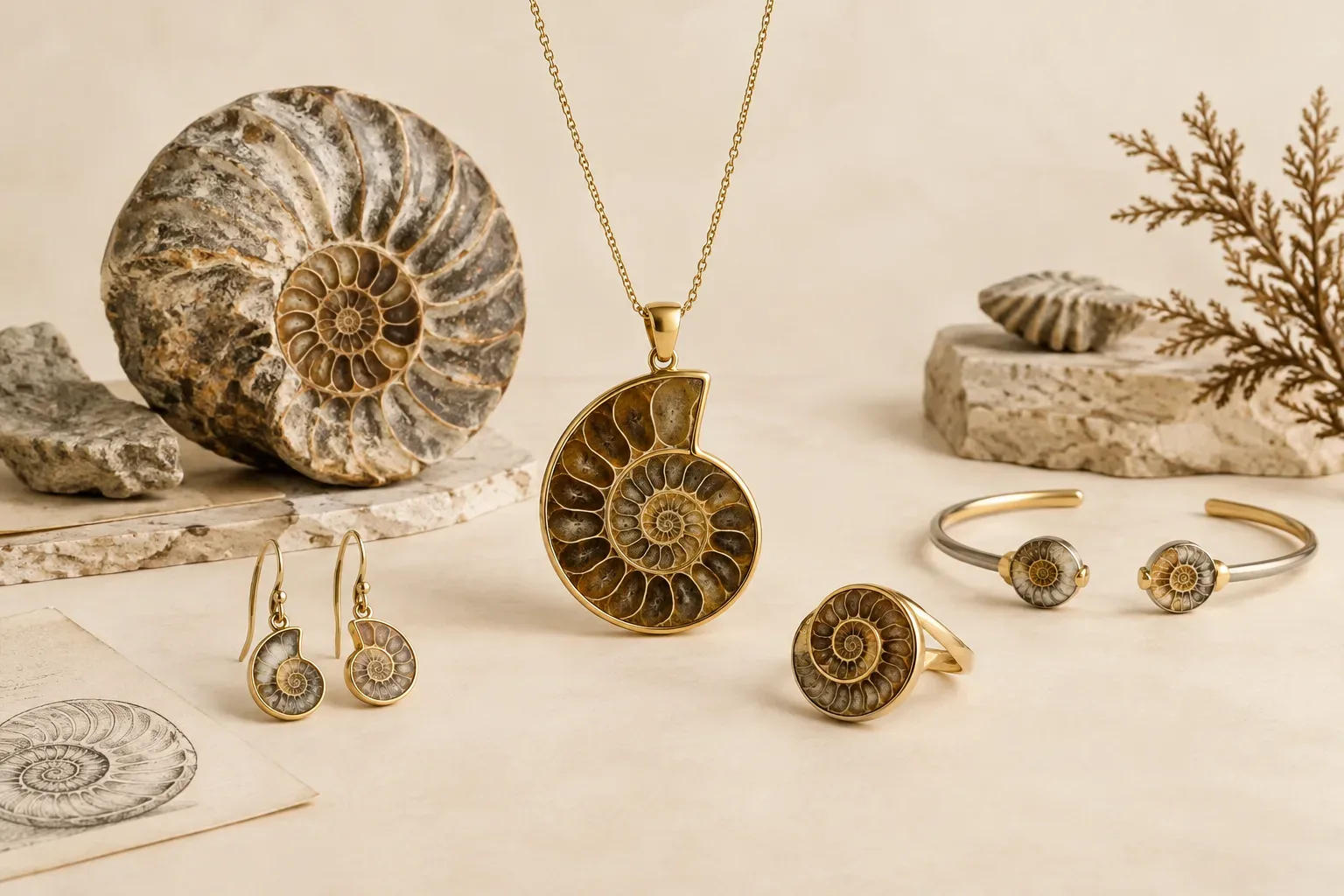
Meaning at a glance
Documented museum scholarship shows that natural specimens have long influenced jewellery design but direct historical evidence tying the nautilus fossil to a single cultural or religious meaning is limited; modern meanings are largely personal or aesthetic. This guide separates what is recorded by curators from contemporary interpretation, explains how the fossil appears in jewelry, and gives practical, ethical buying and care guidance.
Short answer — the headline meaning
In brief: scholarship on jewellery history records that natural forms and fossils have been adopted as decorative motifs at different times, but there is limited documentary evidence that the nautilus fossil carried a single, consistent symbolic meaning across cultures. The contemporary "nautilus fossil jewellery meaning" is primarily modern and personal—rooted in associations people make with the spiral form, the sea, and natural history rather than in a single, documented ancient tradition.
What the historical evidence actually shows
Museum surveys of jewellery and gemstones show that makers have repeatedly borrowed from nature for materials and motifs. The Victoria and Albert Museum describes how jewellery styles and materials change with social context and tastes, and how natural specimens became fashionable at certain moments in European history, particularly during the 18th and 19th centuries when interest in natural history and collecting grew among collectors and patrons.
That same scholarship does not establish a continuous, cross-cultural symbolic meaning for the nautilus fossil specifically. Where historians can identify the origins or clear symbolic uses of an emblem, they typically point to documented rites, inscriptions, or sustained iconography. For the nautilus fossil motif, the stronger evidence in museum literature relates to the broader practice of using natural curiosities and shells in decorative work rather than to a widely shared religious or mythic meaning pinned to the nautilus itself.
Separating documented meanings from modern interpretations
Documented historical meanings are those recorded by museums, collectors, or contemporaneous sources and linked to particular cultures or periods. In the record compiled by curators and historians, examples of jewellery made from shells and other natural curiosities appear within specific fashions—such as the natural-history craze in late Georgian and Victorian Britain—but these sources do not present the nautilus fossil as a single, ancient symbol with a universal meaning.
Modern interpretations, by contrast, are personal, artistic, or marketing-driven. Contemporary wearers and designers commonly associate the nautilus spiral with ideas of growth, proportional beauty, or the sea. Some people connect the form to mathematical concepts like logarithmic spirals or to life cycles because of the shell’s chambered structure. These are reasonable modern readings but they should be treated as contemporary meanings people choose or as poetic associations rather than as historically documented beliefs.
How the nautilus fossil motif appears in jewellery today
In current jewellery practice designers and artisans use fossilized nautilus shells and related cephalopod fossils in several ways. Makers mount polished shell sections, cross-sections, or whole shells as pendants, inlays, brooches, and earrings. The spiral profile is often the focal graphic motif, translated into metalwork or paired with gemstones and enamel. Contemporary pieces range from clearly naturalistic mounts to abstracted spiral motifs inspired by the shell.
The stone and gemstone literature discussed by museum collections emphasises identification and context: makers and buyers should expect a range of treatments, settings, and styles, and to see fossil shell used both as a raw natural specimen and as a medium adapted by the goldsmith or lapidary. The visual appeal is as often about texture, pattern, and the spiral form as it is about any single symbolic reading.
Responsible selection: provenance, disclosure, and authenticity
When choosing nautilus fossil jewellery, prioritize provenance and clear seller disclosure. The Federal Trade Commission advises buyers to ask about treatments, enhancements, and imitations for gemstones and related materials; sellers should disclose when a specimen has been altered, stabilized, dyed, or reproduced. Ask for written information about material treatments and, where appropriate, independent identification.
If you care about conservation or legal compliance, request provenance details. Some fossils and shells may be subject to collection restrictions or export rules in certain jurisdictions; a reputable seller will provide documentation or explain legal provenance. When in doubt, opt for pieces sourced from established dealers, museum shops, or reputable studios that document how and where the material was obtained.
Gifting and cultural sensitivity
Treat the nautilus motif as a personal or aesthetic gift rather than as a sure symbol with a universal spiritual meaning. If you plan to give a piece because you think it carries a particular cultural or religious significance, first verify that association with the relevant community or source. Since museum research indicates that much of our knowledge about motifs comes from documented fashion and collecting trends, avoid asserting an asserted ancient meaning unless you have clear evidence for a specific culture or period.
Match the piece to the recipient’s interests: lovers of natural history, marine biology students, and people who appreciate organic forms often value nautilus pieces for their shape and provenance. When presenting the gift, explain clearly whether the meaning is your personal sentiment, a design inspiration, or a historically documented symbolism.
Authenticity, care, and practical questions to ask sellers
To assess authenticity ask the seller how the material was prepared, whether the fossil has been stabilized or treated, and if any filling, bonding, or dyes were used. The FTC guidance on buying gemstones and related materials underscores the importance of disclosure when items have been treated or when imitations are involved. A credible seller will answer questions directly and provide supporting documentation when available.
For care, treat fossilized shells gently. Avoid prolonged exposure to water, strong chemicals, or ultrasonic cleaners that could affect adhesives, mounts, or fragile fossil surfaces. Store the piece away from extreme humidity and direct sunlight, and have mounts checked periodically by a jeweller to ensure settings remain secure.
Final notes — combining respect for history with personal meaning
The nautilus fossil is compelling because of its visual form and natural story. Museum scholarship reminds us that jewellery meaning is often historical and context-dependent; it also shows that natural specimens have repeatedly found favour in different periods and markets. Where documented historical meanings are absent or limited, modern meanings are legitimate as personal or artistic choices but should not be presented as ancient or universal truths.
If you collect or gift nautilus fossil jewellery, do so with attention to provenance, seller disclosure, and the recipient’s values. That approach respects both the object’s material history and the contemporary symbolic life people choose to give it.
Frequently asked questions
What does nautilus fossil jewelry mean?
There is no single, historically documented meaning for nautilus fossil jewellery across cultures. Museum scholarship shows natural forms have been used decoratively at different periods, while modern wearers often choose nautilus pieces for their spiral form and associations with the sea or growth. Those modern meanings are personal or artistic rather than universally historical.
How can I tell if a nautilus fossil piece is real?
Ask the seller for provenance and any treatment disclosures, and request independent identification if needed. The Federal Trade Commission recommends that sellers disclose material treatments and imitations for gemstones and related materials. A reputable dealer will provide clear answers about preparation, stabilisation, or any enhancements.
Are nautilus fossil pieces ethical or legal to buy?
Ethics and legality depend on how and where the material was collected. Some jurisdictions regulate fossil or shell collection and export. Ask sellers for provenance documentation and choose reputable dealers or museum shops. If conservation is a concern, prefer well-documented fossils or pieces explicitly sourced from legal, sustainable channels.
How should I care for nautilus fossil jewellery?
Treat fossilized shells gently: avoid prolonged water exposure, harsh chemicals, and ultrasonic cleaners that could harm mounts or adhesives. Store the piece away from direct sunlight and extreme humidity, and have metal settings checked periodically. For specific care, ask the maker or a conservator for guidance tailored to the piece's materials.
Can I gift a nautilus fossil piece as a symbol of a particular belief?
Yes, you can gift a nautilus piece with your personal meaning, but avoid representing that meaning as an ancient or universal truth unless you have clear evidence linking the symbol to a particular culture or tradition. Museum research shows that many symbolic readings people apply today are modern and personal rather than historically established.
Sources and further reading
- Bedazzled: A History of Jewellery — Victoria and Albert Museum
- An A-Z of Gemstones — Victoria and Albert Museum
- Buying Gemstones, Diamonds, and Pearls — Federal Trade Commission