Meaning at a glance
Orthoceras jewelry meaning is largely a modern, personal and decorative phenomenon rather than a well-documented ancient symbolic tradition; museum research shows jewelry has long adopted natural materials and motifs, and choosing orthoceras pieces responsibly means asking sellers about authenticity, treatment, and provenance while respecting the recipient’s cultural or religious context.
Natural history and why fossils become jewellery
Orthoceras are fossil cephalopods widely recognized by their long, straight, chambered shells; as fossils they are visually striking and durable enough to be polished and set. Over centuries natural history collections and scientific curiosity made fossils desirable objects, and jewellery has borrowed from those collections as tastes shifted toward wearable curiosities.
Museums and curators who survey jewellery history emphasise that jewellery often reflects contemporary interests — natural history, travel, and scientific collecting have inspired decorative use of shells, minerals, and fossils at different moments. This broad pattern helps explain why orthoceras fossils appear in modern jewellery even where there is no earlier documented symbolic system tied specifically to that fossil. The Victoria and Albert Museum notes that jewellery's functions and materials have changed with fashion, social values, and access to materials, and that natural materials have repeatedly been incorporated into personal ornament for both aesthetic and social reasons.
What the historical record actually shows (and does not show)
Careful historical practice separates what surviving objects and records demonstrate from later storytelling. There is good documentary evidence, collected and interpreted by museums, that certain periods adopted natural motifs (for example, shells, botanical forms, and fossil-looking materials) for reasons ranging from fashion to memento functions. However, specific claims that orthoceras fossils carried a discrete, consistent religious or cultural meaning across ancient societies are not supported by published archaeological records in the general surveys of jewellery history.
Where curators and historians have identified symbolic jewellery from past societies, they rely on contextual evidence: inscriptions, burial contexts, contemporary texts, or repeated iconography tied to named deities or rites. For orthoceras, surviving modern usage rests primarily on the visual appeal of the fossil and on modern tastes for fossils as connection to deep time and natural history rather than on a continuous symbolic tradition documented in historical sources. The Victoria and Albert Museum’s broad history of jewellery underscores the need to ground symbolic claims in tangible historical evidence rather than in later popular attributions.
Documented meanings versus modern personal interpretations
Documented meanings: museum-oriented studies of jewellery show documented symbolic systems when supported by historical records, but they do not provide a clear, documented symbolic tradition specific to orthoceras across ancient cultures. Scholarly and curatorial work stresses contextual evidence for symbolic attribution rather than retrospective assignment.
Modern interpretations: today, people ascribe a range of personal or fashion-related meanings to orthoceras jewellery. Common contemporary associations include connections to the sea and marine life, an appreciation for deep time and natural history, the aesthetic contrast of black-and-white fossil patterns, and the idea of endurance or antiquity. These are modern, often individualized readings rather than meanings that can be reliably traced through continuous cultural practice.
How the orthoceras motif appears in jewellery
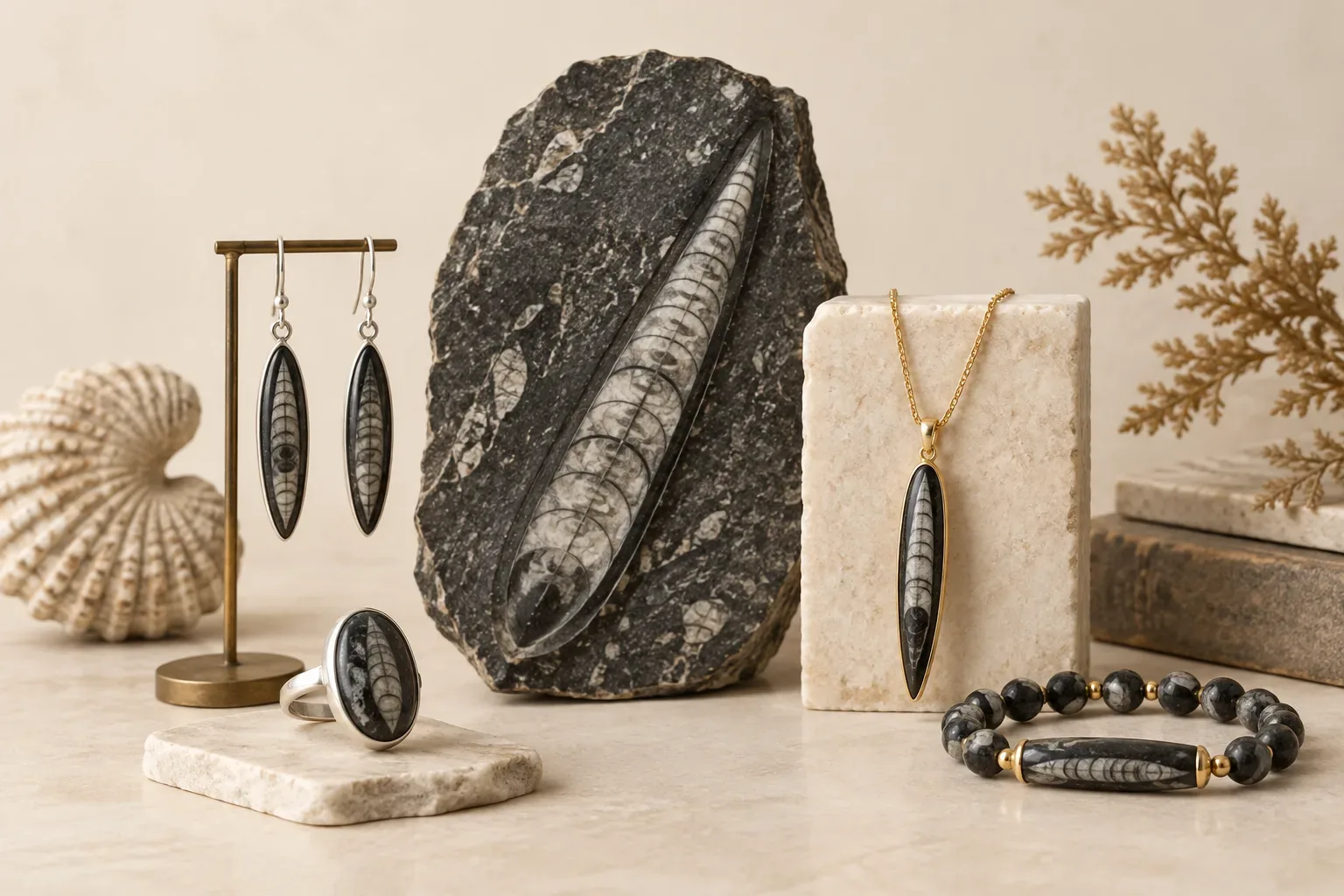
The orthoceras motif appears in contemporary jewellery in several material and design forms. Genuine fossil pieces often appear as polished whole fossils, cross-sections that reveal internal chambers, bezel-set pendants, cabochons, beads, and inlaid pieces. Artisans also carve or slice fossils to show the internal structure, or set small fossil segments into silver and other metals as focal elements.
Beyond genuine fossil material, many makers use cast or resin replicas that copy the black-and-white contrast and chambered pattern. Some designers combine orthoceras fossils with complementary materials — for example, silver, leather, or semi-precious stones — to create a natural-history aesthetic. Because treatments and composites are common in decorative material, buyers should confirm whether a piece is a natural fossil, a stabilized composite, a repaired specimen, or a full replica.
Practical and respectful selection or gifting guidance
Ask straightforward questions of sellers and makers about the object before purchase. Request written confirmation of whether the item is a genuine fossil, whether it has been stabilized or treated (for example with resins or adhesives), and whether any parts are reconstructed. The Federal Trade Commission’s consumer guidance on buying gemstones, diamonds, and pearls emphasises the importance of disclosure about material treatments and imitations; the same standard is useful for fossil-based jewellery.
Consider provenance and legality. Some countries restrict the removal or sale of certain fossils. If provenance is important to you or the recipient, request information about where the fossil was sourced and whether the seller complies with local collection laws. For a thoughtful gift, match the piece to the recipient’s likely interests: choose a minimalist pendant for someone who prefers subtlety, or a statement brooch for a collector of natural-history objects. When gifting with intended meaning, be explicit and personal: describe why you chose the fossil and avoid asserting unverified historical or religious symbolism.
Caring for orthoceras jewellery
Treat fossil material as both organic-derived and mineralized: avoid strong acids, prolonged exposure to water, and extreme heat. Many fossil pieces are stabilized with adhesives that can soften under high temperatures, so remove fossil jewellery during activities that raise temperature or expose pieces to chemicals such as household cleaners or swimming pool chlorine.
Clean gently with a soft, dry or slightly damp cloth and dry immediately. Store fossil pieces separately from harder gemstones and metals to prevent scratching. When in doubt, follow care instructions provided by the seller or a qualified conservator for historic or high-value specimens.
Ethical considerations and respectful display
Orthoceras jewellery sits at the intersection of natural history and personal ornament, so ethical questions arise about collecting, environmental impact, and cultural sensitivity. Ask whether the fossil was legally collected and whether the seller follows best practices for minimal environmental disturbance. If the piece is presented with a claimed cultural or religious meaning, request evidence or provenance for that claim; avoid transmitting unverified historical attributions as fact.
If you are wearing or gifting orthoceras jewellery in a cultural or religious setting, be mindful that meanings are not universal. What is a neutral decorative object in one context may be sensitive in another. When appropriate, explain the modern, personal nature of the meaning you attach to the piece to avoid misrepresenting historical or cultural beliefs.
Final thoughts
Orthoceras jewellery meaning today is primarily contemporary: people wear it for aesthetic appeal, for a personal sense of connection to natural history, or as a conversation piece. Curators and historians remind us to ground symbolic claims in documented evidence; where such documentation is absent, interpretive caution and clear communication are the responsible approach.
Use museum-based guidelines about materials and history to inform purchases and display, and rely on consumer-protection principles for disclosure about material treatments and imitations. When chosen and presented with honesty and respect, orthoceras jewellery can be a distinctive and meaningful adornment — meaningful because of the wearer’s story, not because of an assumed universal historical symbolism.
Frequently asked questions
Is the orthoceras motif an ancient religious symbol?
No reliable historical evidence demonstrates a single, ancient religious or cultural meaning for orthoceras across different societies. Museums that survey jewellery history emphasise that assigning a specific symbolic tradition requires contextual archaeological evidence; most orthoceras symbolism seen today is a modern interpretation.
How can I tell if an orthoceras jewellery piece is a genuine fossil?
Ask the seller for written confirmation of authenticity and for details on any treatments or stabilizing resins. Genuine fossils will often show natural internal chambering and matrix, but high-quality replicas can closely imitate appearance. The Federal Trade Commission recommends clear disclosure for material treatments and imitations when buying natural-material jewellery.
Are orthoceras fossils treated or stabilized before being set in jewellery?
Yes, many fossil specimens used in jewellery are stabilized with adhesives or resins to prevent crumbling or to fill cracks. Sellers should disclose such treatments; if a piece has been enhanced, know how the enhancement affects care and value.
How should I care for orthoceras jewellery?
Clean fossil jewellery gently with a soft, dry or slightly damp cloth and avoid acids, strong detergents, high heat, and ultrasonic cleaners. Store pieces separately from harder gemstones to prevent scratching, and follow any specific care guidance provided by the seller.
Is it ethical to buy fossil jewellery?
Ethical considerations include legality, provenance, and environmental impact. Ask the seller where and how the fossil was sourced and whether they comply with local collection laws. Purchasing from reputable dealers who provide transparency is the best way to address ethical concerns.
What should I say when gifting an orthoceras piece?
Explain why you chose the piece and whether its meaning is personal rather than historically certain. Avoid asserting unverified historical symbolism and, if the recipient has cultural or religious considerations, check that the gift is appropriate for their context.
Sources and further reading
- Bedazzled: A History of Jewellery — Victoria and Albert Museum
- An A-Z of Gemstones — Victoria and Albert Museum
- Buying Gemstones, Diamonds, and Pearls — Federal Trade Commission