Meaning at a glance
Odin-inspired jewelry uses attributes such as ravens, the spear, the one eye, runes, wolves, and the eight-legged horse, but identifying an archaeological figure as Odin can be uncertain and modern combinations remain interpretations.
What the historical evidence shows
Museum research and Viking Age studies identify a consistent group of attributes that later storytellers and craft traditions associate with the god Odin. The Swedish History Museum notes that Odin is linked with ravens, wolves, the horse Sleipnir and the motif of one eye, and that he is connected with runes and quests for knowledge. The National Museum of Denmark likewise associates Odin with ravens, wolves, Sleipnir and with runes and learning.
These links come from a mix of sources: Old Norse literary texts composed in medieval Iceland, inscriptions that include runic sequences, and Viking Age material culture such as carved images and decorated objects. Museums stress that reading an image as Odin depends on context, iconographic parallels and the interpretive work of researchers; not every figure with a spear or a bird is confidently identified as Odin. In short, the archaeological and textual record supports certain recurring motifs, but assigning an artifact to Odin is sometimes uncertain and debated among scholars.
Documented historical meanings versus modern interpretations
Documented historical meanings: Museums and specialists trace several associations to Odin in the Viking Age and the later Old Norse literary tradition. Runes, in both inscriptions and story, are associated with Odin as a discoverer of runic knowledge. Ravens and wolves are repeatedly linked to his entourage in medieval sources and interpreted in material culture studies as his animal companions. The image of a one-eyed figure appears in iconography and is explained in later narratives as a symbol of sacrifice made in pursuit of wisdom. However, museums caution that these are interpretive links drawn from scattered evidence rather than a straightforward catalogue found on every object.
Modern personal and commercial interpretations: Contemporary jewelry designers and wearers often combine several attributes—two ravens flanking a spear, a single eye on a pendant, runic bands around a ring—to create a recognizable 'Odin' aesthetic. These combinations are modern syntheses intended to evoke themes associated with Odin such as wisdom, battle, sacrifice and guidance. While inspired by historical motifs, such combinations are not necessarily faithful reconstructions of any single archaeological object or a single period practice, and meanings can be personal, symbolic, or purely aesthetic.
How Odin motifs appear in jewelry
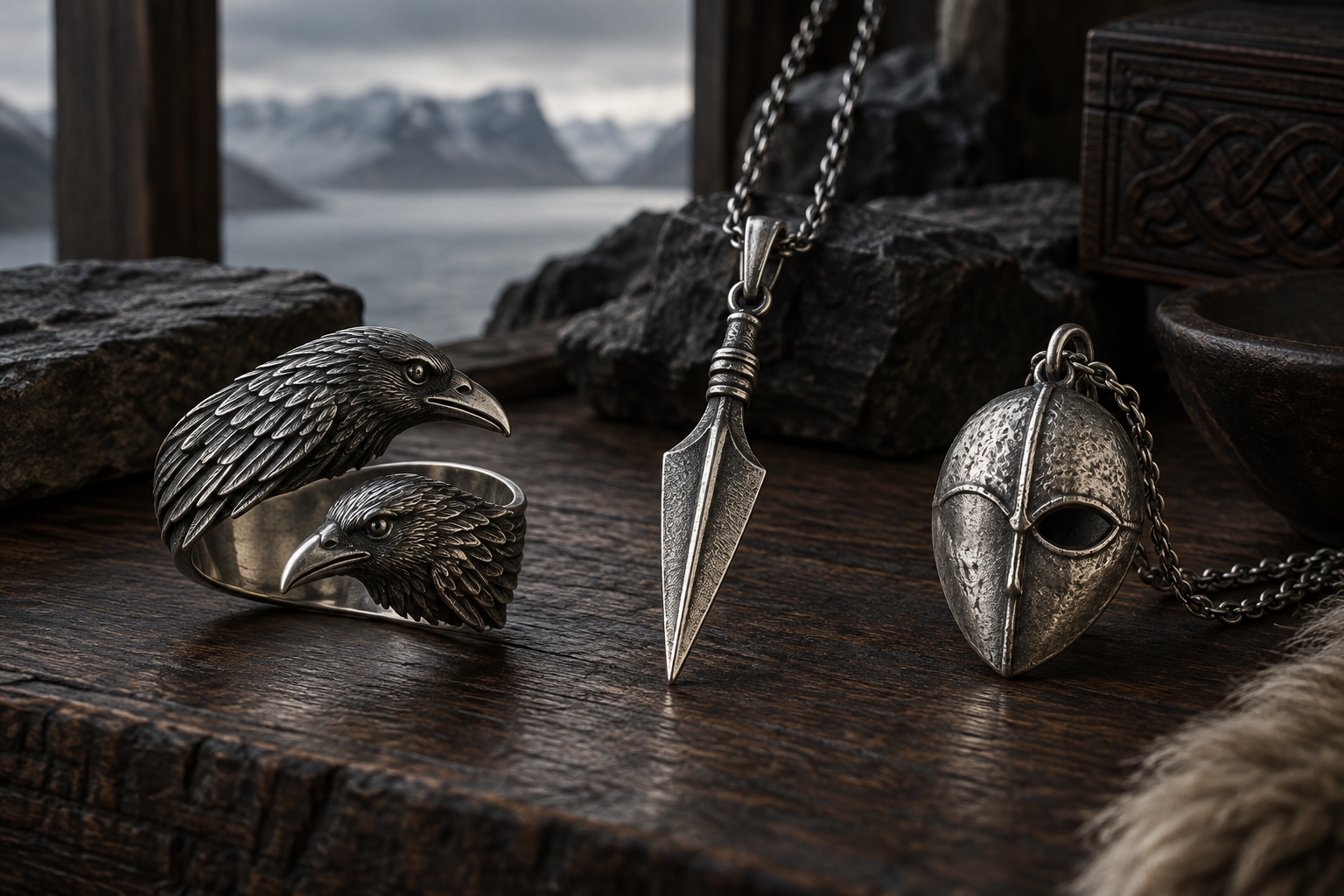
Ravens: Raven motifs appear as small sculpted heads, engraved profiles, or paired charms on necklaces and brooches. Designers render ravens realistically or stylize them into knotwork and geometric shapes. Raven imagery in jewelry evokes the pair Hugin and Munin known from the literary tradition as Odin’s messengers and is often used to symbolize memory, thought, and watchfulness.
Spear: The spear, associated with Odin through myths and iconography, is used as a vertical pendant, a bar through a ring, or an engraved motif on bands. Some pieces abstract the weapon into a simple line or a rune-like form. In historical terms, weapons in graves and art signal warrior identity; in modern jewelry they can express protection, leadership, or martial heritage.
The one eye: The single-eye motif appears as a central gem, a drilled dot, or a stylized eye symbol on pendants and signets. Designers use asymmetry or deliberately cover one eye on a figure to reference the stories of Odin’s sacrifice of an eye for wisdom. This motif is evocative and personal rather than a direct copy of a specific archaeological piece.
Runes: Runic inscriptions, actual Elder Futhark or younger runes, are commonly set around rings, cuffs and pendants. Some designs use transliterated names, protective words, or individual runes chosen for meanings assigned in modern rune-books. Museums connect runes to Odin as the discoverer of their mysteries, but inscribing runes on jewelry today ranges from historically inspired reproductions to contemporary messages using rune shapes.
Wolves and Sleipnir: Wolf heads and paw motifs are used like raven imagery to suggest Odin’s companions, while Sleipnir appears more rarely as an eight-legged horse motif in high-detail pieces or stylized emblems. These animal motifs can be sculptural or engraved, and are often combined with knotwork or runic bands to create a Norse-inspired aesthetic.
Gemstones, metals and traditional techniques
Historically, Viking Age jewelry commonly used silver, bronze, gold and glass inlays, and gemstones were not always central to iconography in the way modern buyers expect. Contemporary makers often choose silver for its historical resonance, or oxidized finishes to suggest age. Gemstones used in Odin-themed pieces are selected for symbolic color or durability rather than historical authenticity: dark stones such as onyx or smoky quartz can echo the funerary or martial associations of the motifs while amber, a historically traded material in the North, appears in many Scandinavian designs.
Traditional techniques such as casting, granulation and silver filigree inspire modern makers who want a historical feel, but many contemporary pieces are made with modern methods and finishes. When accuracy matters to buyers, look for makers who explicitly describe their use of period techniques or who reference museum examples in their design notes.
Practical and respectful selection and gifting guidance
Know what you want the symbol to convey. If you are choosing a piece to represent historical interest or scholarly appreciation, select designs that state their inspiration and sourcing clearly and, where possible, reference museum or archaeological parallels. If you want a piece to express a personal value such as wisdom, protection or remembrance, consider designs that combine a single motif with explanatory tags or accompanying notes so the receiver understands your intent.
Be mindful of cultural sensitivity. Odin belongs to the Norse mythic tradition and to peoples across Scandinavia and the North Atlantic, and modern misuse of Norse symbols has occurred in some political contexts. Choose vendors and makers who present Norse imagery respectfully and avoid brands that appropriate such symbols for extremist messaging. A maker who explains the historical associations and avoids sensationalist language is a safer choice.
Consider recipient preference and background. Not everyone will welcome a mythic symbol that has strong cultural or political connotations. When gifting, provide context: a short card explaining the historical motifs and clarifying that the piece is inspired by Norse myth and museum research can be helpful. For a partner or family member who values authenticity, a handcrafted piece using traditional metals or amber may be appropriate. For someone who prefers modern minimalism, a subtle raven pendant or a single rune might be better received.
Size, durability and wearability matter. Odin motifs can be bold and heavy; consider the recipient’s usual jewelry habits. For everyday wear choose durable metals and secure settings. For investment or display pieces prioritize maker reputation and clear material descriptions.
Caring for and contextualizing Odin-themed pieces
Treat historic motifs with respect in description and display. If you sell or gift a piece described as 'Odin-inspired,' avoid definitive claims that present the piece as an ancient relic. Instead, explain which motifs inspired the design and, if relevant, cite museum resources or analogous objects.
Care instructions depend on materials: silver may need polishing, amber prefers gentle cleaning, and enamel or inlay work benefits from professional servicing. Store pieces to avoid scratches and keep any documentation or maker notes with the object to preserve its interpretive context.
Conclusion
Odin symbols in jewelry draw on a small set of recurring attributes associated in scholarship with the figure called Odin: ravens, wolves, runes, a spear, the motif of one eye and the horse Sleipnir. Museum studies support these associations but also remind us that identifying a particular archaeological image as Odin is not always straightforward. Contemporary makers synthesize motifs imaginatively, so buyers and gifters should distinguish documented historical links from modern personal meanings and choose pieces with clarity, respect and appropriate context.
Frequently asked questions
Are raven and wolf motifs definitely Odin in archaeological finds?
Not always. Museums and specialists link ravens and wolves with Odin through a combination of medieval texts and material evidence, but identifying a particular image or object as Odin depends on context and interpretation rather than a single conclusive marker.
Do runes on jewelry mean the wearer follows Norse religion?
No. Runes can be used for historical interest, aesthetic appeal, or personal meaning. While runes are associated with Odin as a discoverer of their mysteries in later texts, modern use on jewelry does not automatically indicate religious belief.
Is the one-eye motif common on Viking Age jewelry?
The motif of a one-eyed figure appears in iconography and is explained in later narratives as part of Odin’s sacrificial story, but it is not a universal design found on everyday Viking Age jewelry. Modern uses of a single-eye motif are often evocative interpretations.
How can I respectfully gift Odin-inspired jewelry?
Choose pieces from makers who describe their historical inspiration, avoid sellers who use Norse symbols for extremist messaging, and include a note explaining the motifs and your intention so the recipient understands the cultural and historical context.
Which materials are historically appropriate for Norse-inspired pieces?
Historically, silver, bronze, gold and glass inlays were common. Amber was a traded material in the North and appears in archaeological finds. Modern pieces may use these materials or contemporary substitutes; look for makers who specify materials and techniques if authenticity is important.
Sources and further reading
- Odin – leader of the gods — Swedish History Museum
- The Viking gods — National Museum of Denmark