Meaning at a glance
Yggdrasil jewelry represents the Norse world tree and can thoughtfully express connection, interdependence, endurance, the search for wisdom, and the relationship between fate and change; these are modern readings grounded in Norse myth, not proof that surviving Viking Age tree-shaped jewelry carried one fixed meaning.
What the historical sources actually show
When historians and museums describe Yggdrasil, they are referring to a central image in Norse myth: a vast cosmic tree that links different parts of the Norse cosmos. This basic identification is stated clearly by the Swedish History Museum and in editions of the Eddic material such as the Uppsala Edda, which treat Yggdrasil as the Norse world tree with roots, wells, and associated living beings.
Medieval written sources that discuss Yggdrasil and related figures require careful source criticism. The National Museum of Denmark explicitly warns that medieval texts and later compilations are not straightforward eyewitness accounts and must be read with attention to context and transmission. Scholarship therefore builds on a combination of late medieval literary material, archaeology, and careful interpretation rather than on any single definitive source.
Linguistic and textual work shows that the name Yggdrasil itself is debated. An etymological study from Uppsala University summarizes scholarship that variously links the name to Odin and to terms for 'terrible' or 'yew'—but the etymology is not settled and remains a subject of academic discussion.
Finally, several strands of the medieval material connect Yggdrasil to fate and to certain gods. The Swedish History Museum and the Uppsala Edda note that the Norns—female figures responsible for fate—are depicted in relation to the tree, and other textual traditions associate Odin, runes, and the world tree in broader mythic contexts.
Documented history and modern interpretations
In the surviving Norse mythic corpus, Yggdrasil functions as a cosmic or world-tree figure connecting different parts of the mythic cosmos. Its roots, wells, and living creatures help give that cosmos shape, while the Norns connect the tree with fate (Swedish History Museum; Uppsala Edda).
Medieval and later sources also connect the world tree in different ways with Odin and the runic tradition. Those connections belong to a complex literary record, however, rather than to one unchanging doctrine shared by every Norse community (Uppsala University; Swedish History Museum).
Contemporary readings often emphasize connection between realms, interdependence, resilience, endurance, the pursuit of wisdom, and the relationship between fate and change. These can be sincere personal or cultural meanings, but they are modern interpretations grounded in myth rather than evidence that one symbolic message was encoded in every tree-shaped Viking Age object.
It is important not to treat the modern symbolic list as a claim about what every Norse person thought. As the National Museum of Denmark points out, medieval written sources and later traditions require critical interpretation; surviving artifacts do not prove a single fixed message across all makers or users.
How the Yggdrasil motif appears in jewelry today
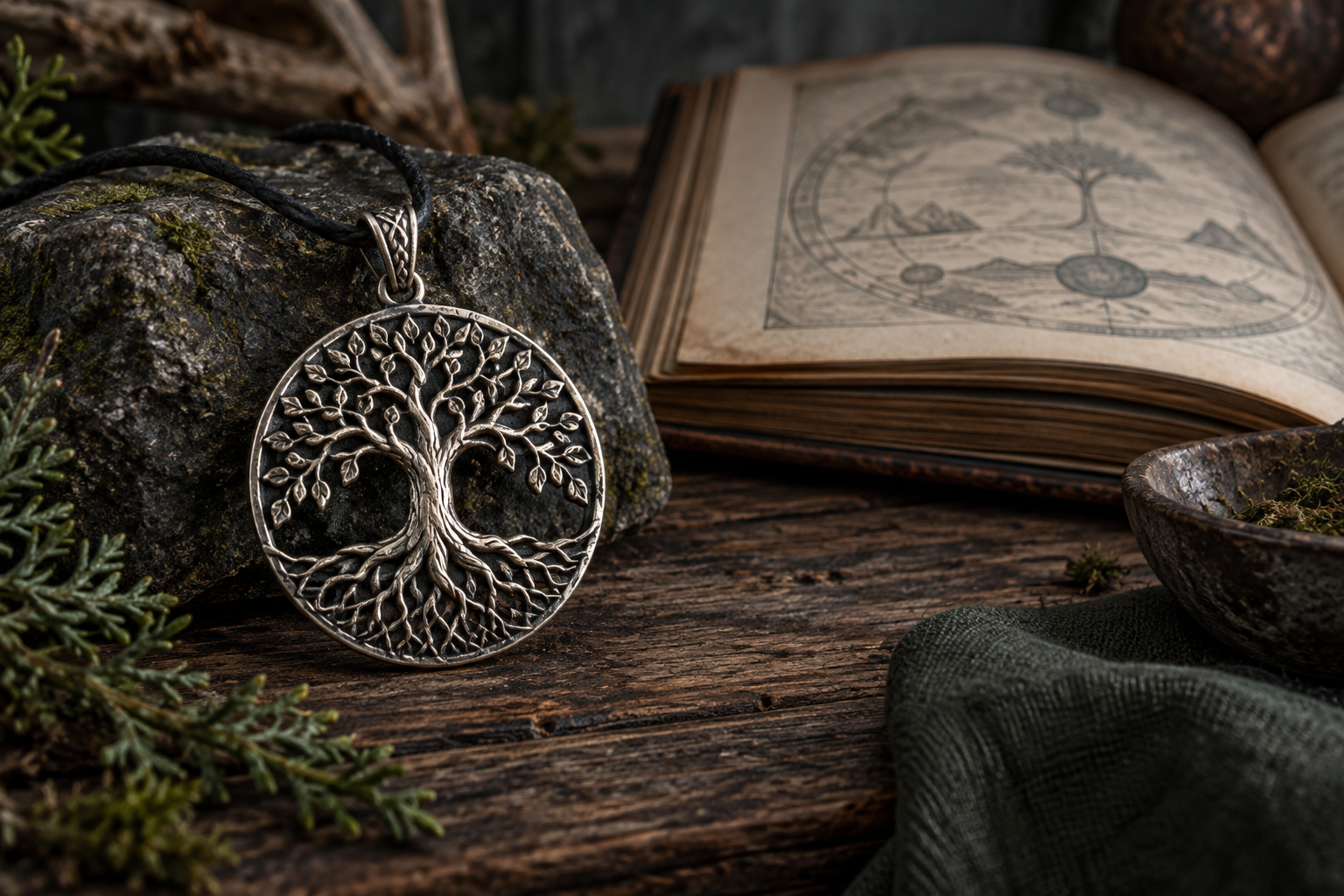
Contemporary Yggdrasil jewelry often uses a stylised tree with one trunk and spreading roots and branches. Compact, graphic forms make the motif legible on necklaces, rings, and other small objects, but that visual resemblance does not make a piece a replica of a documented Viking Age object.
Designers sometimes combine the tree with runes or rune-like inscriptions. This pairing draws on literary associations among Odin, runic knowledge, and the world tree, but joining these symbols in a modern jewel is a contemporary aesthetic and interpretive choice rather than a direct archaeological reconstruction (Uppsala University; Swedish History Museum).
Other designs refer to the tree's mythic surroundings through animals, roots, or wells. These details can place the tree within the wider Norse cosmology described by the Swedish History Museum and the Uppsala Edda instead of presenting it as a generic tree of life.
Modern makers use silver, bronze, gold-plated metals, and mixed media for Yggdrasil designs. Material choice normally reflects present-day taste, price, durability, and craft rather than a documented ancient rule.
Practical and respectful guidance for selecting or gifting Yggdrasil jewelry
Know the difference between a historical claim and a contemporary meaning. If historical authenticity matters, present the piece as inspired by Norse myth and modern interpretation, not as a verbatim Viking Age object. The National Museum of Denmark advises caution when reading medieval texts as direct evidence; claims about artifacts deserve the same care.
Consider the recipient’s beliefs and background. Some people wear Norse imagery as cultural heritage, some as part of contemporary heathen or pagan practice, and others simply for its appearance. Respect the recipient's customs and preferences; if you are unsure, ask or choose a neutral design.
Choose symbolism deliberately. For a modern reading centered on endurance, connection, or wisdom, look for a maker who explains the design intent. A simple pendant may read as a general tree of life, while runes or additional mythic figures add further interpretive layers.
Prioritise reputable makers and clear product information. Whether a piece is handcrafted or mass-produced, the seller should identify materials, construction, dimensions, and the intended inspiration. Clear information matters especially when price or a claim of historical authenticity influences the purchase.
Museum literature can make a thoughtful supplement to a gift. A short note and a reliable resource from the Swedish History Museum or National Museum of Denmark help the recipient distinguish medieval evidence from modern symbolic use.
Avoid treating Yggdrasil jewelry as a one-size-fits-all talisman. The medieval tradition contains several themes and complex associations; a modern wearer should not assume that every such object had one historical ritual purpose.
Frequently asked questions
What does Yggdrasil symbolize in Norse myth?
In the medieval Norse tradition Yggdrasil is presented as a cosmic or world tree that structures the mythic cosmos and is linked with wells, roots, and living beings; later texts also connect it with the Norns and with themes of fate (Swedish History Museum; Uppsala Edda).
Does wearing Yggdrasil jewelry mean I follow Norse religion?
Not necessarily. Many people wear Yggdrasil as a cultural, aesthetic, or personal symbol. If you adopt it as part of a religious practice, be aware that modern religious uses are contemporary interpretations rather than direct continuations of a single documented ancient practice.
Did Vikings wear Yggdrasil pendants?
Surviving material culture and texts do not establish a single, uniform use of tree-shaped jewelry in the Viking Age; modern claims that a particular piece type carried one fixed meaning are not supported by the evidence. Museums and scholars advise careful interpretation of the sources (National Museum of Denmark).
Can Yggdrasil jewelry include runes or other mythic symbols?
Yes—many modern designs pair the tree motif with runes or other mythic elements. The medieval literature links the world tree with Odin and runic knowledge in certain contexts, but combining symbols in contemporary jewelry is a modern design choice informed by that literary association (Uppsala University; Swedish History Museum).
How do I choose a respectful Yggdrasil gift?
Be explicit about whether the piece is a modern interpretation. Consider the recipient’s beliefs, choose reputable makers, and provide reliable museum or academic resources if you want to share historical context (National Museum of Denmark; Swedish History Museum).
Sources and further reading
- The old religion — National Museum of Denmark
- Vikingarnas mytologiska värld — Swedish History Museum
- The Aesir – the gods of the aristocracy — Swedish History Museum
- Yggdrasill: An Etymological Study — Uppsala University
- The Uppsala Edda: DG 11 4to — Viking Society for Northern Research