Meaning at a glance
New moon jewelry meaning combines an astronomical phase—when the Moon is near the Sun and largely unseen—with a long history of celestial motifs in decorative arts; museums such as the Victoria and Albert Museum document how crescent and lunar shapes have been used in different periods and cultures for decorative, social, and sentimental reasons, while many modern wearers adopt personal meanings like renewal, potential, or privacy. Practical buying guidance includes checking gemstone treatments and disclosures (FTC), choosing designs that respect the recipient’s beliefs, and considering materials and care.
Astronomy in brief — what the new moon is
In ordinary astronomical terms, “new moon” names the lunar phase when the Moon lies roughly between the Earth and the Sun and the side of the Moon that is illuminated faces away from an observer on Earth. That makes the lunar disc hard to see with the naked eye and associates the phrase with darkness, concealment, or a beginning in observational cycles. This basic astronomical fact helps explain why the new moon has been appealing as a motif for ideas of starting points or hidden potential in modern symbolism.
Historical evidence and cultural periods
Museum collections and curated exhibitions provide the clearest archaeological and documentary evidence for the appearance of lunar motifs in jewellery. The Victoria and Albert Museum’s coverage of jewellery history emphasizes that celestial forms—including crescents, full-moon discs, and stars—appear in objects from the ancient world through the medieval period into the modern era, and that meanings shifted with time and place rather than remaining constant.
The V&A’s collections include examples from the ancient Mediterranean and Near East where jewellery makers used stylized celestial elements as ornament; items from the medieval and Islamic worlds where crescent shapes are present in decorative arts; and extensive material from the European Renaissance and Victorian eras where moon and star motifs appear in private and public jewellery. The V&A frames these instances as part of jewellery’s changing social context rather than as evidence of a single symbolic interpretation across cultures.
Documented historical meanings (what museums show)
When curators and catalogues treat the moon motif historically, they most often record the object’s form, materials, and likely social context: whether the piece is high-status ornament, everyday personal jewelry, protective amulet, or sentimental keepsake. The Victoria and Albert Museum highlights how jewellery’s social meanings change with fashion, technology, and social structure, demonstrating that the same motif can serve decorative, status, or commemorative purposes at different times.
For example, crescent-shaped mounts or pendants in certain periods are best read as fashionable decoration, while in other contexts similar shapes can occur on devotional or protective objects. Museums generally stop short of declaring single, universal meanings for lunar imagery and instead situate pieces within their specific cultural and chronological contexts, emphasizing documented provenance, materials, and usage where available.
Modern meanings and personal interpretations
Contemporary wearers frequently adopt new moon imagery for meanings that reflect personal experience or contemporary symbolic vocabulary: renewal, intention-setting, new projects, privacy, or the feminine and cyclical aspects of life. These are modern associations shaped by contemporary spirituality, wellness culture, and popular media rather than simple continuations of all historical uses.
It is important to treat modern interpretations as individual or subcultural choices. While some people regard the new moon as a timely emblem for beginnings, others may wear the motif purely for aesthetic reasons or to reference cultural identities. Museums such as the V&A help clarify that past uses were diverse; they do not validate any single contemporary reading as the historic norm.
How the new moon motif and related gemstones appear in jewelry
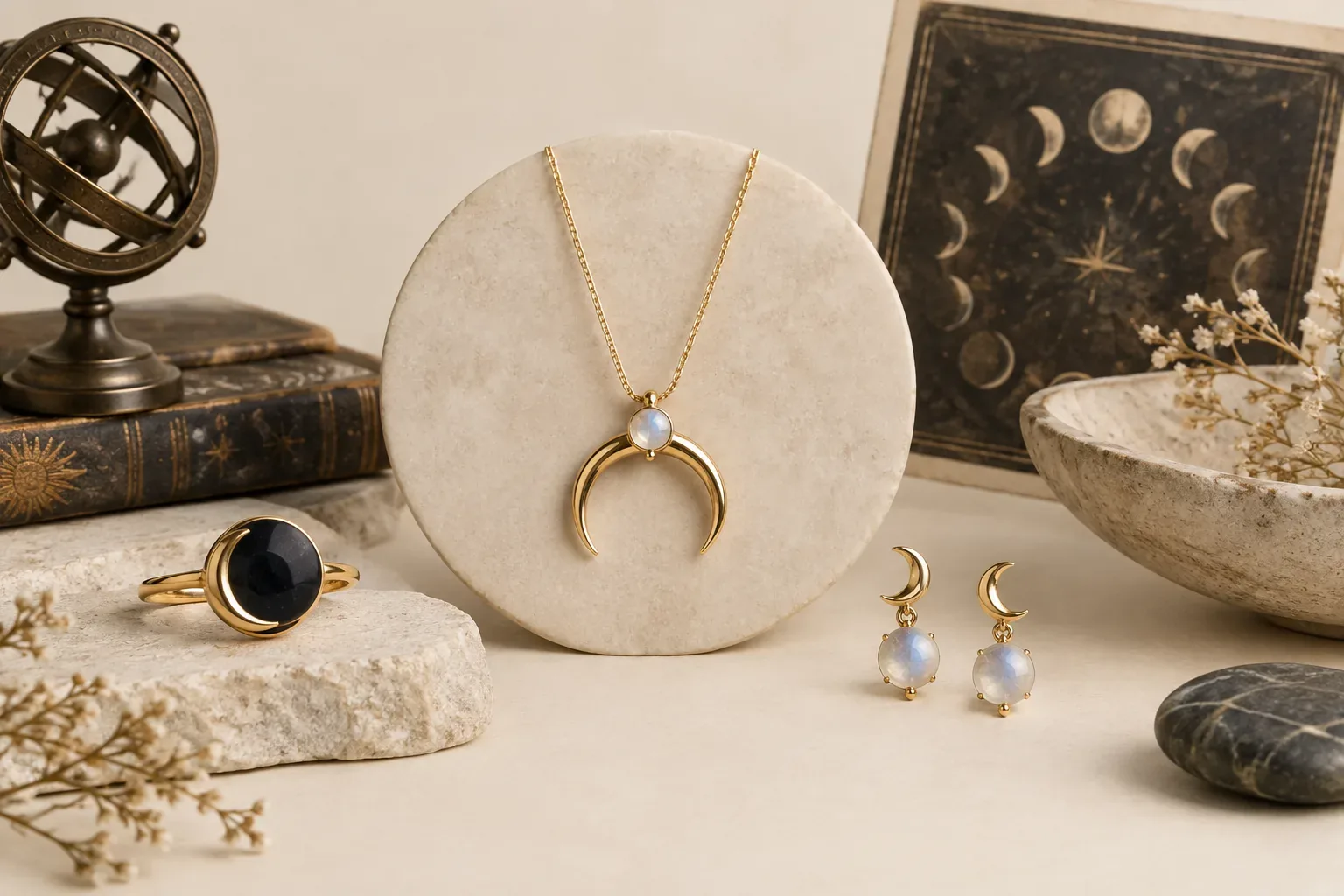
Designers render the new moon motif in many ways: as a crescent pendant, a subtle arc in a ring or earring, a carved moon disc, or as part of constellation-themed clusters. The motif can be literal—a crescent silhouette—or abstracted into curved metalwork and negative space. Image, scale, and placement change a design’s visual emphasis and cultural feel, from delicate minimalist pieces to larger statement objects.
Gemstones commonly paired with lunar imagery include moonstone and pearl because of their optical qualities and traditional associations with the moon’s sheen. The Victoria and Albert Museum’s A–Z of Gemstones provides background on gemstones’ historical use and identification, which can help explain why certain stones became linked with lunar motifs. Jewelers also combine metals and finishing techniques—matte surfaces, hammered textures, or high polish—to underline ideas of night, reflection, or newness.
Material, treatment, and authenticity considerations
If you are selecting new moon jewellery with specific gemstones, check for material treatments and imitations. The U.S. Federal Trade Commission’s guidance on buying gemstones, diamonds, and pearls recommends that sellers disclose treatments, enhancements, and whether a stone is natural, laboratory-grown, or simulated. Transparent disclosure affects value and care, and is particularly relevant for moonstone, pearls, and other materials that are commonly treated, dyed, or imitated.
Museum and educational sources like the V&A’s gemstone guides can help you identify characteristic properties of stones, but when in doubt ask the seller for written information and, for more expensive purchases, an independent laboratory report.
Practical advice for choosing or gifting new moon jewelry
First, consider intent and the recipient. If the piece is a gift intended to convey a message—support for a new beginning, encouragement, or remembrance—use language that clarifies your intention so the recipient can interpret it within their own beliefs. Respect cultural or religious meanings by asking gently if you are unsure whether lunar imagery has specific significance for the person you are giving it to.
Second, match style and durability to lifestyle. For everyday wearers, select durable metals and low-maintenance settings; for someone who cherishes occasional pieces, you can choose more delicate or historically styled items. Think about metal allergies, clasp types, and stone hardness when making your decision.
Third, verify materials and disclosure. Follow FTC guidance by asking sellers about treatments and requesting documentation for higher-value gemstones. Consider provenance and maker reputation for artisanal pieces, and prefer clearly described items when buying online.
Finally, understand care requirements and presentation. Some moon-associated materials—pearls and certain opalescent stones—need gentler care; include care instructions with the gift. If the symbolic meaning is important to the recipient, consider pairing the jewellery with a short note explaining your intention so the gift is both beautiful and intelligible.
Honoring history while respecting personal meaning
Wearing or gifting new moon jewellery can be both an aesthetic choice and a personal or social statement. The historically attested uses recorded by institutions like the Victoria and Albert Museum show that lunar motifs are versatile and have served many purposes over time. That variety is a reminder not to assume a single, universal meaning and to treat the motif with curiosity and respect for the wearer’s context.
If you are researching a specific antique piece, consult museum catalogues and provenance records and, where possible, speak to a qualified conservator or specialist. For contemporary designs, ask makers about their sources of inspiration if historical continuity matters to you.
Frequently asked questions
What does new moon jewelry symbolize?
There is no single historical meaning. Museums such as the Victoria and Albert Museum show that lunar motifs have served decorative, social, and sentimental roles in different cultures and periods. In contemporary use many people adopt the new moon as a personal symbol for beginnings, intention-setting, or quiet potential, but these are modern interpretations rather than universally documented historical meanings.
Are there gemstones traditionally linked to the moon motif?
Gemstones often paired with lunar imagery include moonstone and pearls because of their sheen and optical qualities; the V&A’s A–Z of Gemstones offers background on how different stones have been used historically. Always ask sellers about treatments and whether a stone is natural, lab-grown, or simulated, following FTC guidance.
How should I care for moon-associated materials like pearls or moonstone?
These materials can be softer or more sensitive than many faceted gemstones. Keep them away from harsh chemicals, avoid ultrasonic cleaning for porous or treated stones, and store them separately to prevent scratching. For specific care instructions consult the maker or a professional conservator.
Can I gift new moon jewelry to someone of a particular faith or culture?
Respect individual and communal meanings by asking if lunar imagery has particular significance to the recipient. Museum evidence shows meanings vary by culture and period, so a considerate conversation helps avoid unintended offense and ensures the gift’s symbolism is appropriate.
How do I verify a seller’s claim about gemstone treatments?
Request written disclosure from the seller and, for higher-value purchases, a report from an independent gemological laboratory. The Federal Trade Commission recommends clear disclosure of treatments, enhancements, and whether a stone is natural, lab-grown, or simulated.
Sources and further reading
- Bedazzled: A History of Jewellery — Victoria and Albert Museum
- An A-Z of Gemstones — Victoria and Albert Museum
- Buying Gemstones, Diamonds, and Pearls — Federal Trade Commission