Meaning at a glance
This article explains documented historical use of moon and full-moon motifs in jewelry (as recorded by the Victoria and Albert Museum), separates those findings from later popular interpretations, and gives practical, respectful advice for choosing and caring for full moon jewelry while noting consumer-protection guidance from the FTC.
Quick answer
The full moon motif in jewelry has long been used as a visual and decorative theme; museum documentation shows that celestial motifs—including moon shapes and objects associated with the moon—appear in many periods and cultures. Modern wearers often layer personal meanings (cycles, femininity, intuition) on top of those historical uses. This article follows the Victoria and Albert Museum's account of changing jewelry contexts for historical evidence and uses the V&A's gemstone guide and U.S. Federal Trade Commission consumer guidance when discussing materials and purchases.
What the historical evidence shows (and where it comes from)
The most reliable, documented evidence for how jewelers used moon imagery comes from museum collections and curatorial research rather than from a single universal source. The Victoria and Albert Museum (V&A) presents a broad history of jewellery that demonstrates how motifs shift with fashion, technology, patronage, and belief. The V&A's exhibition materials and collection records show that celestial motifs—including stars, suns, and moon shapes—are visible across multiple regions and eras, and that their meanings changed with context rather than remaining fixed.
Examples in museum collections and catalogues include objects from ancient civilizations such as Egypt and Rome, medieval and Renaissance Europe, the courts of the Ottoman and Mughal empires, and the popular and commercial jewellery of 18th- and 19th-century Europe. The V&A shows how these items should be read as part of specific social and artistic settings: a crescent motif in an Ottoman court piece is not the same cultural expression as a Victorian brooch that borrows classical shapes for fashion.
For gemstones associated with the moon—most notably moonstone, but also pearls and certain opals—the V&A's 'An A–Z of Gemstones' provides historical context about when and where these materials were favoured and how they were set and treated in different periods. That source documents trade, cutting styles, and the ways particular stones were valued in decorative arts over time.
Separating documented historical meanings from modern interpretations
Documented historical meanings are what curators and historians can demonstrate from objects, inventories, correspondence, and fashion records. The V&A's work emphasizes that meaning often derives from context: patronage (who commissioned the object), occasion (funerary, devotional, courtly display), and technical innovation. For example, a moon-shaped amulet in an archaeological collection may have been worn for calendrical or ritual reasons in its original context, but what survives in museum catalogues is the object and the record, not a single, universal message.
Modern interpretations—such as reading full-moon jewelry as a symbol of feminine power, emotional cycles, or new beginnings—are common today and meaningful to many wearers, but they are contemporary layers of meaning. These personal or popular symbolic uses are often informed by modern spirituality, astrology, literature, and fashion rather than by direct continuity with a single historical tradition. The V&A materials make clear that motifs are frequently reinterpreted as aesthetics, trends, or personal symbols in later periods.
Astronomy and why the full moon became a motif
The full moon is an easily observed monthly phase that has structured many societies' calendars and rituals. Because the full phase is visible and regular, it naturally became available as a symbolic reference in decorative arts. Across cultures, the moon's visibility, cycle, and effects on night illumination made it a useful and evocative reference that could be adapted to multiple purposes in design.
When jewelers and patrons chose a moon motif, they could reference observable astronomy without needing technical accuracy. The motif functions visually—a circular disc, a crescent, or a pearlescent surface—rather than as a scientific diagram. Museum collections demonstrate that makers used that visual vocabulary in different ways depending on taste, technique, and symbolic intent.
How the full moon motif and lunar gemstones appear in jewelry
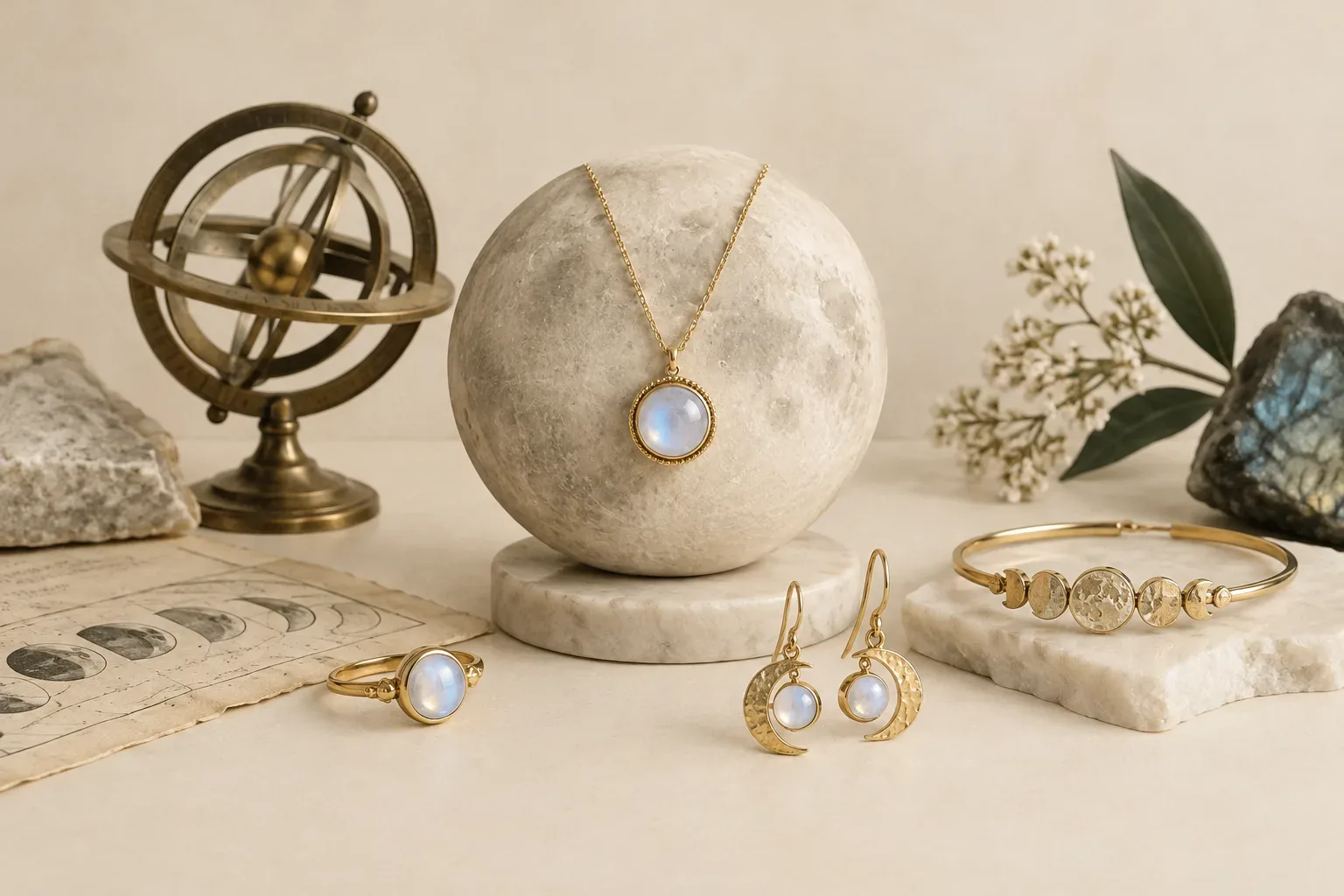
The full moon motif appears in jewelry in a few clear ways: as a round, disc-like motif that evokes the full lunar face; as crescents and half-moons that reference other lunar phases; and as pearlescent or adularescent gemstones meant to suggest moonlight. The V&A's publications and collections show these shapes in many object types, including pendants, brooches, rings, and decorative ensemble pieces. Makers have also used enamel, engraving, and textured metals to create a luminous effect.
Specific materials historically associated with lunar qualities include moonstone—valued for its adularescence—pearls, and certain opals that play with light to resemble lunar sheen. The V&A's 'An A–Z of Gemstones' explains the traditional gemological and decorative uses of these materials and traces how cutting, setting, and trade affected their popularity. In later centuries, gem-cutting techniques and mounting styles changed how these stones were used visually and commercially.
Practical guidance for selecting, wearing, and gifting full moon jewelry
Decide whether you want historical authenticity, contemporary style, or personal symbolism. If your interest is historical, consult museum catalogues, specialist dealers, and reputable makers who reference a period style. If you want a piece that carries a contemporary personal meaning, choose a form and material that resonate with the recipient and explain your intention when gifting.
Be mindful of cultural specificity and avoid assuming universal meaning. The same moon motif may have been used in very different ways across ancient Egypt, the Ottoman court, and 19th‑century Europe; implying a single cultural origin can misrepresent those traditions. If you know a piece will be interpreted through a religious or cultural lens, ask about the recipient's preferences before gifting.
Check materials, treatments, and claims. The U.S. Federal Trade Commission's guidance on buying gemstones, diamonds, and pearls recommends asking sellers clear questions about treatments, imitations, and disclosure. Ask whether a moonstone or opal has been treated, whether a pearl is natural or cultured, and whether any simulated materials are present. Reputable sellers will explain enhancements and provide documentation where appropriate.
Choose settings and materials that match lifestyle and wearability. Pearls and certain opals can be softer than hard gemstones and may need gentler wear. For everyday jewelry, look for secure settings and durable mounts; for heirloom or occasional pieces, you may prioritise delicate detail. When gifting, include care instructions and, if helpful, a note about the personal or historic meaning you intend.
Buying responsibly and caring for lunar-inspired pieces
Ask questions about origin and treatment and request written confirmation of any seller claims. The FTC recommends that consumers be informed about gemstone treatments and imitations, so make disclosure part of the buying conversation. For higher-value stones, consider a gemological report from an independent laboratory.
Care and maintenance depend on materials: pearls and some opals are sensitive to chemicals and abrasives, while metal finishes and enamels can be damaged by rough handling. Follow the maker's care recommendations, store pieces safely, and have settings checked periodically by a qualified jeweller if the piece will be worn frequently.
Putting it together: meaning without presumption
If you choose or give full moon jewelry, balance respect for historical specificity with the value of modern personal symbolism. Museum research, such as that presented by the Victoria and Albert Museum, helps anchor what we can document about previous uses and aesthetics; modern meanings are valid as personal or cultural expressions but should not be presented as universal continuations of a single ancient practice.
Approach the motif as a layered symbol: an object with historical precedents, an aesthetic form, and a contemporary personal meaning. That multiplicity is part of why moon imagery continues to be popular in jewellery: it is visually distinctive, historically attested, and adaptable to present-day narratives.
Frequently asked questions
Does the full moon symbol always mean femininity or cycles?
No. While many modern interpretations link the full moon to femininity, cycles, and intuition, those are contemporary associations. Historical uses vary by culture and period; museum records show that moon imagery had different functions depending on context. Present-day symbolic meanings are valid personal or cultural readings but are not universal historical facts.
Which gemstones are traditionally associated with the moon?
Historically, stones commonly associated with lunar qualities include moonstone for its adularescence, pearls for their lustre, and some opals that display shifting play-of-colour. The Victoria and Albert Museum's gemstone guide discusses these materials and their historical decorative uses.
How can I be sure a moonstone or pearl is authentic?
Ask the seller for details about origin, whether the stone has been treated, and any certification. The U.S. Federal Trade Commission recommends that consumers obtain clear disclosures about treatments and imitations. For higher-value stones, request a written report from an independent gemological laboratory.
Is it culturally insensitive to wear moon jewelry from another tradition?
Not necessarily, but context matters. Because the same motif can mean different things across cultures and histories, avoid framing a piece as representing a culture's sacred or religious practice without evidence. If in doubt, ask the recipient or a cultural expert, and prefer designs sold by makers with a clear, respectful provenance.
What care do moonstone, pearl, and opal need?
Pearls and some opals are relatively soft and sensitive to chemicals and abrasives; moonstones can also be more delicate than many faceted gems. Follow the maker's care instructions, avoid harsh cleaners, store pieces separately, and have settings inspected periodically if the piece is worn often.
Sources and further reading
- Bedazzled: A History of Jewellery — Victoria and Albert Museum
- An A-Z of Gemstones — Victoria and Albert Museum
- Buying Gemstones, Diamonds, and Pearls — Federal Trade Commission