Meaning at a glance
Documented museum collections show the crescent has long been used as a decorative and symbolic motif whose meanings change by culture and period; modern wearers often add personal or astrological meanings while buyers should verify materials and respect cultural contexts.
Quick answer
The waxing crescent jewelry meaning is not a single, universal symbol: museum collections and curatorial writing show the crescent motif has been used repeatedly across times and places as a decorative, celestial, or status motif, and its specific meanings have changed with social context. Modern meanings—astrological, spiritual, or personal—are often added by wearers today, so choose or gift a waxing crescent piece with attention to the recipient’s tastes and cultural sensitivities.
What the historical evidence shows
Curators and museum exhibitions make clear that motifs travel and change meaning as fashions and social roles change. The Victoria and Albert Museum’s overview of jewellery history emphasizes how designers and owners have repeatedly reused certain shapes—including curved and lunar-like forms—while attaching different social and personal meanings to them across periods and places. That curatorial perspective is the main documented evidence for how a crescent-shaped motif has appeared in jewellery collections.
Which cultures or periods used crescent motifs (and what the sources say)
Museum collections contain examples of crescent-like shapes in a range of objects and timeframes; the Victoria and Albert Museum’s materials and exhibition commentary describe this long-term reuse of forms and the shifting contexts in which they appear. Rather than a single cultural claim, the documented record in museums shows crescents used as decorative motifs, fashionable devices, or ornaments that could be read in different ways by makers and owners depending on time and place.
Documented historical meanings versus modern interpretations
The safe, evidence-based point is that documented historical explanations for motifs usually rely on object provenance, maker records, and contemporary descriptions. Curatorial work represented by the Victoria and Albert Museum argues that meanings are frequently tied to social function—status, fashion, or commemoration—rather than stable metaphysical content. By contrast, many modern meanings attached to the waxing crescent (for example, specific astrological or ritual assertions) are personal or contemporary reinterpretations. Those modern interpretations are valid for the wearer but are not the same as historically documented, universal meanings.
Astronomy and the waxing crescent image
Astronomically, a waxing crescent is the Moon phase following the new Moon when a sliver of the lunar disk becomes visible. In jewelry, that specific phase is often evoked visually by a narrow, curved shape that faces toward an implied illuminated side. Designers use the shape to suggest emergence, growth, or night-sky imagery, but whether the wearer or maker intends an astronomical reference depends on context and should not be assumed without asking.
How the waxing crescent motif and related gemstones appear in jewelry
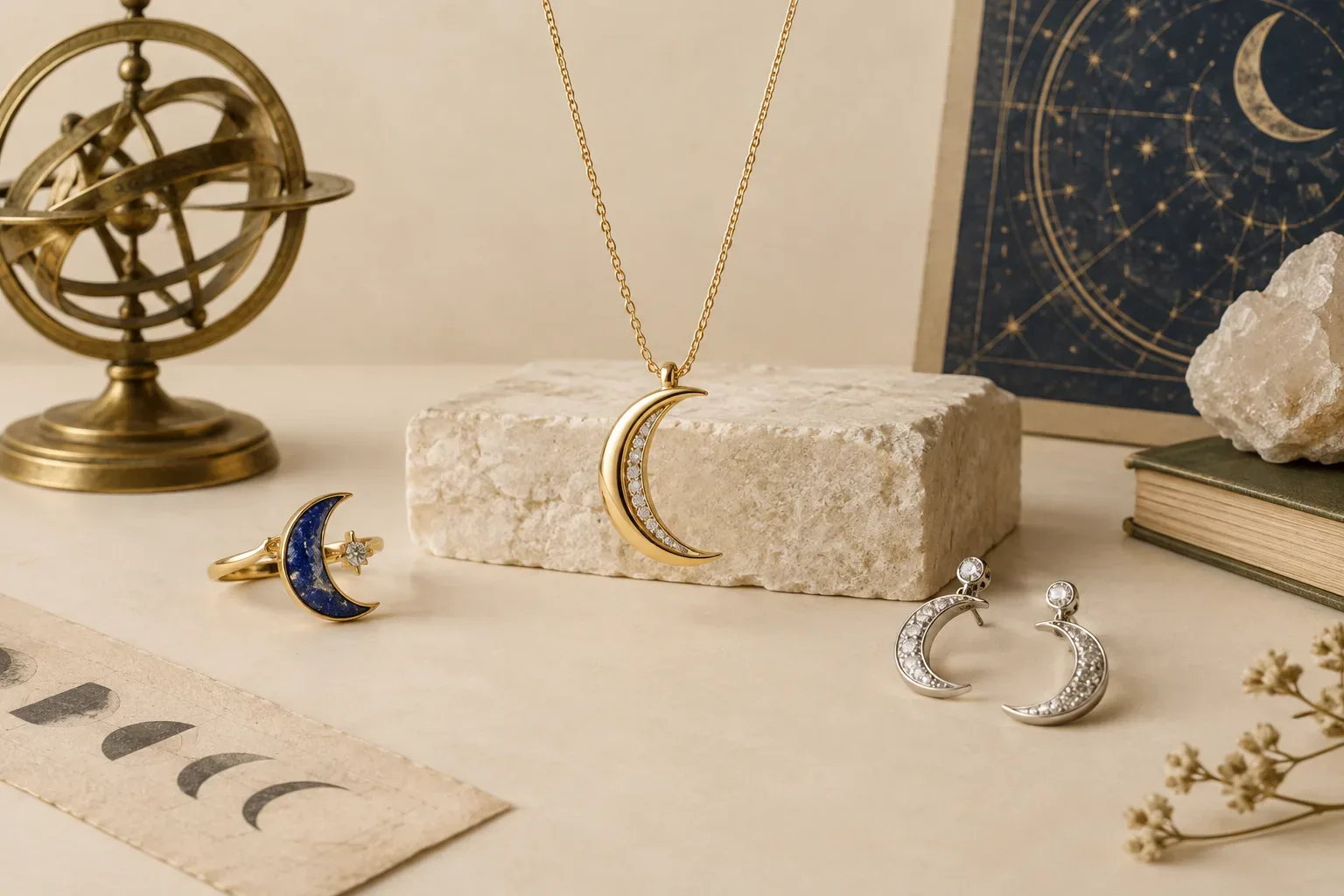
Designers translate the waxing crescent into rings, pendants, brooches, charms, and earring motifs by emphasizing a narrow, curved silhouette. The crescent may be a full metal form, an open-frame shape, or a setting that cradles a gemstone. Jewelers sometimes set pearlescent or iridescent stones—such as pearls, moonstone, or opal—with crescent forms to strengthen a lunar association. For information on the historical use and characteristics of particular gemstones that are often paired with lunar motifs, consult institutional resources such as the Victoria and Albert Museum’s A–Z of Gemstones, which provides context on individual materials and their historical uses.
Material, treatment, and buying considerations
When selecting waxing crescent jewelry, verify the metal, gemstone identity, and any treatments or imitations. The Federal Trade Commission’s consumer guidance on buying gemstones, diamonds, and pearls explains why buyers should ask sellers about treatments, enhancements, and whether stones are natural, synthetic, or simulated. Sellers should disclose these facts; if they do not, request written confirmation. For heirloom or antique pieces, ask for provenance or a museum-quality condition report when available, and consult reputable appraisers for condition and value evaluations.
Modern symbolism and respectful gifting guidance
If you or your recipient attach a personal meaning—growth, new beginnings, femininity, intuition, or an astrological sign—make that intention part of the gift narrative. Ask about the recipient’s style and beliefs when appropriate, especially because crescent imagery can carry religious or cultural associations in some communities. Keep the gesture respectful: avoid assuming a symbol’s meaning is shared, and if the piece references a specific cultural or religious design, consider whether the maker is from that tradition or whether the design could be perceived as cultural appropriation.
Practical tips for choosing a waxing crescent piece
Choose scale and material with the wearer’s everyday habits in mind: smaller, low-profile crescents suit people who prefer subtle jewelry; larger or gem-set crescents make bolder, decorative statements. For longevity, prefer solid metals or well-documented plated constructions and verify gemstone treatment disclosures. If the piece will be an heirloom or an investment, obtain documentation and consider professional cleaning and care guidance. Finally, pair the gift with a short note explaining any intended symbolism to ensure your meaning is communicated without presuming the recipient’s association.
Conclusion
The waxing crescent jewelry meaning is best understood as historically variable and culturally contextual: museum evidence shows crescent forms recur and change meaning over time, while modern wearers freely layer personal, astrological, or spiritual meanings onto the motif. Combining museum-informed awareness with practical buying safeguards from government consumer guidance will help you choose or gift a waxing crescent piece that is beautiful, honest about materials, and respectful of others’ cultural perspectives.
Frequently asked questions
Does a waxing crescent motif always mean the same thing?
No. Museum evidence and curatorial interpretation show that motifs like the crescent have meant different things in different periods and places. Modern wearers may assign astrological or spiritual meanings, but these are contemporary interpretations rather than universal historical facts.
Can waxing crescent jewelry have religious significance?
It can in some contexts, but there is no single religious meaning that applies universally. If the piece resembles a specific religious or cultural design, research its origin and consider the recipient’s background before gifting.
Which gemstones pair well with crescent designs?
Pearls, moonstone, and opal are commonly paired with lunar motifs because of their pearlescent or iridescent qualities, but many other gems are used as well. For historical and identification context, consult museum references such as the Victoria and Albert Museum’s A–Z of Gemstones.
How do I know if a crescent-set stone is natural or treated?
Ask the seller for written disclosures about treatments, enhancements, and whether the stone is natural, synthetic, or simulated. The Federal Trade Commission provides consumer guidance on what sellers should disclose when buying gemstones, diamonds, and pearls.
Sources and further reading
- Bedazzled: A History of Jewellery — Victoria and Albert Museum
- An A-Z of Gemstones — Victoria and Albert Museum
- Buying Gemstones, Diamonds, and Pearls — Federal Trade Commission