Meaning at a glance
Explain the documented history and changing contexts of the mushroom motif, separate cultural or religious evidence from later popular interpretations, and give practical guidance for choosing and wearing the motif in modern jewelry.
Quick answer
In short: the documented historical record offers limited, specific evidence that mushrooms carried consistent symbolic meanings in jewellery across cultures; museum histories show that jewellery motifs often reflect nature and social context, while most meanings now attached to mushroom pendants and rings are modern personal or subcultural interpretations. This article separates what is supported by museum and consumer-protection sources from contemporary uses and offers practical advice for buying, choosing, and gifting mushroom-themed pieces.
What the historical record shows
Surveys of jewellery history indicate that designers and makers have long borrowed imagery from nature—flowers, leaves, insects, and occasionally fungi—to convey aesthetic values, scientific interest, or sentimental connections. The Victoria and Albert Museum’s overview of jewellery history emphasizes how motifs change with social tastes and technological developments, and how naturalism was especially important in some periods, such as the 19th century. That museum-level perspective is useful for understanding why a maker might choose a mushroom motif, but it does not establish a single, documented symbolic meaning for mushrooms across periods or places.
Where and when mushroom motifs appear (precise cultural notes)
Museum histories and catalogues show that explicit mushroom depictions are relatively rare in major historical jewellery collections compared with botanical motifs such as roses or oak leaves. When mushroom-like forms do appear, they are most often part of broader naturalistic or fantasy ornament rather than a clearly recorded religious or civic signifier. The Victoria and Albert Museum places such motifs within its broader account of changing social contexts and taste: for example, the 19th-century interest in natural history and the Arts and Crafts movement encouraged makers to depict a wide range of organic forms, sometimes including fungi, in brooches and tumbled gem settings.
Outside of museum cataloguing, some cultures have long-standing symbolic relationships with fungi in food, medicine, and ritual, but those social practices do not automatically translate to documented, historically attested meanings in jewellery. Where documentary evidence for a specific, historic symbolic meaning tied to jewellery exists, it is best found in detailed object histories or ethnographic records rather than in general surveys of ornament.
Documented meanings versus modern interpretation
Documented meanings: museum scholarship and object catalogues tend to describe maker intent, materials, and provenance. Such documentation supports statements about when and why jewelers used natural motifs, and it can identify the era in which mushroom-shaped pieces were made or fashionable. The Victoria and Albert Museum’s work on jewellery history is a reliable source for these types of museum-based, object-level claims.
Modern interpretations: many of the familiar meanings attached to mushroom jewellery today—growth, transformation, connection to forest or earth spirituality, and associations with psychedelia—are contemporary readings or personal statements by wearers and makers. These interpretations are valid as individual or subcultural meanings, but they are not the same as a documented historical use. When using or gifting mushroom jewellery, treat these contemporary meanings as expressive choices rather than as inherited, universal symbolism.
How the mushroom motif and gemstones appear in jewelry
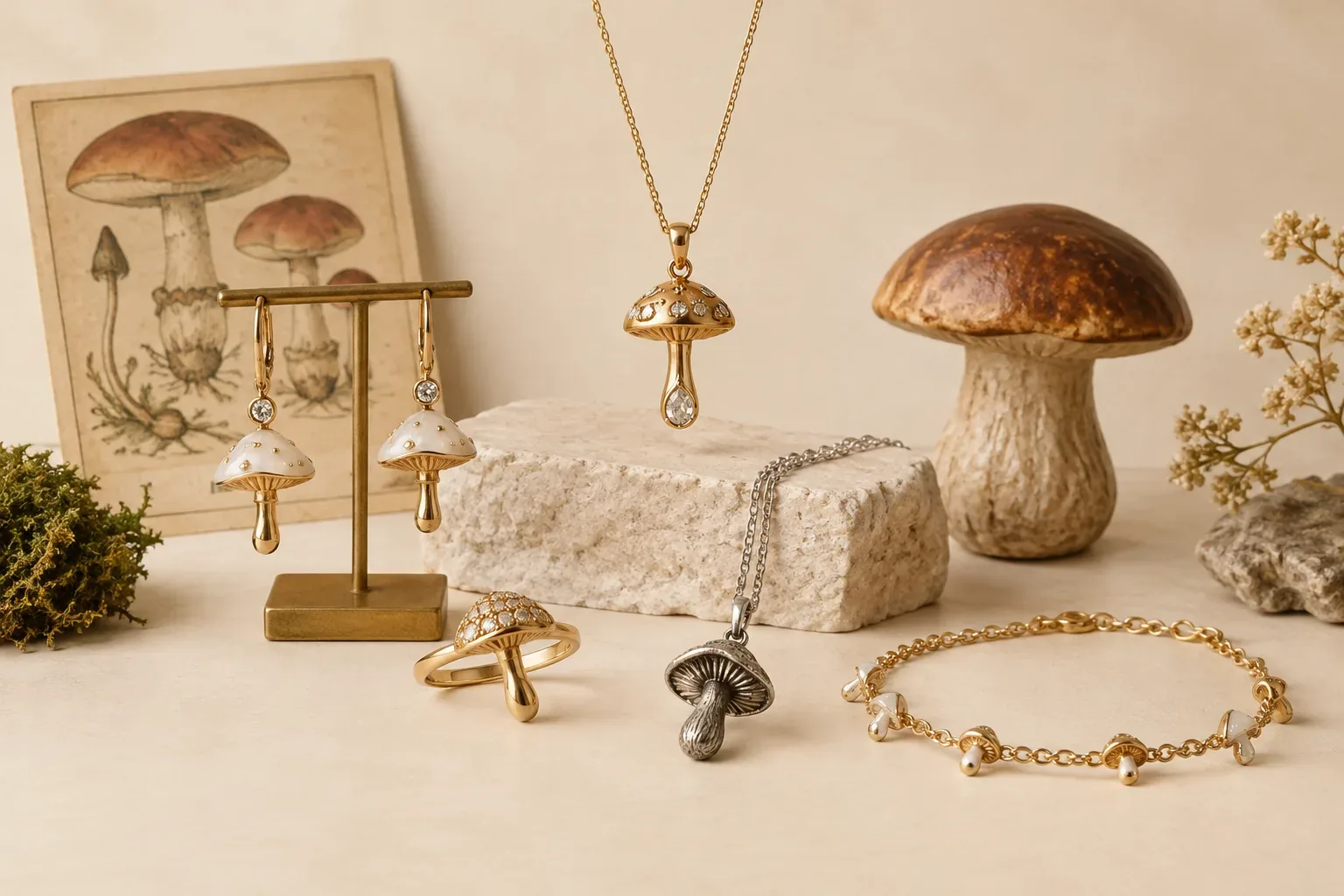
Design-wise, mushroom motifs appear in jewellery in several ways: as literal miniature mushroom charms and pendants, as stylized caps and gills suggested in metalwork, or as whimsical composite motifs combined with leaves, insects, or crystals. Makers may use carving, enamelling, or sculptural metal techniques to create convincing fungal forms, and the scale ranges from tiny charm bracelets to bold statement brooches.
Gemstones and materials often play a part in how the motif is read. Semi-precious stones such as agate, moonstone, or jasper are commonly paired with mushroom designs to emphasize natural, earthy aesthetics. The Victoria and Albert Museum’s A–Z of gemstones provides background on many stones that jewellers choose for color, translucency, or historical associations, which helps explain why a designer might pair a mushroom motif with a particular gem. Contemporary artisan makers also use glass, resin, or lab-created stones to achieve vivid color effects.
Materials, treatments, and buying advice
If you are buying mushroom-themed jewellery, treat it like any other jewel purchase: check the materials, ask about treatments, and look for maker or hallmark information. The Federal Trade Commission recommends that sellers disclose significant treatments, imitations, and whether a gem is natural, lab-created, or dyed. That guidance is particularly important when a piece’s value depends on the stone—agate that has been dyed or stabilized, for example, will differ in price and care needs from an untreated specimen.
For precious metals, request clear information about metal type and stampings such as 925 for sterling silver or 14K for gold. For artisan and vintage pieces, ask for provenance or maker statements and whether the piece has been restored. If you plan to buy online, request detailed photographs and inquire about returns and insurance for higher-value items. These practical steps will help you avoid misunderstandings about authenticity, durability, or expected resale value.
Choosing and gifting mushroom jewellery respectfully
Choose a piece that matches the recipient’s personal style and the meaning you intend. If you want to express playful affinity for nature, select whimsical small pendants or enamel charms. If you want something more formal, look for stylized mushroom motifs worked into brooches or rings with classic gemstones. Consider the context: a delicate mushroom necklace may be appropriate as a casual friendship gift, while a heavier, gem-set brooch could be too formal for that purpose.
When gifting with symbolic intent, be explicit about your meaning if it might be ambiguous. Many contemporary wearers embrace mushrooms for very different reasons—environmental affinity, a nod to folklore, or a link to a particular subculture—so explaining why you chose the motif prevents misunderstanding. Also be mindful of cultural specificity: do not assume a motif carries the same weight in other cultures or communities, and avoid claiming that a single symbolic meaning is universal.
Care, styling, and wearing advice
Care requirements depend on materials. Sterling silver mushroom charms will tarnish and benefit from occasional polishing, whereas plated pieces need gentler handling to preserve surface finish. Stones like agate are relatively durable, but enamel and delicate carving may chip. Ask the seller about recommended care and whether the piece is water-resistant.
Styling-wise, mushroom jewellery works well layered with fine chains for a casual look or as a single focal charm on a cord for a bohemian vibe. For vintage or statement mushroom brooches, place them on lapels, scarves, or hats to let the sculptural form read clearly. Ultimately, choose pieces that reflect personal meaning and fit the recipient’s day-to-day life.
Frequently asked questions
Does mushroom jewellery have a single traditional meaning?
No. The historical record does not support a single, universal traditional meaning for mushroom motifs in jewellery. Museum studies show that makers used natural motifs in many eras for aesthetic or sentimental reasons, but most of the symbolic meanings commonly attached to mushroom jewellery today are contemporary interpretations or personal associations.
Are mushroom gemstones like agate symbolic in a specific way?
Gemstones carry different associations in various contexts. Reference works such as the Victoria and Albert Museum’s A–Z of Gemstones explain historical uses and visual properties of stones like agate, but any symbolic meaning depends on cultural context and individual attribution rather than a universally fixed meaning.
What should I ask a seller before buying mushroom-themed jewellery?
Ask about materials and metal marks, whether any gemstones are natural or treated, who made the piece, and return or repair policies. The Federal Trade Commission advises that sellers must disclose treatments and imitations, so request written confirmation of any treatments or lab-created stones.
Is mushroom jewellery appropriate as a gift for anyone?
It can be appropriate if you match the style and meaning to the recipient. Because mushroom motifs can suggest different things to different people—nature affinity, whimsy, or subcultural identity—clarify your intent or choose a neutral design if you are unsure how it will be received.
How do I care for mushroom jewellery with enamel or semi-precious stones?
Care varies by material. Avoid prolonged exposure to water and chemicals, polish precious metal parts gently, and protect enamel or carved stones from knocks. Ask the seller for specific cleaning recommendations based on the piece’s materials.
Sources and further reading
- Bedazzled: A History of Jewellery — Victoria and Albert Museum
- An A-Z of Gemstones — Victoria and Albert Museum
- Buying Gemstones, Diamonds, and Pearls — Federal Trade Commission