Meaning at a glance
Explain the documented history and changing contexts of the vine motif, separate cultural or religious evidence from later popular interpretations, and give practical guidance for choosing and wearing the motif in modern jewelry.
Quick answer
The vine jewelry meaning is best described as historically varied rather than fixed: museum records show the vine and other botanical motifs have recurred across many periods primarily as decorative and symbolic elements tied to specific cultural tastes, and modern wearers layer new personal meanings on top of those precedents. This article summarizes the documented history recorded by museum scholarship, separates those records from later popular interpretations, explains how the motif appears in pieces and with gemstones, and gives practical advice for selecting and gifting vine jewelry.
What the historical record shows (by culture and period)
Museum scholarship documents that botanical motifs, including vines, appear repeatedly in jewelry collections from a wide range of periods and places. The Victoria and Albert Museum (V&A) presents examples and commentary showing that jewellers reused plant forms in different social contexts and that those forms moved in and out of fashion according to broader tastes and technologies. The V&A’s resources emphasize change over time: vine-like ornament appears in ancient work through later European decorative styles as a visual vocabulary rather than a single, uninterrupted symbolic meaning.
In practice, the V&A’s historical accounts show two important points. First, jewelers have long drawn on botanical shapes because they translate well into metalwork, stone settings and repeated patterning. Second, different periods attached different emphases to botanical designs: some eras favored naturalistic studies of leaves and tendrils as part of a broader interest in nature, while other periods used stylized vine ornament as a decorative motif within established geometric or architectural frameworks. The museum’s overview of jewellery history makes clear that these uses are historically contingent, connected to changing tastes, techniques and meanings rather than one universal symbolism.
Documented meanings versus modern interpretations
When assessing what vine motifs meant historically, the safest position is to rely on documented context in museum records rather than later popular glosses. The V&A’s cataloguing and exhibitions focus on how jewelry was made, worn and valued in its time, showing that botanical motifs could be sentimental, decorative, status-bearing, or simply fashionable depending on the object’s provenance and period.
Modern popular interpretations often layer new meanings—such as growth, connection, fertility, or resilience—onto vine motifs. Those contemporary associations are valid as personal symbolism, but they should be distinguished from what is documented in an object's original context. In short, historical records establish that vine imagery was widely used; modern metaphors are personal or cultural reinterpretations that postdate many historic examples.
How the vine motif, gemstones, and traditions appear in jewelry
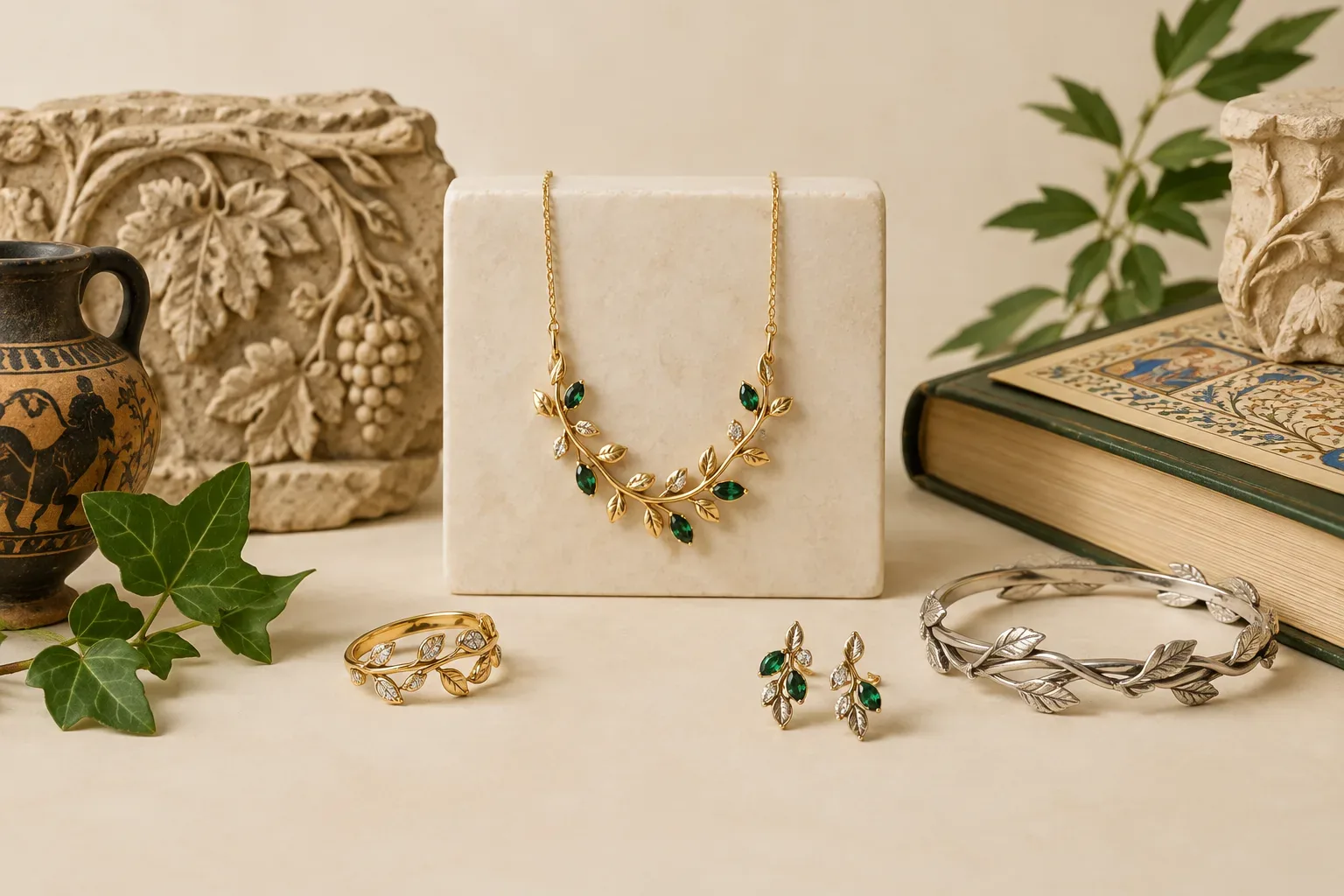
The vine motif appears in multiple technical and stylistic forms. Jewelers have executed vine shapes as delicate wirework, as sculpted leaves and tendrils in metal, as pierced or openwork frames around stones, and as repeating borders on settings. The V&A’s resources show examples across media and periods, illustrating how the same botanical idea can be rendered very differently depending on technique and taste.
Gemstones frequently play a supporting role in vine-themed pieces. Settings may place colored gems at the nodes of stylized vines, use seed pearls to suggest buds or dew, or set a single focal stone within a metal framework of leaves and curling branches. The V&A’s “An A–Z of Gemstones” provides context for how particular stones have been chosen for color, hardness and working properties across time, which helps explain why some stones appear more often in botanical jewelry than others.
Techniques matter: chased or repoussé metal can give three-dimensional leaf forms, while enamelling allows for painted leaf coloration. Gem cutting and stone choices also follow practical constraints; for example, fragile gems are less suitable for exposed prong settings on intricate vinework. Where gemstone treatments, imitations or enhancements are involved, contemporary consumer guidance from the Federal Trade Commission (FTC) stresses the need for clear disclosure by sellers.
Selecting vine jewelry: practical and respectful guidance
Decide what you want the piece to say. If your priority is historical authenticity, look for documented provenance or museum-quality references and compare the object’s style with museum examples. If your priority is personal symbolism, choose a design that resonates with your intended meaning while acknowledging that that meaning is contemporary rather than necessarily historical.
Consider materials and wearability. For everyday wear choose durable metals and harder gemstones; for occasional or ceremonial pieces you can select more delicate metals and softer cabochons. Use the V&A’s materials guidance to understand how different techniques affect durability and appearance, and consult the FTC’s guidance about treated or imitation stones so you can ask sellers the right questions about disclosure.
Be culturally respectful. Avoid asserting a single universal meaning for the vine motif. If you are buying a piece with clear cultural provenance, inform yourself about that culture’s documented uses and, when appropriate, consult reputable sources or specialists before presenting the piece as carrying a particular cultural or religious significance.
Gifting tips: match scale and metal to the recipient’s typical jewelry. For a subtle, symbolic gift choose a small pendant or stud earrings; for a statement or commemorative piece consider a brooch or a larger pendant. If the gift is intended to mark family relationships or life changes, explain the personal meaning you assign to the motif so the recipient understands your intention without assuming historical universality.
Buying, care and authenticity
When buying vine jewelry, ask sellers for clear information about materials, treatments and provenance. The FTC recommends that sellers disclose material treatments, enhancements and whether a stone is an imitation; buyers should request written confirmation when the distinction matters to value or meaning. If a piece is advertised as antique or culturally specific, request documentation or reputable verification.
Care practices vary by metal and gemstone. The V&A’s collections advice highlights that thin filigree and openwork vine pieces are more vulnerable to bending and snagging than solid forms, and that some historic techniques require specialist conservation. For modern pieces, follow manufacturer care guidelines and avoid exposing delicate stones or enamels to chemicals and abrasion.
Finally, remember that authenticity has two aspects: material authenticity and contextual authenticity. A modern piece can be materially genuine yet not historic; conversely, a historic vine motif survives in museum collections but may have had many repairs or later alterations. Where historical meaning matters, seek expert appraisal.
Closing thought
Vine motifs in jewelry are a persistent part of the decorative vocabulary because they adapt well to metalwork and stone settings and because they accommodate both ornamental and sentimental uses. Museum records, as presented by the Victoria and Albert Museum, show diverse historical contexts rather than a single cultural meaning. Modern wearers are free to adopt personal symbolism, but good practice is to distinguish those contemporary meanings from documented historical uses and to buy and gift with clear information about materials and provenance.
Frequently asked questions
Is the vine motif a universal symbol of growth or fertility?
No single universal meaning is documented. Museum records show the vine motif was used in many periods primarily as a decorative form, and while modern wearers often interpret vines as symbols of growth or connection, those contemporary meanings are personal and should be distinguished from historical uses recorded by museums.
How can I tell if a vine piece is antique or a modern reproduction?
Ask the seller for provenance, condition reports and any documentation. Compare the techniques and materials with museum examples and, when necessary, seek an independent appraisal. The Victoria and Albert Museum emphasises examining technique and context rather than assuming age from style alone.
Are certain gemstones traditionally paired with vine designs?
There is no single rule; however, practical considerations recorded in museum gem surveys influence choices. Harder stones and seed pearls are often used where durability is needed, while softer stones may appear in protected settings. The V&A’s gemstone overview explains how working properties and color influenced historical choices.
What should I ask a seller about gemstone treatments?
Request written disclosure of any treatments, enhancements or whether a stone is an imitation. The FTC requires clear information about material treatments and imitations, and buyers should insist on that transparency when condition or authenticity affects value or meaning.
Is it appropriate to gift vine jewelry with a cultural meaning attached?
Gifting is appropriate when you understand and respect the piece’s documented context. If a vine design has clear cultural provenance, learn about that context first and avoid projecting a new meaning onto it without research. When in doubt, explain your personal intention for the gift rather than presenting an asserted historic symbolism as fact.
How should I care for delicate vine motifs?
Delicate openwork and filigree vine pieces are more prone to bending and snagging; store them separately, avoid chemical exposure, and follow any maker or conservator guidance. For historic pieces, consult a professional conservator before attempting repairs or cleaning.
Sources and further reading
- Bedazzled: A History of Jewellery — Victoria and Albert Museum
- An A-Z of Gemstones — Victoria and Albert Museum
- Buying Gemstones, Diamonds, and Pearls — Federal Trade Commission