Meaning at a glance
Viking-period brooches were clothing fasteners and ornaments whose forms varied by region, date, material, and dress practice.
What the archaeological evidence shows (who, where, and when)
Archaeological collections and museum catalogues present brooches from Norse contexts across Scandinavia and areas of Norse settlement, commonly grouped under the broad category 'Viking Age' for medieval Scandinavian cultures. The National Museum of Denmark describes how brooches appear in excavated dress assemblages and in burial contexts from Scandinavian sites and emphasizes their role as part of ordinary dress and jewellery practices. The British Museum's object record for an oval brooch documents both the object's form and its find-context information, which museums use to place individual brooch types within local typologies and chronological sequences. The Metropolitan Museum of Art's collection includes examples such as animal-head brooches that illustrate the use of figurative motifs and skilled metalworking.
Styles and typology: forms that recur in the finds
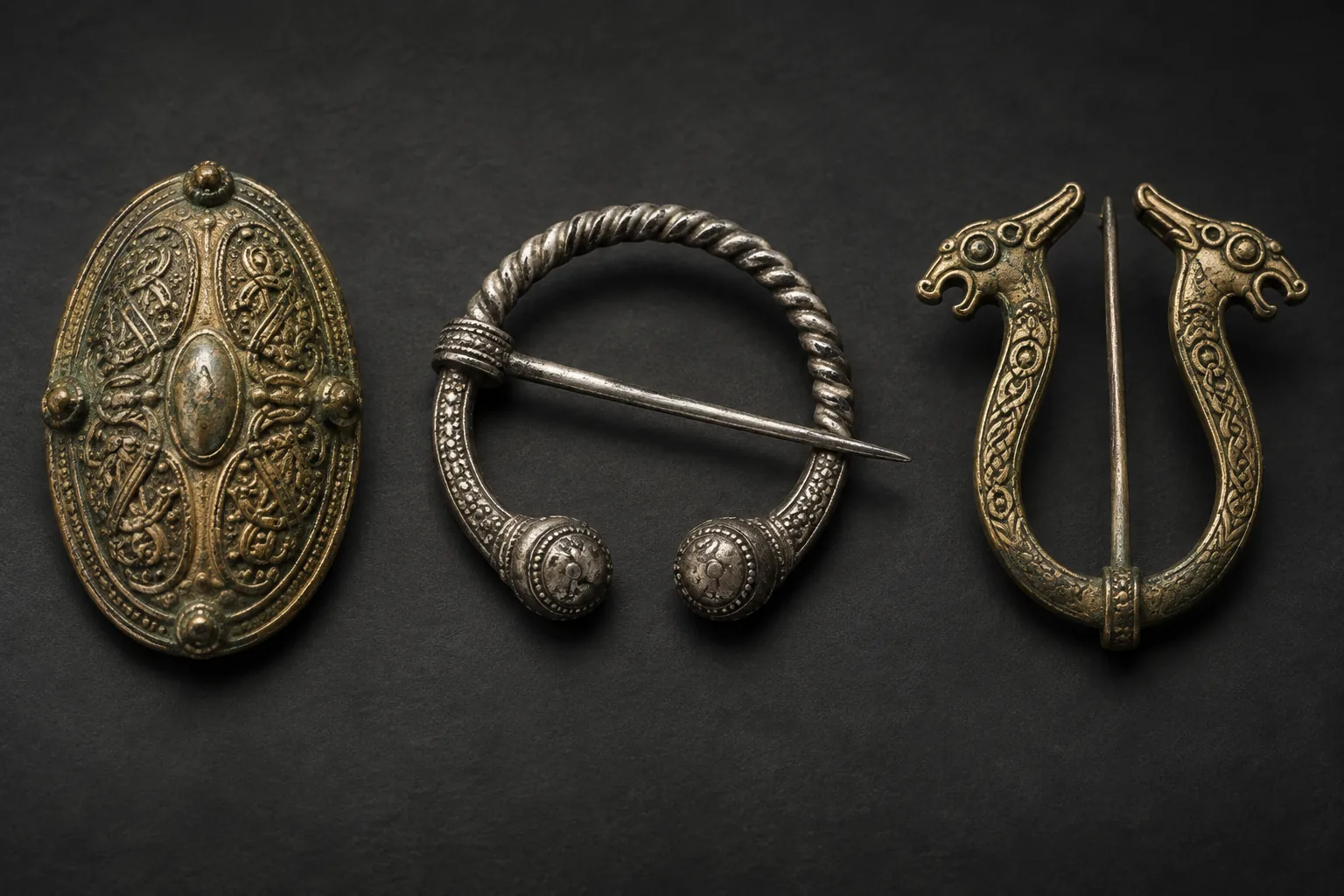
A few brooch types recur in the archaeological record and are often associated with particular dress customs. Paired oval brooches were regularly used in female costume to fasten the straps of an overdress; museum publications show these brooches in a range of sizes and decorations. Penannular and annular brooch forms, and brooches with animal-head terminals, also appear across sites in multiple variants. The British Museum catalogue entry for an oval brooch illustrates the typical shape, decorative bands, and manufacturing techniques seen across many such finds. The Metropolitan Museum of Art's animal-head brooch demonstrates how figurative terminals appear on otherwise functional forms, combining fastening function with identifiable decorative motifs.
Materials and manufacturing evidence
Brooches in museum collections are made in a variety of metals and techniques that reflect available resources and workshop skills. Collections and object records show examples in bronze, base alloys, silver, and gilded metal, and evidence of inlay, filigree, and punching techniques used to add surface pattern. The National Museum of Denmark describes how dress assemblages often combine metal brooches with beads and textile fragments, providing a fuller picture of how these objects were worn. Museum catalogues record wear patterns, repairs, and hoard or grave associations that help archaeologists reconstruct production and circulation.
Clothing, use, and social signals
In the archaeological and museum literature brooches are primarily documented as clothing fasteners and dress ornaments. The National Museum of Denmark explains that certain brooch types are characteristic components of regional female costume and that paired brooches commonly anchor straps on an overdress. The material, size, and decorative complexity of a brooch can reflect economic resources or access to particular workshops and materials; object records such as those in the British Museum make clear that richer materials and more elaborate decoration are archaeological indicators used to discuss status or wealth in a locality, not universal social rules.
Motifs, gemstones, and decorative traditions in jewellery
Museum examples show a range of decorative strategies. Animal-head terminals, seen in the Metropolitan Museum of Art's brooch, are an explicit motif type where the terminal is shaped and modelled to suggest an animal head. Other decorative patterns include geometric bands, punched dots, and interlaced or stylized animal ornament visible across many metal objects in museum collections. Glass beads and coloured inlays appear in associated dress assemblages described by the National Museum of Denmark, and metalwork sometimes incorporates inlay or applied details to create contrast. While gemstones are less common than glass and metalwork ornament in many brooch contexts, surviving pieces can show inlay or settings intended to catch the eye, and museums record these as evidence of local taste and available trade goods.
Documented meanings versus modern interpretations
The archaeological record and museum documentation are clear about what brooches demonstrably were: dress fasteners and ornaments. Publications from the British Museum, the National Museum of Denmark, and the Metropolitan Museum of Art use find-context, wear patterns, and typology to support that primary function. Beyond that, attributing specific ritual, magical, or universally symbolic meanings to brooch motifs is speculative. Modern personal and commercial reinterpretations often assign protective, ancestral, or mythic meanings to particular motifs; these are contemporary meanings layered onto the objects and should be treated as modern interpretations unless directly supported by historic texts or clear ritual contexts in the archaeological record. Museum documentation generally distinguishes functional and contextual evidence from later interpretive narratives.
How motifs and traditions show up in modern jewellery
Contemporary jewellery makers frequently draw on museum examples for inspiration, echoing animal heads, interlace, and oval forms in modern reproductions or reinterpretations. The form of an oval brooch or the silhouette of an animal-head terminal is easily translated into modern silverwork, cast reproductions, or stylized pendants. Where museums describe inlay, filigree, and punched decoration, modern artisans replicate those techniques or simulate them through surface treatments. Responsible makers and sellers who reference museum pieces usually note the archaeological source and distinguish reproductions from originals; museum websites provide useful visual references for design elements without endorsing the attribution of specific symbolic meanings beyond those supported by context.
Choosing or gifting Viking-style brooches: practical and respectful guidance
If you are selecting or gifting a brooch inspired by Viking-period examples, begin by deciding whether you want an archaeological reproduction, a historically informed modern design, or a contemporary piece that simply references the aesthetic. Reproductions and historically informed pieces are useful when the aim is to reflect a particular dress tradition; choose makers who disclose materials and whether a piece is an original or a replica. Consider materials and wearer sensitivities: many museum examples are metal and may contain alloys that can irritate sensitive skin, so look for stated metal content or hypoallergenic options. Be mindful of cultural context: avoid marketing or gifting that claims that a piece conveys specific spiritual powers or authentic ancestral use unless that meaning is documented and appropriate to claim. If the recipient is interested in history, include information pointing to reputable museum pages so they can learn the documented context. For collectors, provenance and clear labeling are essential; an honest description distinguishing modern work from archaeological objects preserves both ethical standards and the recipient's trust.
Limitations in the record and why caution matters
Museum object records and site reports are rich but incomplete. Many organic components of dress do not preserve, and some brooches arrive in collections without secure find context. That limits what can be asserted about ritual use or precise social meaning beyond what is visible in the artifact, its context, and comparable assemblages. The British Museum, the National Museum of Denmark, and the Metropolitan Museum of Art all present objects with careful contextual notes and do not claim universal symbolic meanings for individual motifs. Following museum practice, writers and buyers should avoid overgeneralization and respect the difference between documented use and later interpretation.
Frequently asked questions
Were brooches only worn by women in the Viking Age?
Brooches are strongly associated with female dress in many Scandinavian archaeological assemblages—paired oval brooches are a recurring component of what museums describe as female costume—but other brooch forms were also used and contexts vary by region. Museum documentation distinguishes types by find contexts and does not claim a single rule for all Norse communities.
Do animal-head motifs have a single symbolic meaning?
No single symbolic meaning for animal-head motifs is documented across all finds. The Metropolitan Museum of Art and other collections record the motif as a decorative element in metalwork. Assigning a universal symbolic interpretation is speculative; modern meanings often reflect contemporary interests rather than archaeological evidence.
How can I tell if a brooch is an authentic archaeological object or a modern reproduction?
Authentic archaeological objects are usually accompanied by detailed provenance and collection records from museums or licensed dealers. Museum pages such as the British Museum's object records include find-context and cataloguing information. Reproductions should be clearly labelled by makers or sellers; if provenance is unclear, assume a piece is a modern replica unless verified by a reputable institution.
Is it respectful to wear Viking-inspired jewellery?
Yes, wearing historically inspired jewellery can be respectful when done with awareness. Prefer makers who acknowledge the archaeological sources, avoid claiming unfounded ritual powers for objects, and be honest about whether a piece is an original, a reproduction, or a modern design inspired by museum examples.
Can gemstones found in brooches tell us about trade?
Gemstones and glass inlays associated with brooches and dress assemblages can offer evidence of trade networks and material preferences. Museum records note types of inlay and beads found with metal brooches and use those data to discuss exchange and access to goods, but each claim depends on the specific object's context and associated finds.
Sources and further reading
- Viking oval brooch — The British Museum
- Clothes and jewellery — National Museum of Denmark
- Animal-Head Brooch — The Metropolitan Museum of Art