Meaning at a glance
Documented historical evidence for a distinct "Milky Way" motif in jewelry is limited; museums record how celestial motifs and certain gemstones have been used over time, while modern milky way jewelry draws on astronomy, aesthetics, and personal symbolism—choose pieces with attention to materials, cultural context, and disclosure about treatments.
What the historical record actually shows
When historians and curators catalogue jewelry traditions they often group together designs that reference the sky: stars, comets, suns and moons. The Victoria and Albert Museum (in material supporting its project "Bedazzled: A History of Jewellery") documents how makers across periods used star- and spray-like motifs to signal prestige, fashion, and cosmological interest rather than to represent a single fixed astronomical concept. That broader pattern is the clearest historical evidence available for celestial-themed jewelry.
Separately, the V&A's reference resource "An A–Z of Gemstones" explains the historical use and appeal of specific materials—especially bright white gemstones and stones with internal shimmer such as opal and moonstone—that can evoke a milky, nebulous appearance. These material histories help explain why jewelers, especially in the 18th to 20th centuries and again in contemporary design, combine sparkling diamonds with softer stones to suggest a starry band or misty galaxy.
What we do not find in the accessible museum sources is a continuous, clearly documented tradition in which a particular culture consistently produced a motif explicitly labeled "Milky Way" across many centuries. Instead the evidence is of related practices: using star clusters, scattering small stones in pavé, and choosing opalescent gems to suggest diffuse light. Those are the documented precedents that modern makers draw on.
Separating documented historical meanings from modern interpretation
Documented meanings in museum records tend to be social and stylistic rather than metaphysical. The V&A highlights that jewelry has been used to signal rank, fashionability, memory and sentiment as contexts for a wide range of motifs, including celestial ones. In those records, a star or spray motif often signified vogue, technical skill, or a fashionable allusion to the heavens, rather than a single, universal spiritual belief.
Modern interpretations—as worn and described by many buyers, designers and commentators today—often read the Milky Way motif as a symbol of navigation, fate, connection to ancestry, cosmic wonder, or spiritual guidance. Those contemporary meanings are valid personal or cultural readings, but they are not the same as a single documented historical intent. Treat modern symbolism as layered on top of an older decorative vocabulary rather than as a direct historical claim.
How the milky way motif, gemstones, and techniques appear in jewelry
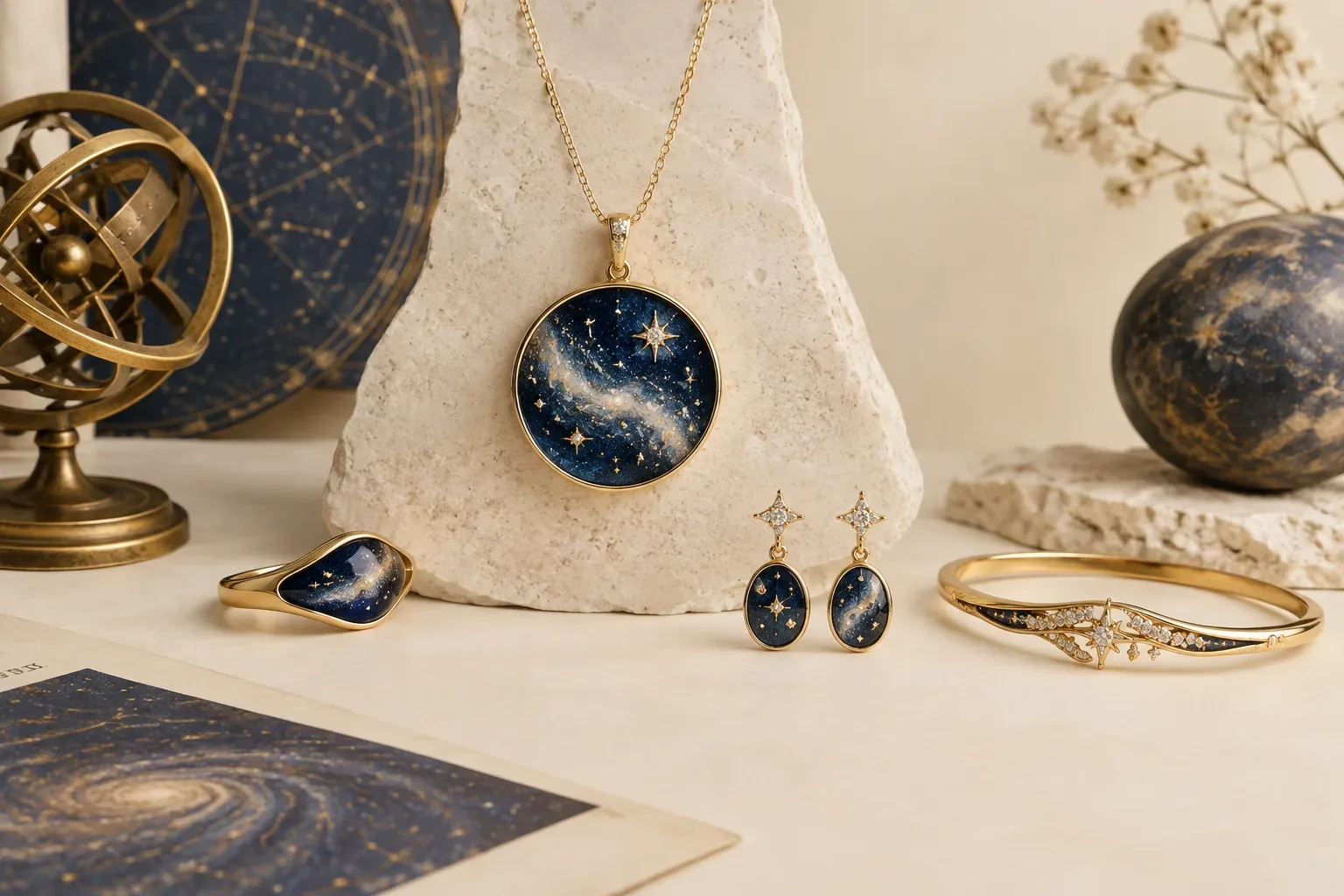
Design language: Jewelers evoke the Milky Way in several recognizably modern ways. Designers may use a linear band of small, closely set stones (pavé or micro-pavé) to suggest a dusty trail of stars. Starburst settings, scattered clusters and asymmetrical trails of stones are common devices to create a sense of movement and diffuse light.
Gemstone choices: White and near-white gems—diamonds, white sapphires, moonstones, and opals—are used to suggest brilliance or a milk-like internal glow. The V&A's resource "An A–Z of Gemstones" explains the historical preference for different stones for their optical effects, which helps explain why designers today pair brilliant-cut diamonds with softer, adularescent stones like moonstone or iridescent opal to achieve a layered, galaxy-like look.
Metalwork and finishes: Matte or brushed silver and platinum can provide a neutral, space-like background; yellow gold gives a warm contrast that can suggest sunrise behind the galaxy. Textured metal can be worked into a band that reads as a nebula or cloud, and enamel may be used to introduce deep blues and blacks to evoke the night sky.
Settings and mounting: Cluster settings that vary stone sizes, graduated pavé, and mixed-metal mounts are technical ways jewelers generate depth and a sense of distance within a small object. Historically documented advances in setting techniques—discussed by the V&A—allowed jewelers to place many small stones closely and securely, enabling the modern milky way aesthetic.
Practical, respectful guidance for choosing and gifting milky way jewelry
Begin with intent: Decide whether you want to emphasize astronomy and aesthetics, a personal story (for example, a meaningful date represented by stars), or an explicitly spiritual or cultural meaning. Being clear about intent helps you select style, materials and the right scale—an understated pendant for everyday wear, a pavé band for formal wear, or a statement brooch for seasonal display.
Consider the recipient's cultural or religious background: Some star, constellation or celestial motifs carry particular meaning in specific cultural or religious contexts. If you are unsure, ask respectfully or choose a neutral, non‑sacred design. Treat motifs that have clear sacred or communal meanings with extra care; avoid using them as mere fashion statements without understanding their significance.
Material and care choices: Match the materials to the wearer's lifestyle. Diamonds and sapphires are durable for everyday wear; opals and moonstones are softer and need gentler handling. For details on gemstone properties and historic use, consult the Victoria and Albert Museum’s reference on gemstones. When buying, follow the U.S. Federal Trade Commission's guidance to ask about treatments, enhancements, and whether stones are synthetic, lab-grown or imitations. The FTC emphasizes that sellers should disclose material treatments and origin.
Budget and disclosure: The FTC advises confirming whether stones are natural, treated, or lab-created and asking for receipts or certificates when appropriate. For high-value purchases, request certification for diamonds and significant colored stones. Understand that many attractive milky or opalescent effects can be achieved affordably with well-crafted synthetic or treated materials, but disclosure and honest description are essential.
Custom work and inscriptions: A custom piece lets you incorporate an exact constellation, a birth chart reference or an engraved message. If you choose custom design that draws on another culture’s star lore or sacred patterns, research and, when appropriate, consult with knowledgeable representatives from that culture so your gift is informed and respectful.
Presentation and context: When gifting, explain why you chose the motif—whether to evoke wonder, to mark a journey, or to celebrate someone’s guiding presence. Those words help distinguish your personal meaning from any historical or cultural associations and make the piece more meaningful to the recipient.
Design and buying checklist
Ask the jeweler what stones are used and whether they are natural, treated, or lab-created. Ask for care instructions tailored to the chosen stones and metal. Match stone hardness and setting robustness to expected wear. If the design references a particular culture’s star imagery, ask about provenance or meaning. For significant purchases, request written confirmation about treatments or certifications in line with FTC guidance.
Final perspective
The phrase "milky way" in modern jewelry mostly describes an aesthetic and a set of design strategies rather than a single historically documented symbol with uniform meaning. Museum scholarship (particularly from the Victoria and Albert Museum) shows that makers have long used celestial motifs and specific gemstones to create brilliance and narrative. Contemporary wearers then add personal and cultural layers of meaning—navigation, wonder, memory, or spiritual connection. Respectful, informed selection and transparent purchase practices (as the Federal Trade Commission recommends) let milky way jewelry be both beautiful and meaningful.
Frequently asked questions
Is the Milky Way a traditional jewelry symbol with one fixed meaning?
No. Museum records (for example those from the Victoria and Albert Museum) show a long history of celestial motifs, but there is not a single, universally documented historical meaning for a "Milky Way" motif. Modern meanings are often personal or cultural rather than continuous historical facts.
Which gemstones best evoke a Milky Way effect?
Gems that offer sparkle or internal glow—diamonds, white sapphires, opals and moonstones—are commonly used. The Victoria and Albert Museum’s resources on gemstones explain how different stones have been valued for their optical properties and how those properties are used in design.
How should I ask a jeweler about treatments or lab-grown stones?
Follow the Federal Trade Commission’s guidance: ask directly whether stones are natural, treated, lab-grown, or simulants and request written confirmation or certification for valuable purchases. Sellers should disclose treatments and origins.
Are milky way designs suitable for everyday wear?
It depends on materials and setting. Hard stones like diamonds and sapphires in secure settings suit daily wear. Softer opals and moonstones need gentler care and protection from impact and chemicals.
How can I gift milky way jewelry respectfully if it references another culture’s star imagery?
Research the motif first and, when feasible, consult knowledgeable representatives of that culture. If you cannot verify that a symbol is appropriate to use as a personal gift, choose a neutral astronomical design or explain the personal intent behind your gift to the recipient.
Can custom pieces reproduce a real constellation?
Yes. Jewelers can place stones to match a star map or constellation and may include engraved coordinates or dates. For custom work, specify scale and materials and ask about stone sizes and setting durability.
Sources and further reading
- Bedazzled: A History of Jewellery — Victoria and Albert Museum
- An A-Z of Gemstones — Victoria and Albert Museum
- Buying Gemstones, Diamonds, and Pearls — Federal Trade Commission