Meaning at a glance
This article separates documented uses of classical and celestial motifs in jewelry from modern personal meanings tied to the Andromeda myth or constellation, and offers practical selection and gifting guidance.
What we mean by “Andromeda”: myth versus astronomy
The name Andromeda can indicate either the mythological princess from Greek legend or the constellation named after her. As a mythological reference, Andromeda appears in stories and art but is not a single, continuous jewellery tradition that can be traced unbroken from antiquity to today. As an astronomical reference, Andromeda evokes the night sky, navigation of the heavens, or ideas of distance and the cosmic. In jewellery, makers and wearers may draw on either or both associations, and meanings shift accordingly.
Documented historical evidence and cultural contexts
Museum collections and scholarship indicate that motifs drawn from classical mythology have been popular at particular historical moments rather than continuously. The Victoria and Albert Museum explains how jewellery styles and motifs change with social context and revival movements, and that decorative arts repeatedly borrow from classical sources during Neoclassical and Victorian revivals. Those periods, for example, saw renewed interest in mythological subjects across jewellery, silver and decorative arts, which sometimes included figures from Greco-Roman stories.
Which cultures and periods adopted classical myth motifs in jewellery?
Ancient Greek and Roman societies produced a broad range of jewellery, but surviving museum commentary emphasizes that later eras—particularly the late 18th and 19th centuries—actively revived classical themes when designers and patrons sought to express ideals associated with antiquity. The V&A provides context for how and why makers in the Neoclassical and Victorian eras referenced ancient subjects; those revivals are the best-documented contexts in which mythological figures appear in European jewellery collections today.
Separating documented historical meanings from modern interpretations
It is important to separate what is documented in museum and curatorial records from popular or contemporary interpretations. Historical records show that classical imagery was used decoratively and to signal tastes, education or social connection to antiquity, rather than carrying a single fixed spiritual meaning. Modern interpretations—such as reading Andromeda jewellery as a symbol of rescue, sacrifice, beauty, feminist reclamation, distance, or cosmic connection—are largely contemporary constructions that depend on wearer intent and cultural moment rather than on continuous documented tradition.
How the Andromeda motif and related celestial themes appear in jewellery
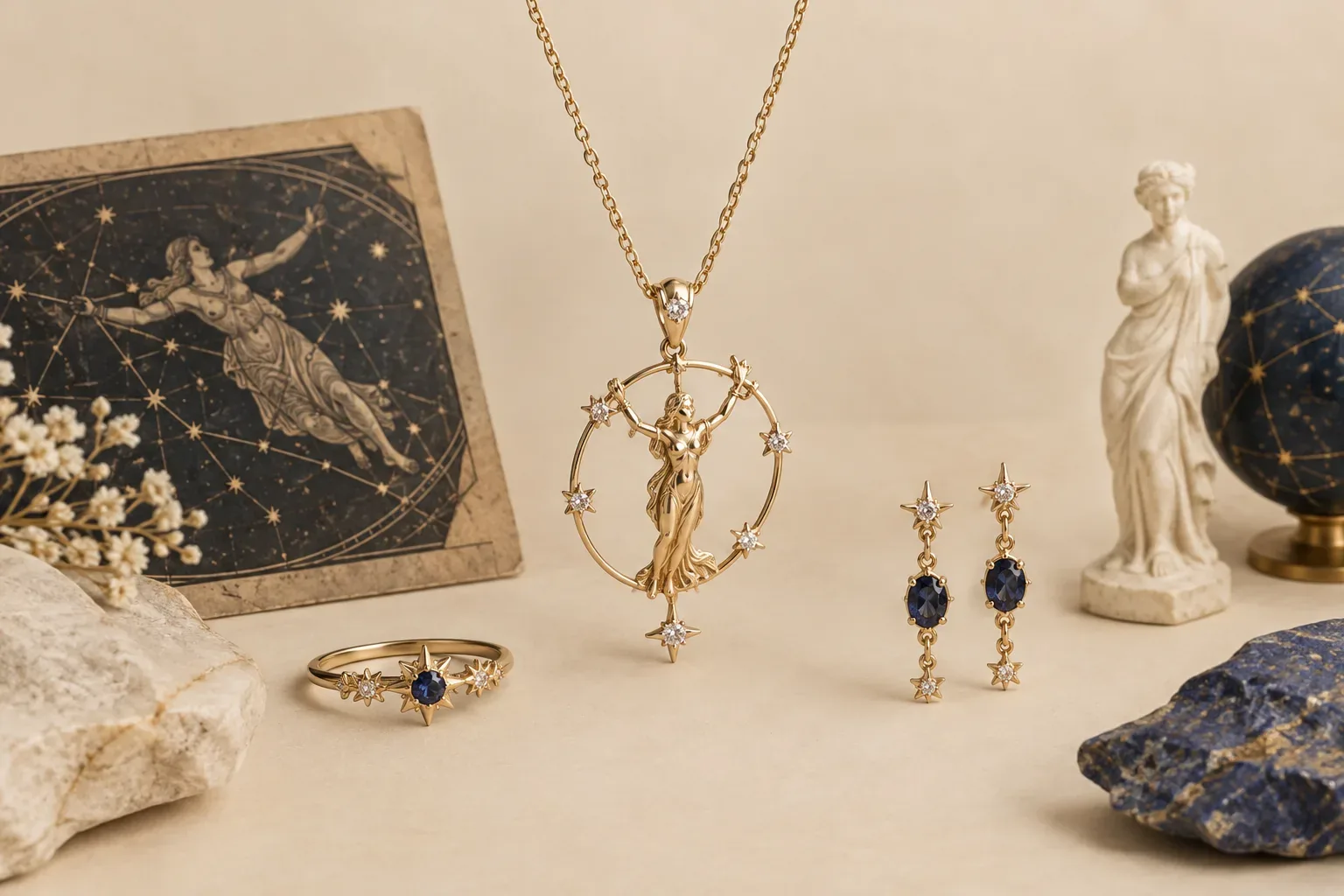
As a motif, Andromeda or related classical figures may appear in cameo portraits, intaglios, engraved lockets and pendant scenes where a maker depicts a human figure and narrative detail. As a celestial motif inspired by the Andromeda constellation, it appears through star patterns, constellation maps, meteor-like clusters, and abstract forms that suggest nebulae or galaxies. Designers also convey the idea of the night sky using stones with blue or iridescent surfaces and arrangements that mimic star fields.
Gemstones and materials commonly used to evoke the Andromeda theme
Museum guidance on gemstones explains how different stones have historically been chosen for colour, optical effects or symbolic resonance. Blue sapphires are commonly used to suggest a deep night sky, opals and moonstones provide iridescence and shifting colour like a distant nebula, and diamonds or small white gems are often set as stars. Pearls and enamel were historically popular for surface colour and texture. Where historical context matters, the Victoria and Albert Museum provides background on gemstone use and how materials signalled taste and meaning in different periods.
How to interpret an Andromeda piece you own or see
Start by identifying form and technique: is the image a cameo, an engraved scene, an enamelled star map, or an abstract celestial design? Provenance, maker marks, and construction can point to a period and therefore to likely historical meanings. If a piece is explicitly tied to a revival period, museum scholarship suggests it was likely intended as a fashionable reference to antiquity or to the aesthetics of astronomy rather than as a sacred object. Modern makers may combine myth and astronomy by placing a human figure amid star motifs; in those cases personal interpretation plays a large role.
Practical guidance for choosing or gifting Andromeda jewellery
When selecting or giving a piece that references Andromeda, consider the recipient’s relationship to myth, astronomy or celestial imagery. A neoclassical cameo or locket might appeal to someone interested in history and antiques, while a modern constellation pendant or galaxy ring suits someone who prefers abstract celestial symbolism. Respectful gifting means avoiding assumptions about religious or cultural significance; ask about the recipient’s tastes and any symbolic meanings they value before deciding.
Authenticity, materials, and buyer protections
If the piece uses gemstones or claims historical provenance, check material disclosure and treatment information. The U.S. Federal Trade Commission provides guidance on buying gemstones, diamonds and pearls, emphasising the need for clear information about treatments, imitations and origin. Ask sellers for certification or written disclosure about treatments, and for any documentation that supports an antique attribution. Professional appraisal or museum consultation can help when provenance affects value or meaning.
Care, display and respectful stewardship
Care instructions depend on materials: pearls and certain opals are sensitive to chemicals and should be stored separately, while hard stones like sapphires and diamonds are more durable. If a piece has historical significance, avoid amateur restoration that could damage original materials or maker’s marks; consult a conservator. Displaying a piece with a short label that explains whether it’s a modern homage, a revival-period piece, or an antique helps viewers understand context without imposing a single symbolic reading.
Conclusion: meaning is layered and contextual
Andromeda jewellery meaning is not a single, universal message. Museum evidence shows that classical and celestial motifs have been adapted in waves, and that their significance depends on period, maker intent and wearer interpretation. Today, a piece may intentionally reference ancient stories, evoke the night sky, or simply provide an attractive motif with personal resonance. Understanding the documented history and the materials involved will help you make respectful, informed choices whether you are buying, wearing or gifting an Andromeda-inspired piece.
Frequently asked questions
Does Andromeda jewellery have a single historical meaning?
No. Museum scholarship shows that classical and celestial motifs have been used in different periods for different reasons. Historical uses typically signalled taste, education or a fashion for antiquity rather than a single, fixed symbolic meaning; modern personal or cultural interpretations are separate from those documented uses.
Were genuine ancient Andromeda pieces common?
There is no continuous documented tradition of 'Andromeda' jewellery stretching unbroken from antiquity to the present. Classical figures were reused and reinterpreted in later revival periods, and many surviving museum examples are revival works rather than direct ancient survivals. Curatorial records provide the best evidence for individual pieces and their periods.
What gemstones work well for Andromeda or celestial motifs?
Gemstones commonly used to evoke celestial themes include blue sapphires for a deep-sky effect, opals and moonstones for iridescence, and small diamonds or white gems to suggest stars. Museum guidance on gemstones explains historical and aesthetic reasons for these choices and how materials affect appearance.
How can I verify a piece’s authenticity or period?
Ask for provenance, maker’s marks and condition reports, and request written disclosure about treatments. For gemstones and claims of age or origin, seek independent certification or professional appraisal. The Federal Trade Commission advises buyers to obtain clear information about treatments and imitations when purchasing gemstones.
Is it appropriate to give Andromeda jewellery as a meaningful gift?
Yes, provided you consider the recipient’s tastes and any cultural or religious sensitivities. Ask about their interest in mythology or astronomy, choose a style that matches their aesthetic, and include context about the piece’s origin or intended symbolism so the recipient can understand its meaning.
Sources and further reading
- Bedazzled: A History of Jewellery — Victoria and Albert Museum
- An A-Z of Gemstones — Victoria and Albert Museum
- Buying Gemstones, Diamonds, and Pearls — Federal Trade Commission